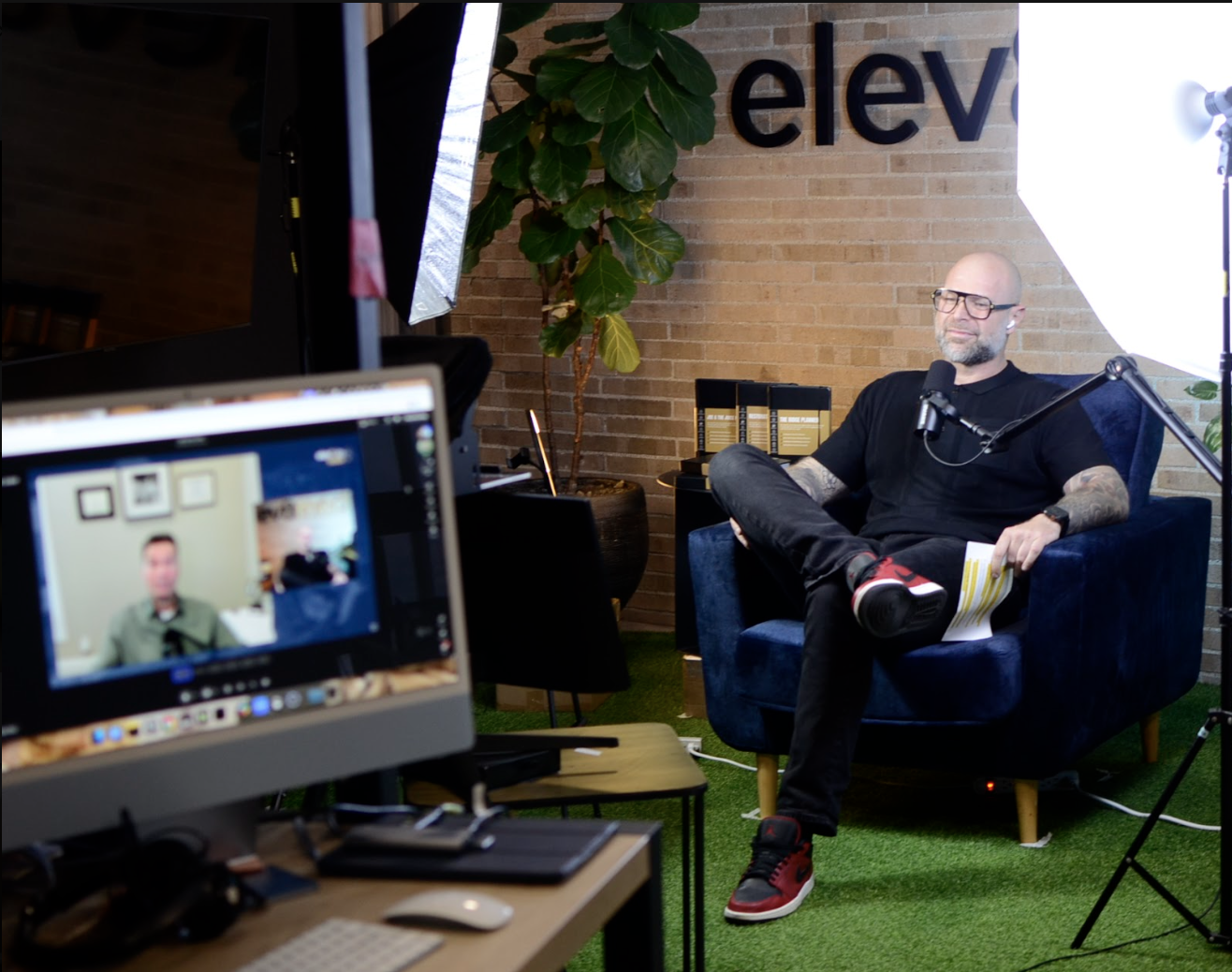
AI, Automation & the Future of Behavioral Health: Ritten CEO Noah Whitehead on What Comes Next
Behavioral health has never had more software to choose from, and that is part of the problem. Many providers are small businesses, and the hard part is not finding tools but synthesizing their own requirements and molding the tools to what they actually need. The landscape is fragmented and often not integrated, which leaves data siloed and teams without the cross-collaboration and insight they need.
In this episode of The elev8.io Podcast, Gary Garth sits down with Noah Whitehead, Co-founder and CEO of Ritten, to work through the platform-versus-best-in-class question, the ROI test every AI project should pass, what AI can do that traditional software cannot, and the one piece of advice Noah gives every executive: solve problems, don’t just buy tools.
Key Takeaways
- Technology should solve problems, not become another one. Many providers are small businesses in a highly regulated environment, and an EMR has four customers — the provider, the payer, accreditation and state licensing. Synthesizing those requirements and molding the tools to them is the real challenge; too often an implementation runs a month or two and then freezes in time.
- The landscape is fragmented and often not integrated. Point solutions that don’t talk to each other leave data siloed and make cross-collaboration and the insights leadership needs hard to get.
- AI is an ROI question first. Is the problem important enough to warrant AI? If not, no amount of good execution makes it the right choice.
- Two things AI does well. Agentic routine tasks that traditional software could do, and non-deterministic work that traditional software can’t. In both cases the problem has to be real enough for the solution to make sense.
- Put someone in charge of each platform. Not necessarily a CIO — one tech-savvy clinician who owns the system and acts as the translation engine between the organization’s problems and the tool. Then decide whether you need a separate CRM, an integrated platform, or a best-in-class stack from an informed place.
“Don't buy tools, solve problems. And if something looks good, it doesn't matter if it's not a problem for you.”— Noah Whitehead, Co-founder and CEO of Ritten
Episode Chapters
- 00:00Intro: one platform or a best-in-class tech stack?
- 01:39The biggest shift in behavioral health tech: the AI explosion
- 03:36Biggest challenge providers face when adopting technology
- 07:54Specialized tools vs. an all-in-one platform: how to decide
- 14:34Is the problem big enough to justify an AI solution? (ROI framework)
- 18:09The fastest-adopted AI feature: "make this better" buttons
- 22:46Where Ritten shines: RCM and billing integration
- 26:35Is your organization complex enough to need a platform like Ritten?
- 30:30Noah's #1 advice: solve problems, don't just buy tools
- 32:33If Noah were president of behavioral health: continuity of care
Frequently Asked Questions
Should a behavioral health organization build around one integrated platform or a best-in-class tech stack?
Noah frames it as a trade-off between two ends of a spectrum: granular workflow control, where a dedicated tool for one function wins, and data integration, where information stays in sync and cross-departmental analysis is possible. For a given set of tasks, ask which side matters more. He adds that AI is tipping the scale toward integrated platforms, because analysis layers work better with more shared context.
Why do so many providers use only a fraction of the technology they buy?
Providers are mostly small businesses focused on client care inside a highly regulated environment, and an EMR really has four customers: the provider, the payer, accreditation and state licensing. Synthesizing those requirements and molding the tools to them is hard, so technology often gets a one- or two-month implementation and then freezes in time.
What is the single most important thing for technology adoption?
Having someone inside the organization who owns each platform. Not necessarily a CIO; often one tech-savvy clinician who makes the system work for the program's workflows and acts as the translation engine between the organization's problems and the tool.
When is AI actually worth it in behavioral health?
It is a return-on-investment question first: is the problem big enough to warrant the investment, the time and an expensive form of computation? If not, no amount of good execution makes it the right choice. Noah sees two kinds of value: agentic execution of routine tasks, and non-deterministic analysis that traditional software cannot do, such as checking whether an assessment meets level-of-care requirements.
Which AI features get adopted fastest?
The ones embedded in an existing workflow with no behavior change required: a button to make this note better, develop this treatment plan with me, or give me feedback on this. Chat-style interfaces that change how people interact with the software see far lower adoption, even though Noah expects that to shift over the next three to five years.
Where does Ritten shine compared with other EMRs?
At the point of interaction between the clinical record and the claim. Behavioral health billing is more complex than outpatient coding but not hospital-scale, and Ritten turns what was charted each day into a billing census that follows each payer's rules, replacing manual touch points and highlighter-driven attendance checks.
How do you know if your organization is complex enough for a platform like Ritten?
Noah's first question is whether services are complex enough that providers can no longer code their own notes: multiple service types, add-on codes, bundled per-diem services and payer-specific contracts. A complicated mix of group and individual sessions is another sign. At the top end, non-behavioral specialties such as dental or an in-house pharmacy start to look more like a hospital, where Ritten may not be the best fit.
What is Noah's one piece of advice for executives evaluating their tech stack?
Solve problems, don't buy tools. If something looks good but it isn't a problem for you, it doesn't matter. Stay focused on the clinical and business problems you actually have, and make sure the right person is in place to make the tools work once they arrive.
Full Transcript
Cleaned and speaker-labeled. Jump to any moment via the chapters above, or open the complete transcript below.
Read the full transcript10 chapters · ~35 min
Intro: one platform or a best-in-class tech stack?00:00
Gary Garth: Welcome back to the elev8.io Podcast, the platform where behavioral health leaders come for innovation, insights, and strategies to build better organizations and ultimately improve patient outcomes. Today, I'm joined by Noah Whitehead, CEO of Ritten, to talk about the rapidly evolving technology landscape in behavioral health.
Gary Garth: We get into a question that almost every center executive is facing today: do you build around one integrated platform, or assemble the best-in-class technology stack? We'll unpack where technology can actually simplify operations and where adding more systems simply creates more complexity. We'll also explore AI and automation, connected data across the patient journey, the future of EMR, CRMs, and RCM, and what behavioral health organizations should be investing in today and over the next couple of years as they prepare for the AI evolution.
Gary Garth: There's a lot happening in the behavioral health technology space today, and Noah has a unique perspective from being right in the middle of it. Noah, welcome to the elev8.io Podcast.
Noah Whitehead: It's great to be here, Gary.
The biggest shift in behavioral health tech: the AI explosion01:39
Gary Garth: Thank you so much for having this conversation today. I'm excited. I've been following you from the sidelines. We have many clients who use your technology. I know you're very innovative and have friendly APIs and technology integrations with multiple systems, so that's just up my alley. I'll try to steer the conversation around different topics, but very much excited. Noah, why don't we kick things off — could you give our audience a little background on yourself?
Noah Whitehead: Yeah, I'd love to. I'm Noah, the CEO and one of two co-founders of Ritten. We've been around about six years now, based in Philadelphia — so go Birds, for the Philly folks out there. But my introduction into the behavioral health world actually came through my mom, who's a clinical social worker. She started out in the higher acuity, more complex programs that we tend to work with, and wound up in private practice because the technology was such a huge pain point for her.
Noah Whitehead: So that was my first introduction to the space, and I've been doing it about six years now. Learn something every day still.
Gary Garth: So since you entered the space six years ago — and obviously you work with a lot of different organizations of different shapes and sizes — what's been your take on how the technology landscape has evolved for behavioral health?
Noah Whitehead: I think the single biggest moment in the journey so far has been the explosion of AI tools, no question. That's obviously impacted providers' workflow, and it's impacted the things we can deliver in the platform. But it's also changed the landscape: the first wave was a ton of companies popping up, other vendors that integrate with us with really targeted solutions.
Biggest challenge providers face when adopting technology03:36
Noah Whitehead: The latest thing we've seen is providers building a lot more of their own tools — custom workflow solutions around the EMR — which has been really exciting as well. So that's definitely the biggest single event we've seen drive a lot of change here.
Gary Garth: A lot of innovation is occurring, and it's almost impossible to keep up with all the new features being released daily from existing and new platforms, to your point. If you were to put your Negative Nancy hat on and be a little skeptical, what areas of improvement should be tackled as a priority?
Noah Whitehead: I don't know if I'd say it's wrong, but I think one of the biggest challenges of deploying technology in this space is that a lot of providers are small businesses. They're really focused on client care, but they operate in a very highly regulated environment.
Noah Whitehead: And so being able to know all the requirements that they have — because there are really four customers to an EMR, I like to say. You've got the provider, who's got what they want. You've got the insurance company, the payer. You've got national accreditation, potentially. And you've got state-level licensing.
Noah Whitehead: So the provider's ability to synthesize those requirements and then mold the tools to what they need is a big challenge. And so what we see a lot of is providers purchase technology, there's a one- or two-month implementation, and then it freezes in time. It's not a journey they're on all the time with their tech vendors, constantly growing alongside those programs. So I'd say the biggest challenge is just that there are a ton of tools, but providers don't always have the capacity to make the most of them.
Gary Garth: Agreed. One thing that I come across a lot — and I don't know if you recognize this — we work with 45-plus facilities now. Some have many locations, some have few. But across the board, I see some commonalities in terms of adoption of the technologies. Some they're very embedded into and fully integrated. And other technologies, they're just scratching the surface, using maybe 20% of the features.
Gary Garth: Another component to that challenge I see is that it's typically very fragmented and not necessarily integrated, so that leads to siloed data, not ideal cross-collaboration as you would want it, or insights and analytics. What's your recommendation for how to tackle that? How to increase adoption?
Noah Whitehead: A big part of it's on the software vendor, for sure. We think about it all the time: the product is only as good as the way people use it. So if it can do something but that's not being used, that's partially our responsibility — to make it more intuitive and surface it in a way that people find it. So part of that's on the vendor.
Noah Whitehead: And then when it comes to the program itself, I think it's really important not to build your organization around the technology, but to make sure you have people in the organization who are going to take ownership of the different platforms.
Noah Whitehead: Now, maybe that's one person. It doesn't mean you need a CIO. You might just need one clinician who's extremely tech-savvy and becomes the person who spends the time to make the technology work for the program's workflows. But having the right workforce design and the organizational structure and skill to handle it is probably the single most important thing — because then you can make informed decisions about whether you need a separate CRM versus your EMR or not.
Noah Whitehead: A lot of people we see are having issues with the CRM, and their answer is, "Okay, let's change the CRM. Let's try another one." And it may just be that we haven't taken the time, or we don't have the expertise, to make that CRM work for us.
Noah Whitehead: So that's the biggest thing we see. The way to answer that question is, before you go either buying a bunch of different tools, or combining into one, or splitting up into others, make sure you have the folks looking at the problem who can help make a really informed decision there.
Specialized tools vs. an all-in-one platform: how to decide07:54
Gary Garth: Agreed. When we had a previous conversation, you made an interesting point. Now, with the velocity of new features and AI enabling platforms to start developing at a significantly faster pace, there's a lot of discussion about whether you want an all-in-one inclusive platform, or you go with the best-in-class — a specialized platform for EMR, call tracking, CRM, RCM, et cetera. How should a behavioral health executive decide? What's the right direction for them based on their organization?
Noah Whitehead: The way I think about that decision — specialized tools versus an all-in-one — is that it depends on what's most important to you. There are two sides of that spectrum. On one side, you have granular workflow control: I need to be able to customize this platform in such a granular way that I may need a company whose only job is to deliver this one workflow.
Noah Whitehead: And on the other side of that decision-making spectrum is, let's call it, data integration — the reachability of data across these platforms, the way in which information's kept in sync between them. That degrades as you have two separate platforms.
Noah Whitehead: So the way I think about that question — because we have the same sort of questions we deal with internally for our operational technology — is: for a given set of tasks, which side of that balancing act is more important? Is it more important for me to have completely in-sync data at all times, to have better cross-departmental analysis possible? Or is it more important to have extreme workflow control and extremely dedicated tools for a specific function?
Noah Whitehead: The way I think AI is changing that — I'm maybe biased, but I think it tips the scales more often toward an integrated platform, because it allows those analysis layers to have more context as they're helping you with workflows, helping you make decisions. When the powers of analysis become much stronger, then the pros of having that data shared commonly across your platforms become stronger.
Noah Whitehead: But that's not always the case. Sometimes that granular workflow control still wins, and you should go get Salesforce or whatever for a really robust CRM.
Gary Garth: That's a good perspective. The other day I was talking with a provider who had outgrown their current tech stack, and they were asking for recommendations on where to go. They weren't happy — I think they were with another EMR platform that had different features. I said, "On a scale from one to 10, how happy are you with the EMR?" They said, "9 out of 10." Okay. "On a scale from one to 10, what about the CRM feature?" And they're like, "Ah, we barely use it. It doesn't cover our needs. It's two out of 10."
Gary Garth: And then we had the conversation about multiple platforms or one integrated. Then the question came up: this executive is concerned about compliance, HIPAA, security — all the different elements of combining too many platforms into one. What would be your take or response to that concern?
Noah Whitehead: If anything, that's an example of what we started the conversation with, which is that the environment providers are operating in is really complicated, and it can cause paralysis when it comes to technology. That's a great example: do I need to get a lawyer to help me understand which CRM I should buy? That's a tough place to be.
Noah Whitehead: And so in that sense, for that person, it's an obvious question — but is that decision, and the research required to understand it, to make sure you're doing it in a compliant way, does that outweigh the pain of the CRM? Maybe we can make it work with what we have. Maybe there's a different all-in-one platform that's better suited across everything.
Noah Whitehead: But in that instance, maybe we'll add another factor to the decision, which is simply that the research required to procure separate tools is in and of itself a barrier. And so maybe a single vendor is better in that case.
Noah Whitehead: A similar conversation we have with a lot of providers is that sometimes it's easier to have a single vendor just because it's one entity that you interact with, and you don't get into the finger-pointing game — "Well, the data's bad from that vendor." "We sent it good and then it showed up bad."
Noah Whitehead: So even in the perfect world, there are trade-offs to be made. But then in the real world, there are even more variables that go into that analysis.
Gary Garth: It's not an easy decision. And then you've got the organization and the tech savviness, the resource allocation — there are so many different considerations.
Gary Garth: So if you're looking at the siloed data that sometimes occurs by having a tech stack of 15 different technologies that is sometimes integrated and most often not, what does a behavioral healthcare organization lose, besides the siloed data, by operating with so many different platforms?
Noah Whitehead: Expertise is certainly one of them. Like I mentioned before, organizations tend to have more success when there's a person who becomes the expert in that system — whether it's their full-time job or just something they have an aptitude for, so they take ownership. The more systems you have, the more things there are to be an expert in within that organization, so that can create challenges for sure.
Noah Whitehead: And then, like I mentioned before, there's the vendor relationship part of it, which is separate from the technology: is this a vendor I'm going to be able to have a successful partnership with? When you find that company and things are going well and you're able to achieve projects together, there's value in having that single relationship as well, separate from the technical elements of being on a combined platform.
Gary Garth: Wholeheartedly agree. Let's shift gears a little bit. I was recently on a panel discussion about AI and its adoption into behavioral health tech, and it was a panel with a West Coast approach. There were a couple of different panelists and different points of view — a clinician from admissions on the front end, then the EMR standpoint, and a billing provider. So, looking at it from many different angles.
Is the problem big enough to justify an AI solution? (ROI framework)14:34
Gary Garth: Now I think AI, to some extent, has been embedded into every platform. Everybody now says they have an AI feature — you can have a conversation, pull data, all the different things. What's your take on when it's valuable, and what kind of insights or features would you recommend it for, and when is it maybe more hype than anything else?
Noah Whitehead: Ultimately, like any technology, it's a return-on-investment question in many instances. Obviously there are patient safety elements it can also be helpful for, but by and large we're talking ROI. And so the first question is: is the problem that this feature or this product is solving even big enough to warrant the investment, to warrant the time? This is an expensive form of computation.
Noah Whitehead: So is the problem important enough to warrant that? And if the answer's no, then no amount of good execution makes that the right choice for the clinic. Then: what kind of workflows is this stuff good for? My thinking's evolving on this, like I'm sure everybody else's, but the way I've been thinking about it recently is that there are essentially two types of tasks that AI can be really good for within an EMR context.
Noah Whitehead: They're actually really different in terms of where the value lies, but both are real. The first I would call agentic execution of tasks. This is the AI doing things in the application that presumably a user could do, or you could build a specific software feature to solve — but let's say it's super unique to how the clinic does it, so the platform doesn't have it organically, and I would rather just have a robot do this all the time, every night. Have this agent do it.
Noah Whitehead: So there's definitely value there, but fundamentally it's normal software things, with an agent taking care of it on your behalf. That's one form of value. And again, if the ROI of the agentic task is greater than the cost and the risk, then that's a win.
Noah Whitehead: Then there's a totally separate other form of value that can come from these features, which is non-deterministic analysis — something that traditional software can't do. Read this assessment and determine if it meets the level-of-care requirement, and flag it if it doesn't. Or compare these things, or produce a summary that's going into the discharge plan. Those are fundamentally non-deterministic. Those are not something traditional software could do, that AI can often be very good at.
Noah Whitehead: And so when we think about deploying it in the application, there are really these two forms of value. Often they're intermingled, but they are really different, and AI can be really good for both. But again, in both cases, the problem has to be real enough for the solution to make sense at all. So that's how we break it apart in our conception of our AI features.
Gary Garth: What is the most common agentic workflow that is either requested, or that you identify as needed for most organizations, that's a quick win?
Noah Whitehead: I'll answer the question with a story. One of the trade-offs we think about a lot is: do you embed a button within the existing workflow that just says "do this workflow for me"? The user's doing the same thing, but there's a button that makes it easier for them to do that thing.
The fastest-adopted AI feature: "make this better" buttons18:09
Noah Whitehead: And then there's a much more radical set of AI features that we've conceived of and deployed, which fundamentally change the way people interact with the software. Am I doing this thing in a chat that I used to do with clicks? Very different. What we found in terms of both demand and adoption is that the first category gets much, much higher adoption, always — because there's no behavior change needed from the user.
Noah Whitehead: So to answer your question, the quickest, fastest adoption we see is: I'm writing a note and I have a button that says "make this better," or "develop this treatment plan with me," or "provide me feedback on this." Those get a ton of adoption immediately, because there's no training needed.
Noah Whitehead: Now, I think there's ultimately a ceiling on the value those types of things can provide. And so when I think about what this looks like three to five years from now, I think the way people are interacting with software is a lot different. What we try to balance is: can we get out ahead of where we think this is going in the next three years, but also not live in the clouds, and actually deliver features our customers can get value out of next week? So we try to strike a balance there and do both of those things at the same time.
Gary Garth: That's always a good strategy with technology implementation, adoption being one of the bigger challenges. I'm always amazed when I'm sitting on solution demos with our clients. We're not that big, so I'm still very hands-on with many relationships. I come from old-school tech, and I think the best in the category is probably Salesforce, right? With 80% market share, and every sales pitch is selling it on impact. There's an ROI calculation: the adoption of this technology will yield X amount of time saved, increased length of stay, extra patient acquisitions, et cetera.
Gary Garth: I see that very rarely in this space, maybe for reasons unknown. When you're meeting with prospective clients, or talking with your existing client base, what are the quantifiable metrics or objectives where you say, "Here's something you can expect with Ritten," or with any EMR, when implemented correctly?
Noah Whitehead: Sometimes it's easy. If there's a big billing issue — if getting clean claims out the door is a big challenge and that's slowing down the rev cycle — obviously there's an easy ROI there. Similarly, on the CRM side, if there are clients who are a good fit falling through the cracks, then there's an easy story to be told there. So a lot of times that's pretty simple.
Noah Whitehead: For the cases where a clinic is like, "Okay, it's fine, what we're doing is fine" — if I'm on a sales call, there needs to be some issue you're having. Otherwise, you should keep doing what you're doing, for sure. We're here to help. If you're having success, then best of luck and do great things.
Noah Whitehead: So there needs to be some issue. And I'm not a big believer that everything needs to be drawn out into an ROI calculation on the call. When we're buying software and somebody's trying to do the math for me, I'm like, "Okay, this feels like a bit of a stretch." I don't find those, as a buyer, to be super compelling, and so that's not the approach I like to use.
Noah Whitehead: Most of the providers in this space are smaller businesses, maybe some medium-sized roll-ups. And so they have enough of what I'll call a visceral feeling of what's not working in their organization, and how big of a problem that is, that they usually understand whether this is something worth solving or not. We're also a small business, and as a business owner myself, I can usually feel when a problem's big enough that we need to take decisive action to solve it. Most behavioral health programs feel that in some way.
Noah Whitehead: I find that if we try to map that into dollars and cents — if it's $1,002 we buy the new EMR, but if it's $995 we don't — you're probably not going to be successful, because you don't have that much precision in any of your measurements.
Noah Whitehead: So call it more of a vibes-based sale, but for us that's not usually the conversation we're having with folks. It's still oriented around real problems, but we're not trying to necessarily quantify those into dollars and cents all the time.
Gary Garth: For context, I come from a sales background where it's a little bit more KPI-driven — with therapists, clinicians, and alumni coordinators. When we spoke, I asked where Ritten particularly shines versus other EMRs, and you brought up the whole RCM billing integration aspect. Can you expand a little on that and why that's important?
Noah Whitehead: Definitely. One of the things we were focused on when we started the company was what we'll call the point of interaction between the clinical record and the claim. That was something we saw as pretty broken in the behavioral health world — I'll talk about that in a second. But that was the moment of the most pain we saw across programs, across different levels of care, and so it's always been a focus for us.
Where Ritten shines: RCM and billing integration22:46
Noah Whitehead: Now, when we started, we found there are a lot of clinical things you've got to do before you can go solve someone's billing. If you can't administer meds at the right time for the right people on the right day, then nobody cares how good your claim scrubbing is. And so it took us a couple of years before we could even really tackle that problem we had set out to solve.
Gary Garth: Is that not the core problem? What I see, in essence, is that the operational inefficiencies get transferred over to the billing implications. Or am I wrong?
Noah Whitehead: Yeah — or it's the workflow. I'll call it manual billing census creation. Essentially what we see is these services get delivered, they get charted, and then it's a ton of manual touch points to turn that into coded claims. And there are a lot of reasons for that.
Noah Whitehead: The way I characterize behavioral health is that it's more complicated than your traditional outpatient "I have a service, I give a code, I send a claim" — I call it mailing letters. You write a letter, you put it in the mail, you send it to the insurance company. But it's also not like a hospital billing department where there are going to be 800 service lines every day, and the anesthesiologist, and this, that, and the other. It's in between, where it's a hard enough problem that it's not super simple and you can't just use the outpatient EMR.
Noah Whitehead: But it is a tractable problem to just say, "Look at everything that was charted today and produce a billing census based on the payer requirements." That's a tractable problem for technology to solve, and that's where I think we really shine.
Noah Whitehead: So when I'm talking to prospective clients, it's: is creating clean claims, creating a billing census, a manual process? Do you need to have people with highlighters going through attendance for different groups? Or does my biller have to make sure, oh, my Anthem people get the 15-minute unit code, and my Humana people get the per diem? Those kinds of questions are solvable through technology, and we didn't see that implemented well, so that's just always been a focus for us.
Gary Garth: That makes sense. The other day I was talking with another EMR, a larger one, and I was curious, because I was talking a little bit about some of these challenges and use cases that were brought up. I said that must really depend on the size of the organization, as at least one value in the consideration. And he was very specific: "2.3 locations is the average we see, and that's typically when they have these challenges, X, Y, Z." What's the case for Ritten? What's your ideal client profile, or your current average client in terms of number of locations — and what are the top three challenges they face?
Noah Whitehead: The questions I ask are: does it make sense for you to get on a platform like ours, or should you use a different class of system — whether it's a really simple note-taking system, or a more complicated enterprise hospital-grade system?
Noah Whitehead: Let's start at the bottom end. The first question to ask is: are your services complex enough that providers can't code their own notes? That's not the only criterion — there are other reasons why it might be a good fit — but that's a good start, where it's like, I'm going to graduate from a really simple "I go online, I download the thing, $40 a month."
Noah Whitehead: But if I've gotten to the point where my providers can't just code their own notes, because they're only using three codes — and maybe it's because I'm offering a bunch of different services, so I've got some psychiatry, I've got some counseling, I've got some add-on codes, some injections — okay, now we're getting complicated enough that a system like ours makes sense.
Is your organization complex enough to need a platform like Ritten?26:35
Noah Whitehead: Or maybe it's a combination of bundled per diem services. Maybe your payer mix is complicated enough that, like the example I use, oh, Anthem, you code it this way, but Aetna's on a different contract, you bundle it for the week, you do it that way. So all that to say: if you don't trust your providers to pick the right code, now it's probably worth a conversation.
Noah Whitehead: And then the other piece is: do you have a complicated mixture of groups and individual sessions? That has implications for scheduling. We're scheduling groups, we've got different tracks, we need to be able to schedule these cohorts. That's always a good sign that you're a good fit.
Noah Whitehead: And then when you push up into the upper end, we don't think so much about number of locations. It's more like what's happening at a given location. Do you have specialties that aren't behavioral health? You have a dental practice, or maybe you have a pharmacy within the facility and you need to also manage dispensing medications centrally. There are just some things where it's like, okay, this is starting to look more like a hospital — and we may not be the best fit there. So that's how we break it out. Those are the questions we ask to start to see whether this makes sense for a provider.
Gary Garth: So: program type, levels of care, the amount of services to be billed for, and the tech activity. Makes sense.
Noah Whitehead: And the way we see it, the more complicated your billing, the better, as far as we're concerned — because you probably have more pain. And so if you've got a bunch of different MCOs, and this one's bundled, this one's census-based, this one's encounter-based, I'm sure the value we can provide just goes up the more complicated that gets.
Gary Garth: Do most of your clients have a billing company associated, or do they do it in-house?
Noah Whitehead: It's about half and half, which I think is probably representative of the broader industry. There are people who do it in-house — almost all of that is happening on our RCM platform, because there are just a lot of advantages. The CRM is one thing to have integrated, but the RCM is just so much easier when it's on the same platform. And then there are some billing companies where the billing company uses our RCM — that happens a lot. And then there are billing companies using other platforms to do the billing, and we have an integration there. So we see all three of those.
Gary Garth: So tell me — AI is rolling out faster than ever. Legislative changes. Payer scrutiny. The market is becoming more and more saturated and competitive. So if you're an executive, you're trying to fix the marketing leak problem, you have systems, you have attrition with staffing, et cetera, and you're going out and investing in all these different technologies. Typically I say that to adopt the technology you should allocate a full three to six months, have an internal champion, do manuals — and I'm preaching to the choir here, obviously, with you.
Gary Garth: So if you were put in the corner and had to give a behavioral health executive one recommendation, and one recommendation only, on what technology to assess within their tech stack — because of what's occurring now in the industry — what would that be and why?
Noah Whitehead: I'll give two answers. The first one: don't lose sight of solving problems instead of buying tools. Don't buy tools, solve problems. And if something looks good, it doesn't matter if it's not a problem for you. So just stay focused on the problems that you have, and then maybe these tools are just a new set of techniques to solve them. That's advice number one — just keep it focused on the business and clinical problems that you have.
Noah's #1 advice: solve problems, don't just buy tools30:30
Noah Whitehead: Then number two — and I don't think this needs to be super formal — just make sure you have the right people in the organization who can take advantage of these tools once they're in. Because that's a journey. Everybody's going to say, "Oh, you don't need anything. You just turn it on, in two weeks you're going to be live, and then you're going to get all the insights."
Noah Whitehead: Sometimes that's the case, but realistically, it's always better to have somebody who can... it's not even that they know how to use the system. It's that they're the translation engine between your problems and this tool. You may have these problems and you buy the tool to solve them — that doesn't even mean it's going to work, unless you have somebody to make sure those problems are at the forefront of what that tool is doing.
Noah Whitehead: So I guess that's my advice: stay focused on the problems. That's all there is. Everything else is just another form of software. It's really powerful, and I think it's changing a lot about what people do, but ultimately it is just another tool.
Gary Garth: Amen, brother. Very good. Very tangible and straightforward. Sometimes you can't see the forest for the trees. I tell myself that — I tend to overanalyze and complicate. But sometimes: what's going to make the biggest impact, and can we do it? That's great.
Noah Whitehead: Exactly. And then pick the right person, put them in charge of it, and let them run with it. What's the worst thing that happens? You're just back where you started.
Gary Garth: Amen. Fantastic. Noah, let me finish with this. You're six years into the industry now, and have many clients and a deep understanding of this space. If you were appointed president of the behavioral health industry tomorrow, what's the first thing you would change about the industry, and why?
If Noah were president of behavioral health: continuity of care32:33
Noah Whitehead: Ooh. It's easy to identify issues; it's harder to solve them, always. I think providing better continuity of care — not just as you step down, but throughout your life. In some cases, for some patient populations, folks are fortunate enough to have a coach or somebody who follows them through their journey for years and helps put the different puzzle pieces together. But most people don't, and so you end up with a really isolated, perhaps intense period of care, and then another one, and nobody's stitching this together.
Noah Whitehead: So, finding a way to tie these distinct episodes of care together in a way that helps providers provide the best care possible. And then hopefully, following that, payers can incentivize the best care possible, and then everything's fixed. I'm sure we're right around the corner from all that — but if we could solve that problem, I think that would help a lot.
Gary Garth: Noah, you got my vote. I'm going to vote you for president. I like it. Noah, this was fantastic. Thank you so much for sharing your wealth of knowledge here. If any of our listeners want to get a hold of you or learn more about Ritten, what's the best way to get in contact?
Noah Whitehead: Either head to our website at ritten.io — there are a bunch of ways there — or shoot me an email, [email protected]. It's no W, just R-I-T-T-E-N.
Gary Garth: Fantastic. Awesome. Thank you so much, Noah.
Noah Whitehead: Thanks, Gary. Thanks for having me on the show. It was a pleasure.
Gary Garth: Thank you for tuning into the elev8.io Podcast. If you like the content you heard today, make sure to subscribe to our channel and share this episode with somebody who needs to hear it. I'll see you in the next show.
About the Guest
Noah Whitehead — Ritten
Noah Whitehead is the Co-founder and CEO of Ritten, an EMR and practice management platform built for behavioral health. Ritten serves programs across the continuum of care — detox, residential, PHP/IOP and outpatient — in substance use, mental health, eating disorders and process addiction, bringing charting, AI-assisted notes, billing and CRM into one system.
Connect on LinkedInAbout the Host

Gary Garth
Founder & CEO, elev8.io
Gary Garth is the Founder & CEO of elev8.io, where he helps behavioral health organizations achieve full census through integrated marketing, admissions, and technology-driven growth systems. With more than a decade of experience working alongside Google, Microsoft, and high-growth technology companies, Gary has built and implemented scalable growth frameworks now used by 55+ treatment centers across the United States to drive admissions and operational efficiency. Read more
Connect on LinkedInRelated from elev8.io
Curious what your true cost per admission is?
Run your numbers with our Behavioral Health Growth Calculator,
or talk strategy with our team.