How AI Visibility and Search Is Changing Rehab Marketing
Search is no longer a list of links — it’s a world of answers. The question for your center is no longer “Do we rank?” It’s “Do AI engines trust us enough to recommend us?” Here’s the complete playbook.
Key Takeaways
- Search is shifting from a list of links to a world of answers — the question is no longer “Do we rank?” but “Are we trusted enough to be cited and recommended?”
- SEO is not dead; it is now one layer of a four-part visibility stack — SEO, AEO, GEO, and AI search visibility.
- AI rewards structure, authority, and clarity: schema, direct Q&A formatting, author credentials, reviews, and fast crawlable pages.
- The new rehab marketing moat is trust — visibility without admissions infrastructure is just expensive noise.
For years, rehab marketing had a fairly simple playbook. Rank on Google. Buy high-intent keywords. Build landing pages. Answer the phone fast. Track cost per lead, cost per VOB, cost per admit — and scale what works. That playbook still matters. But it is no longer enough.
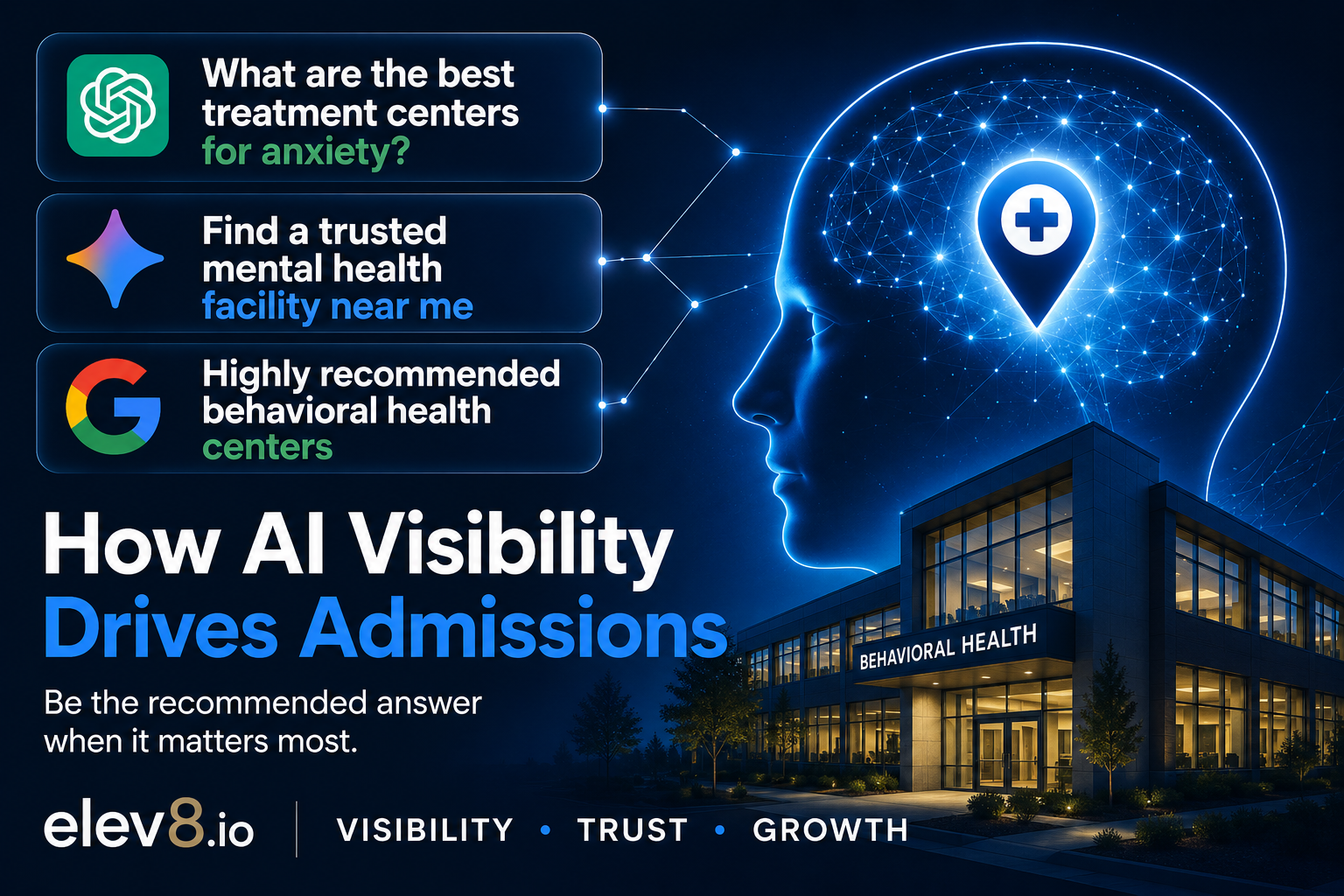
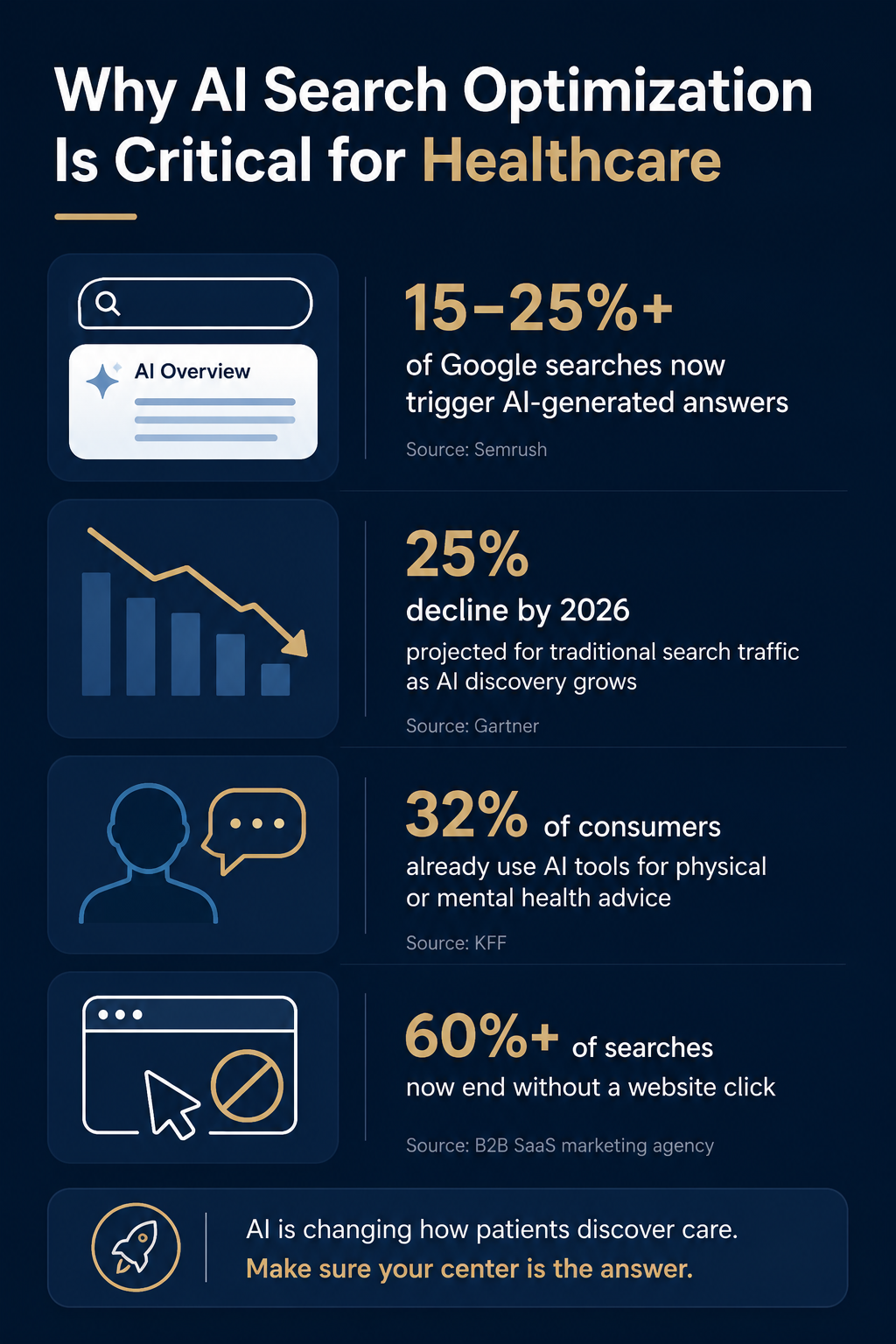
Search is changing from a list of links into a world of answers. Families are no longer just typing “drug rehab near me” and scrolling through ten blue links. They are asking ChatGPT, Gemini, Perplexity, Google AI Overviews, and voice assistants direct questions:
When AI becomes the front door to Search, the question is no longer “Do we rank?” The question becomes: “Are we trusted enough to be cited, summarized, and recommended?”
SEO Is Not Dead. It Has Evolved.
Let me be clear: anyone telling you SEO is dead is either trying to sell you something shiny or they don’t understand how patient acquisition actually works. SEO is still the foundation. But SEO by itself is now only one layer of the visibility stack.
At elev8.io, we now think in four connected layers:
Will AI understand you, trust you, and recommend you — or will it recommend your competitor?
Why This Matters More in Behavioral Health
In most industries, a lost search impression means a missed sale. In behavioral health, it can mean a missed intervention.
A mother searching at midnight because her daughter is spiraling is not browsing casually. A spouse trying to understand detox options is not doing relaxed comparison shopping. They need clarity. They need trust. They need guidance.
They will try to “hack” AI search the same way bad agencies used to hack SEO — keyword stuffing, thin content, fake authority, AI-generated pages with no real experience. That may work for a minute. It will not build a sustainable census engine. The future belongs to centers that demonstrate real expertise, real outcomes, and real trust signals across their entire digital footprint.
AI Rewards Structure, Authority, and Clarity
AI systems do not read websites the way humans do. They parse structure. They extract answers. They evaluate entities. They look for consistency, citations, schema, headings, FAQs, author signals, page speed, and clear topical relationships.
Visibility is earned through a combination of:
Is Your Center Ready to Be Cited by AI?
We run a complimentary 30-minute AI visibility and SEO audit for qualifying behavioral health organizations.
Your Website Has to Become an Answer Engine
Most treatment center websites were built like brochures. Homepage. About page. Programs. Admissions. Insurance. Contact. That is no longer enough.
Your website now has to function like an answer engine — every major page must help AI understand exactly who you serve, what levels of care you provide, and what next step a family should take.
That means your content strategy must address the questions families are actually asking:
AEO requires concise, direct answers. GEO requires authoritative depth. SEO requires technical execution. And patient acquisition requires conversion paths that move someone from education to action.
The New Rehab Marketing Moat Is Trust
In Gary Garth’s book, The Zero to 100 Million Sales Blueprint, he stresses the importance of understanding your customer, their pain points, the buying journey, and the value proposition — and of sending the right message to the right people at the right time. That principle matters even more now. Here are seven reasons the new rehab marketing moat is trust:
At elev8.io, we don’t believe SEO, AEO, GEO, or AI visibility should exist in a silo. Visibility without admissions infrastructure is just expensive noise.
It’s Not About the Traffic
The goal is not traffic. The goal is measured in admissions, not impressions:
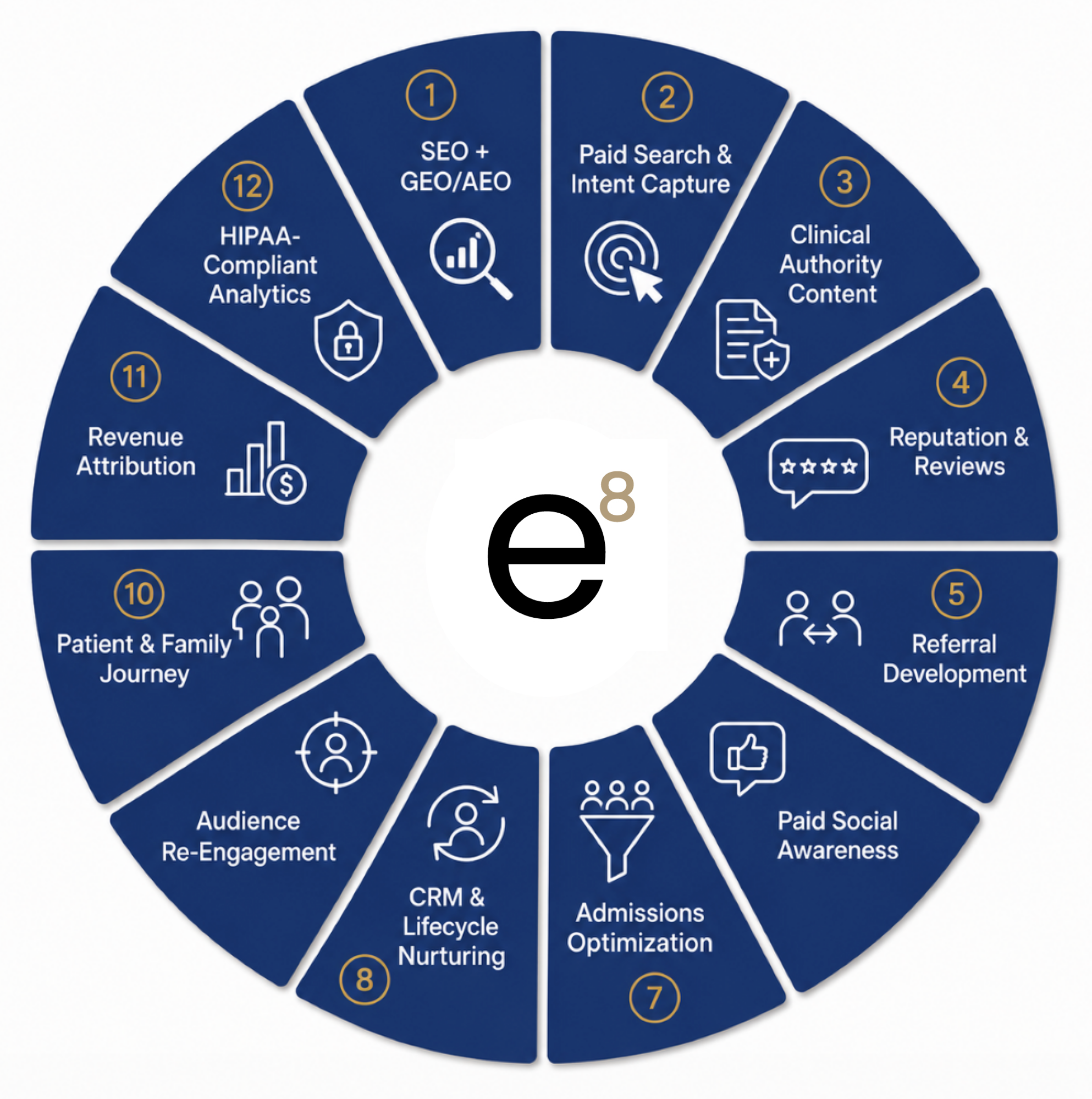
That’s why elev8.io’s value proposition is not “we do SEO.” It’s 360° Patient Acquisition Solutions for Behavioral Health Centers — combining:
Increasing VOB-qualified leads · reducing cost per admission · reaching full census · improving ROI across paid ads, SEO, and BD outreach · and streamlining the entire lead-to-admit journey.
The Old Funnel Is Becoming a Flywheel
Traditional rehab marketing was linear: run ads, get leads, answer calls, track admits, repeat. The new model compounds over time.
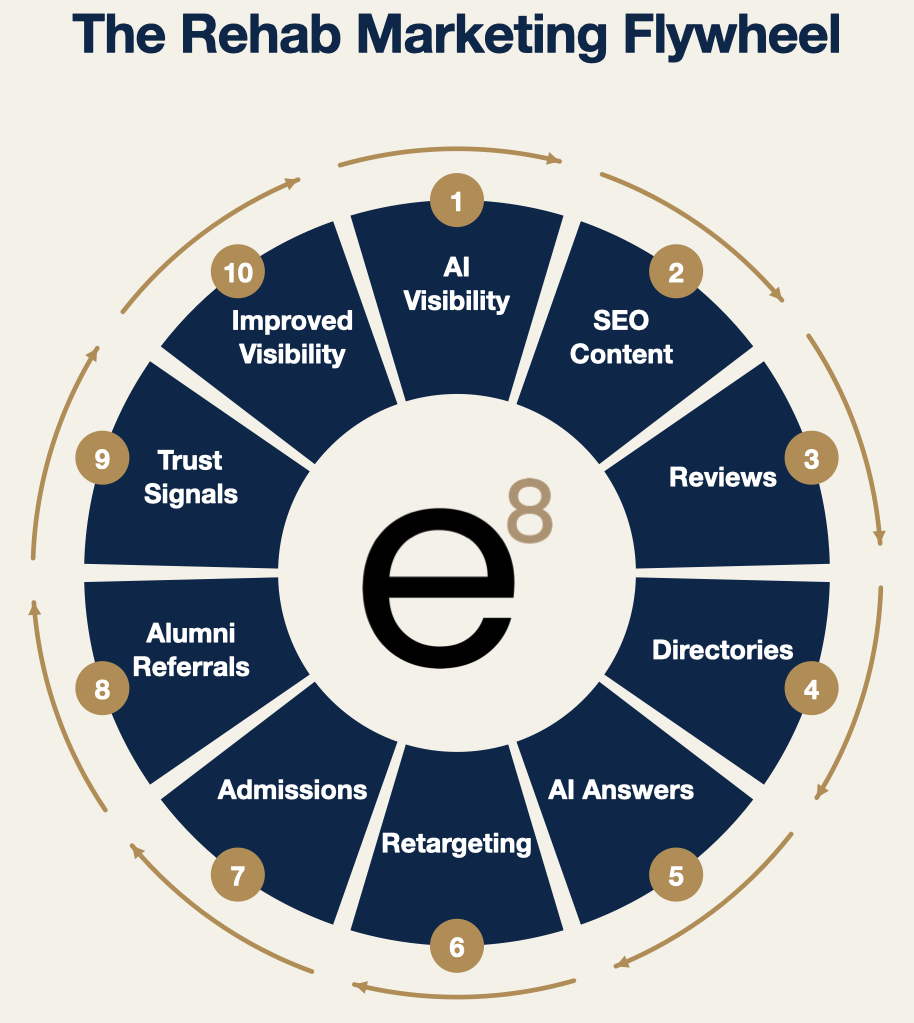
Once it starts working, it compounds. This is why elev8.io’s Demand Generation plan connects inbound, content, podcasting, PR, SEO, paid media, and CRM into one operating system — not disconnected tactics.
What Treatment Centers Should Do Now
Our Partnership With Call Tracking Metrics
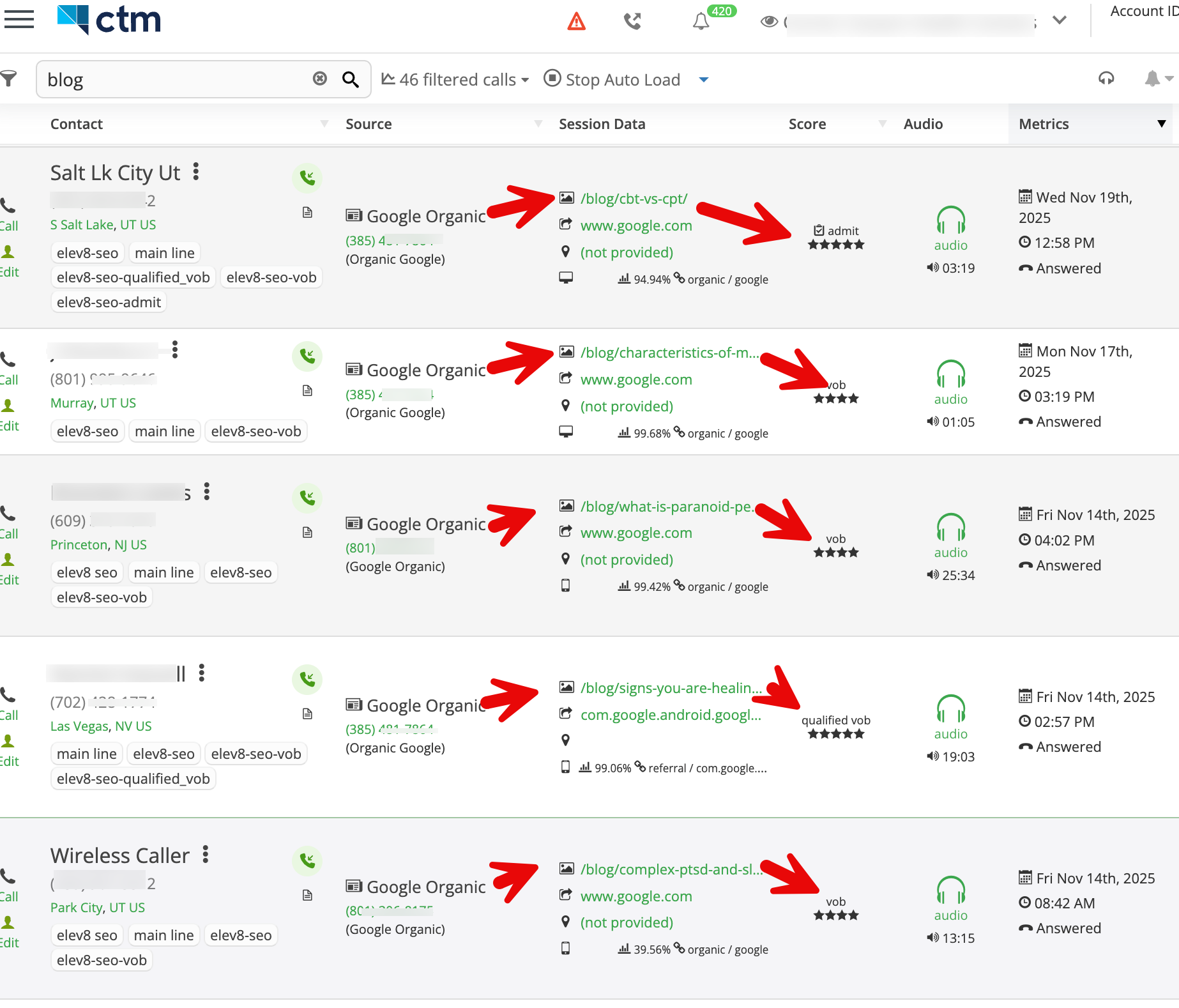
At elev8 we partner with CTM to ensure full-funnel, cross-channel lead attribution — so the path to admission and every major marketing touchpoint is documented.
The example below shows the impact of publishing authoritative blog articles that gain AI visibility among out-of-state prospective patients. These yield valuable, low-cost opportunities and admits at a fraction of the cost of conventional paid-media strategies.
The Big Opportunity
AI search will create winners and losers. Some facilities will see organic traffic decline and blame the algorithm. Others will adapt, build authority, and become the source AI engines trust when families are looking for help.
Rehab marketing is not becoming less competitive. It is becoming more sophisticated. The future will not reward the loudest agency, the biggest ad budget, or the facility with the most generic blog posts.
It will reward the organizations that combine clinical credibility, technical excellence, structured content, ethical messaging, and operational follow-through.
Begin with the end in mind. The end is not a ranking. The end is a person getting help. AI visibility is simply the next evolution in making sure they find the right facility at the moment that matters most.
Are You Trusted Enough to Be Cited, Summarized, Recommended, and Surfaced?
Talk to elev8 about whether AI understands you, trusts you, and recommends you. Contact elev8 today.
Sources
- Garanko, J. (2025). Semrush AI Overviews Study: What 2025 SEO Data Tells Us About Google’s Search Shift. Semrush.com.
- Gartner (2024). Gartner Predicts Search Engine Volume Will Drop 25% by 2026, Due to AI Chatbots and Other Virtual Agents. Gartner.com.
- Annenberg Public Policy Center, University of Pennsylvania (2025). Many in U.S. Consider AI-Generated Health Information Useful and Reliable.
- Montero, A., et al. (2026). KFF Tracking Poll on Health Information and Trust: Use of AI For Health Information and Advice. KFF.
- Pru, M. (2026). How AI Overviews Crush Click-Through Rates. Stackmatix.com.

Head of Growth · elev8.io
Freddie Francis is Head of Growth at elev8.io, where he partners with behavioral health executives and industry leaders to uncover growth opportunities across the entire patient journey—from lead generation and admissions enablement to CRM optimization, operational efficiency, and long-term census growth.
Freddie holds nearly a decade in marketing and new business development, and has been focused on behavioral health since 2022 — four years — improving how clients leverage data-driven approaches to build predictable growth systems while improving the experience for both patients and admissions teams in behavioral healthcare organizations.
Freddie shares insights on patient acquisition, admissions performance, behavioral health marketing, AI-enabled growth systems, and revenue operations.
How CEOs Should Think About Patient Acquisition in 2026
From Fear to First Call: How to Build a High-Converting, VOB-Optimized Landing Page