
PlatformComing Soon
Addiction Treatment CentersMental Health Centers
Eating Disorder CentersComing Soon
ExecutivesMarketingAdmissionsAlumni CoordinatorsBusiness DevelopmentVC & PE Firms
elev8media™
  • SEO & LLM Visibility
  • Paid Media Management
  • Content & Authority Engine
  • Web Dev & CRO
elev8tech™
  • CRM & Tech Enhancement
  • Attribution & Call Tracking
  • Reporting & Analytics
  • Alumni & Advocacy Systems
elev8sales™
  • Alumni Planner
  • Admission Enablement
  • Referral & Partner Growth
  • Fractional CMO
Website AssessmentNewROI & Growth CalculatorFree
TestimonialsCase StudiesThe elev8.io PodcastBlogSales Blueprint Book
AboutMedia & EventsPartnersCareers
Portal
Platform
Addiction Treatment CentersMental Health Centers
Eating Disorder CentersComing Soon
ExecutivesMarketingAdmissionsAlumni CoordinatorsBusiness DevelopmentVC & PE Firms

elev8media™

SEO & LLM VisibilityPaid Media ManagementContent & Authority EngineWeb Dev & CRO

elev8tech™

CRM & Tech EnhancementAttribution & Call TrackingReporting & AnalyticsAlumni & Advocacy Systems

elev8sales™

Alumni PlannerAdmission EnablementReferral & Partner GrowthFractional CMO
Website AssessmentNewROI & Growth CalculatorFree
TestimonialsCase StudiesThe elev8.io PodcastBlogSales Blueprint Book
AboutMedia & EventsPartnersCareers
Client Portal Login
Thought Leadership · elev8 Insights

How CEOs Should Think About Patient Acquisition in 2026

Demand is not the problem — systems are. How behavioral health CEOs should treat patient acquisition as a coordinated, accountable system in 2026, not a list of disconnected marketing activities.
Gary GarthGary GarthFounder & CEO · elev8.ioJun 2, 202610 min read
How CEOs Should Think About Patient Acquisition in 2026
Key Takeaways
  • The gap between demand and census is a systems problem that sits in the CEO’s seat — not a clinical or marketing-department problem.
  • A real patient acquisition system connects demand generation, conversion infrastructure, and attribution so every channel reports to one outcome: verified admissions.
  • The three failure points are channel concentration, the admissions gap, and attribution blind spots — and they show up in that order.
  • Measure cost-per-admit and revenue-per-admit, not clicks or leads; the difference between cost-per-lead and cost-per-admit is where census falls apart.
  • Census is the primary driver of enterprise value, which makes patient acquisition an executive competency, not a back-office function.

The demand is not the problem. Roughly 80% of people who needed treatment for a substance use disorder in 2024 did not get care1. An estimated 61.5 million Americans — about 1 in 4 adults — experienced some form of mental illness in 2024, and 48.4 million people aged 12 and older met criteria for a substance use disorder1.

The market is enormous. The need is unambiguous. And yet most treatment facilities are not running at capacity. The gap between demand and census is not a clinical problem. It is a patient acquisition problem — more specifically, a systems problem — and it sits squarely in the CEO’s seat.

Most operators elev8 encounters have a collection of marketing activities: a website, an SEO vendor, a PPC account, and maybe a business development team to cultivate reciprocal and non-reciprocal partnerships. What they do not have is a coordinated patient acquisition system.

In a real system, every channel feeds the same funnel, every lead is tracked to an outcome, and the executive team can look at a number and know whether census will be up or down next month.

2026 will separate facilities with systems from those still running on activity. Here is how CEOs should be thinking about it.
Gary Garth · Founder & CEO · elev8.io
01
The Landscape

The Market Context CEOs Need to Understand First

Before building a patient acquisition strategy, you need an accurate read on the environment you are operating in. Three structural shifts define the 2026 market.

02
Market Reality I

Demand Is High, but Treatment Utilization Is Falling

Past-year substance use disorder remained roughly constant at 16.8% of the population — about 48.4 million people — yet fewer people received substance use treatment in 2024 (10.2 million, or 3.5%) compared to 13.1 million in 20231.

That is not a population getting healthier. That is a population losing the pathway to care.

There were also 3 million fewer adults and 300,000 fewer adolescents who received any mental health treatment in 2024 compared to 2023. The treatment gap is widening2. For well-run facilities with a functioning acquisition system, that represents a growth opportunity. For facilities lacking one, it signals ongoing census pressure with no natural relief.

03
Market Reality II

The Competitive Environment Is Not Getting Easier

The U.S. behavioral health market was valued at approximately $96.9 billion in 2025 and is projected to reach $159.35 billion by 2035, expanding at a compound annual growth rate of 5.1%3.

Private equity continues to consolidate the space. Multi-site operators with capital and infrastructure are investing heavily in digital channels. That raises the cost of visibility and intensifies competition for every qualified lead4.

Patient acquisition costs in behavioral health are 30–40% higher than just a few years ago. Depending on payer mix and region, they can vary from a few thousand dollars to upward of $10,000 for out-of-network California facilities — and that figure assumes you are measuring correctly5. Most facilities are not.

!
Most facilities measure the wrong number

They track cost per click or cost per lead, not cost-per-VOB, cost-per-viable-VOB, and cost-per-admit. The difference between those numbers is exactly where the census falls apart.

The dashboard below shows how elev8 helps behavioral health facilities understand their funnel across every channel and focus on the metrics that truly matter from a patient acquisition standpoint.
Sample elev8 marketing dashboard showing funnel performance across all channels
A sample elev8 marketing dashboard — funnel performance across every channel, focused on the patient-acquisition metrics that actually matter.
04
Market Reality III

The Search Environment Has Changed Structurally

Patients now get a significant portion of their information directly from Google’s AI Overviews. Nearly 60% of U.S. searches end without a click to any website, as AI-generated answer boxes on tools such as ChatGPT, Perplexity, Copilot, Gemini, and Claude surface more information at the top of results6.

Facilities that built their acquisition strategy entirely on organic traffic from traditional SEO are seeing that traffic erode. Search is still critical — but what it takes to win in search has changed.

The facilities capturing intent in 2026 are the ones building authoritative, structured content that gets cited by AI systems, not just indexed by crawlers7.

05
First Principles

What a Patient Acquisition System Actually Is

Most CEOs in this industry have been sold a version of patient acquisition that looks like a channel list: SEO, PPC, social, referrals. That framing produces fragmented activity, not outcomes. A patient acquisition system is something different.

A system connects three layers, and every component has to function and feed the next one: demand generation (awareness, search visibility, referral outreach), conversion infrastructure (admissions processes, call handling, lead response time), and attribution (the ability to trace a specific admit back to a specific channel and a specific spend).
Infographic connecting demand generation, conversion infrastructure, and attribution into one patient acquisition system
Demand generation, conversion infrastructure, and attribution are not three projects — they are one connected system.
elev8 patient acquisition system diagram showing each channel feeding a single funnel
Every channel feeds the same funnel, and every component reports to the next.

When elev8 audits a facility’s acquisition operation, we typically find the same failure points in the same order.

I
Failure Point One: Channel Concentration
Facilities that built their census on a single channel — usually Google paid search — are highly vulnerable. If search accounts for more than 70% of the budget, the facility is likely leaving growth on the table and creating structural risk: a policy change, a LegitScript compliance issue, or a competitor entering the auction with more capital can cut census in days. A functioning system distributes risk across channels and builds demand at multiple stages of the patient journey, not just at the bottom of the funnel when someone is already in crisis and searching. A Recovery.com survey of behavioral health marketing leaders found the paid-media proportion of a healthy census should not exceed 35–50%8; my own response was more conservative — 25–35%, especially for smaller facilities.
II
Failure Point Two: The Admissions Gap
Generating inquiries is the job of marketing. Converting inquiries to admits is the job of admissions. Most facilities treat these as separate departments with separate accountability. They are not separate — they are one funnel. elev8’s internal data shows that the largest source of census loss at most facilities is not insufficient lead volume; it is lead attrition between first contact and admission. Inquiry response time, call handling quality, insurance verification speed, and the handoff from intake to clinical all determine whether a qualified family that found you actually becomes a patient. CEOs who focus exclusively on top-of-funnel spend while ignoring conversion infrastructure are filling a leaking bucket.
III
Failure Point Three: Attribution Blind Spots
You cannot manage what you cannot measure. A growing number of behavioral health organizations report uncertainty about which channels produce the strongest results, even as leadership teams want to understand how marketing contributes to patient volume and revenue. That uncertainty is expensive. Without attribution that connects spend to actual admissions, budget decisions are guesses: channels that appear to perform by volume may generate low-quality leads, while channels that look quiet may drive your highest-value admits through assisted conversions that never get credited. In behavioral health, attribution is complicated by HIPAA constraints on pixel-level tracking — a compliant, functional model requires intentional architecture. It does not happen by default inside a standard Google Analytics setup.

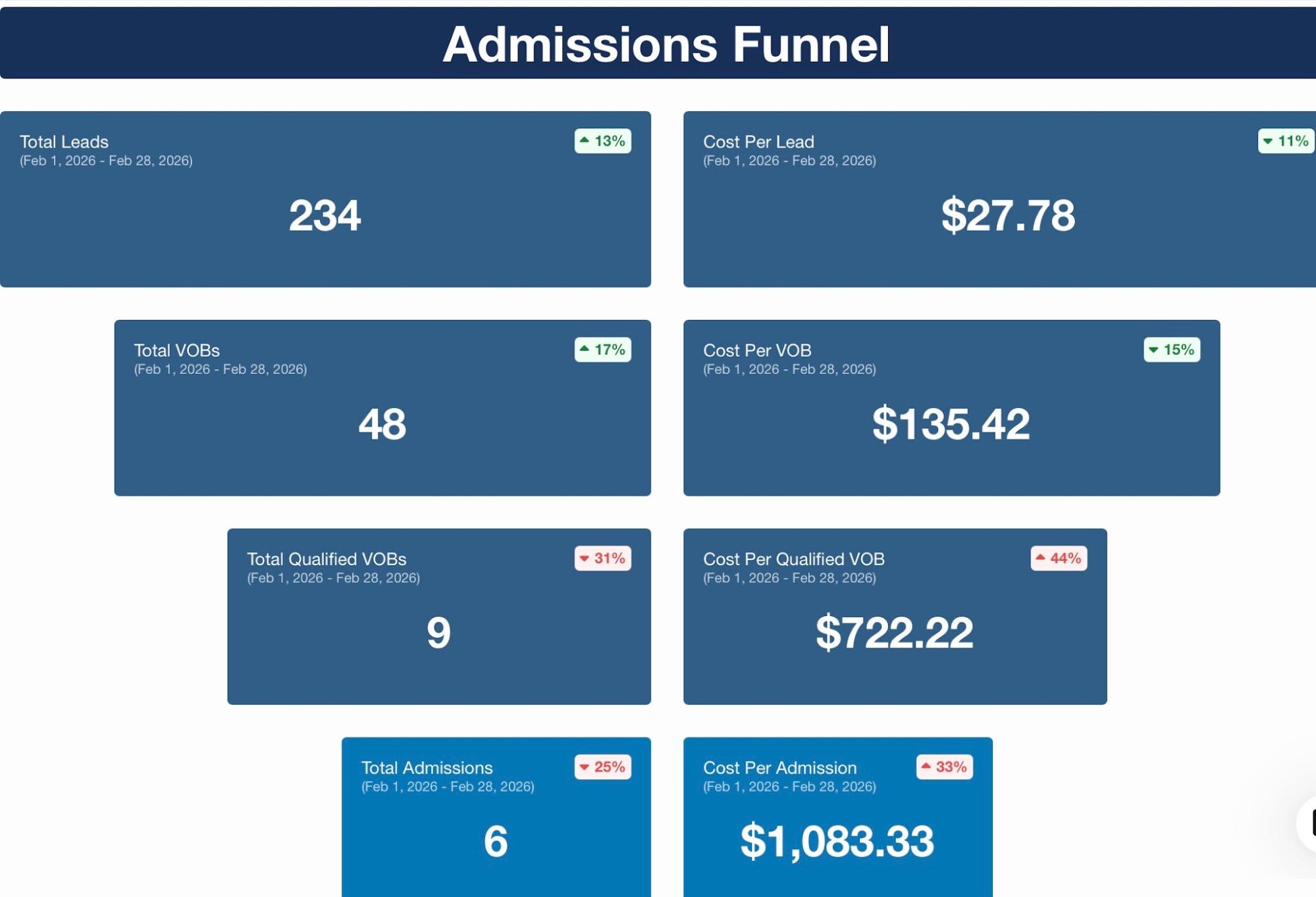
The image below shows a snapshot of elev8’s dashboards focused on the key conversion metrics inside an admissions funnel — the kind of view that requires close collaboration between Marketing and Admissions to optimize effectively.

elev8 dashboard focused on admissions-funnel conversion metrics
elev8’s dashboards focused on the key conversion metrics inside the admissions funnel — optimized through close Marketing–Admissions collaboration.

Demand generation, conversion infrastructure, and attribution are not three projects. They are one system — and a CEO is the only person positioned to make them report to a single outcome.

Free Census Strategy Session

Is your growth engineered—or accidental?

We map your channels, admissions funnel, and attribution against the metrics that actually move census.

Book a Session
06
The Playbook

The Four Decisions That Determine Your Census in 2026

elev8’s experience working with facilities across the U.S. highlights four strategic decisions that separate facilities running at capacity from those perpetually chasing census.

#1
Build a Channel Architecture, Not a Channel List
A channel architecture maps each channel to a specific role in the patient journey. Paid search captures bottom-of-funnel intent from people actively looking for help. SEO and content capture earlier-stage research from families trying to understand what treatment looks like. Referral development builds a warm pipeline from clinical professionals who see patients before those patients find you online. Reputation management — reviews, profiles, and listing accuracy — determines whether any of those channels convert when a prospective patient does the final comparison before calling. When capacity alignment is paired with regular coordination with operations — scaling spend up when beds are open and pulling back when capacity is constrained — marketing becomes far more efficient. Redirecting spend to available capacity increases booked appointments and lowers acquisition costs. Most facilities run their marketing at a flat spend rate regardless of census. That is a significant inefficiency.
#2
Invest in the Top of the Funnel Before You Need It
Operators who only activate marketing when census drops are buying time, not building a system. Search works best when it is supported by channels that build awareness and shape the decision before someone types a query. Families researching treatment options for a loved one do not start that process the day they call — they start weeks earlier by reading articles, watching videos, and comparing options. The facilities that win those calls have been present throughout that research. The 2026 market increasingly demands outcomes-driven storytelling — showing that your care actually works, including for the clinicians who refer patients to you7. Rather than only sharing success stories, leading organizations use anonymized, evidence-based, easy-to-digest data to demonstrate clinical credibility to both prospective patients and referral sources. That content serves the top of the funnel and referral development simultaneously.
#3
Align Marketing Spend to Admissions Outcomes, Not Marketing Metrics
The CEO’s job is not to evaluate click-through rates. It is to evaluate cost per admit, revenue per admit, and return on marketing investment measured at the admissions level. The facilities lowering patient acquisition cost right now treat online reputation as the foundation every paid channel runs on, produce authentic provider video, treat phone calls as first-class conversions, and measure cost per patient acquired — not cost per lead5. This requires your marketing team, admissions team, and CRM to be connected, inquiry-source data to pass through verification and enter your EHR, and reporting infrastructure a CEO can read in ten minutes and act on: call tracking that connects campaigns to scheduled appointments, data integration across CRM and ad platforms, and dashboards that show spend, booked appointments, cost per acquisition, and revenue9.
#4
Treat Referral Development as a Marketing Channel, Not a Sales Function
Referral relationships with detox programs, hospital discharge planners, ERs, outpatient therapists, and primary care providers represent one of the most durable patient acquisition channels available to a treatment facility. They also tend to produce higher-quality admits — patients with clinical preparation, appropriate expectations, and an established relationship with a referring provider who cares about the outcome. Most facilities underinvest in referral development because it is slow and dependent on relationships. That is precisely why it is a competitive advantage. Competitors who rely on paid media can be outspent. Competitors who rely on SEO can be outranked. A referral network built over 24 months cannot be replicated in a quarter. Treating business development as a system — documented referral sources, outreach cadences, outcome reporting back to referrers, and a CRM that tracks referral volume by source — produces census stability that no digital channel can match on its own.
07
The Model

The elev8 Business Development Model

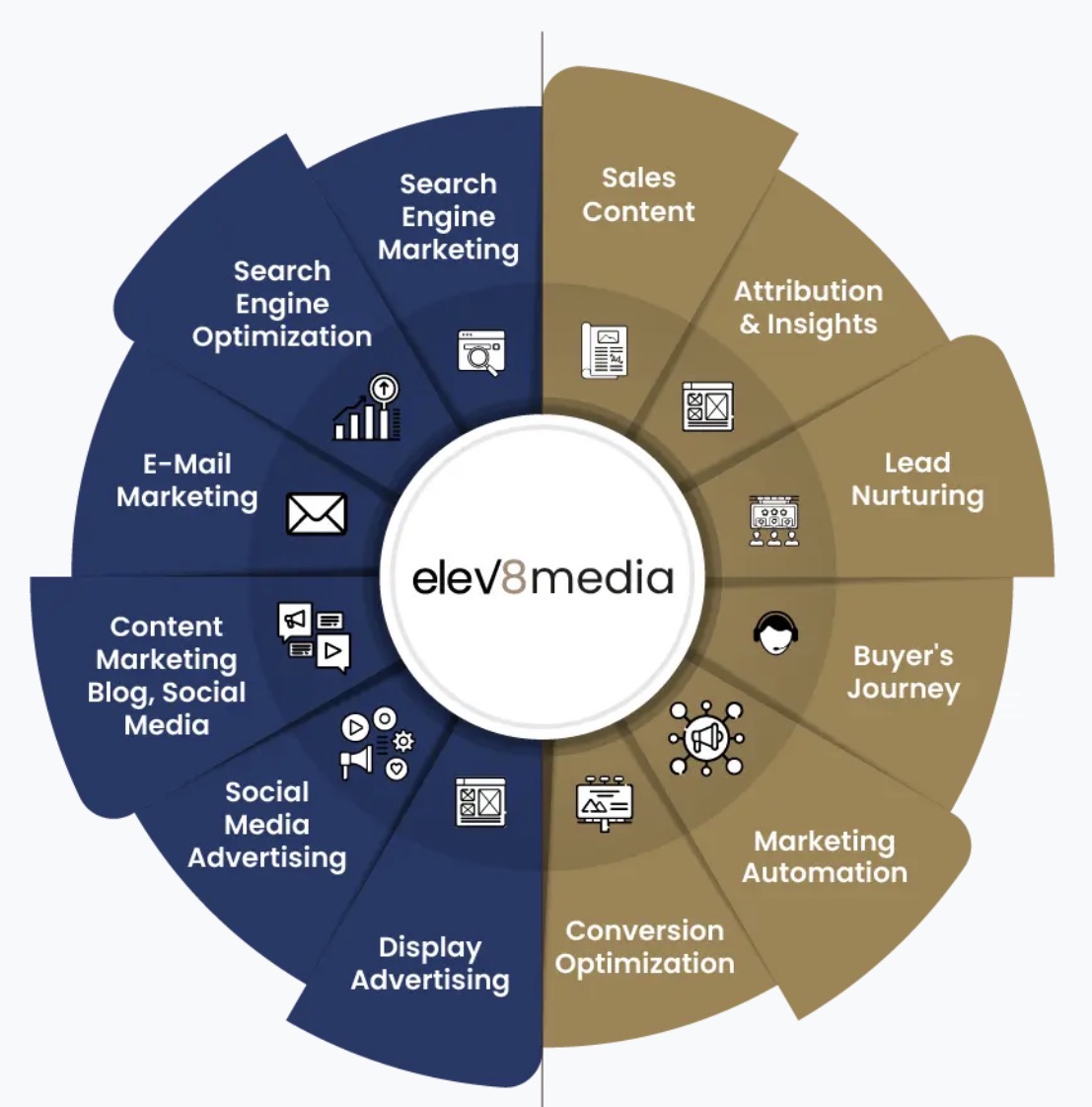
Today’s leading facilities treat business development and marketing as a uniform, collaborative ‘Smarketing’ strategy. The elements complement one another instead of cannibalizing resources and negatively impacting outcomes.

A patient acquisition journey often requires multiple touchpoints. Attribution should never be isolated — it should distribute weight among all contributing touchpoints.
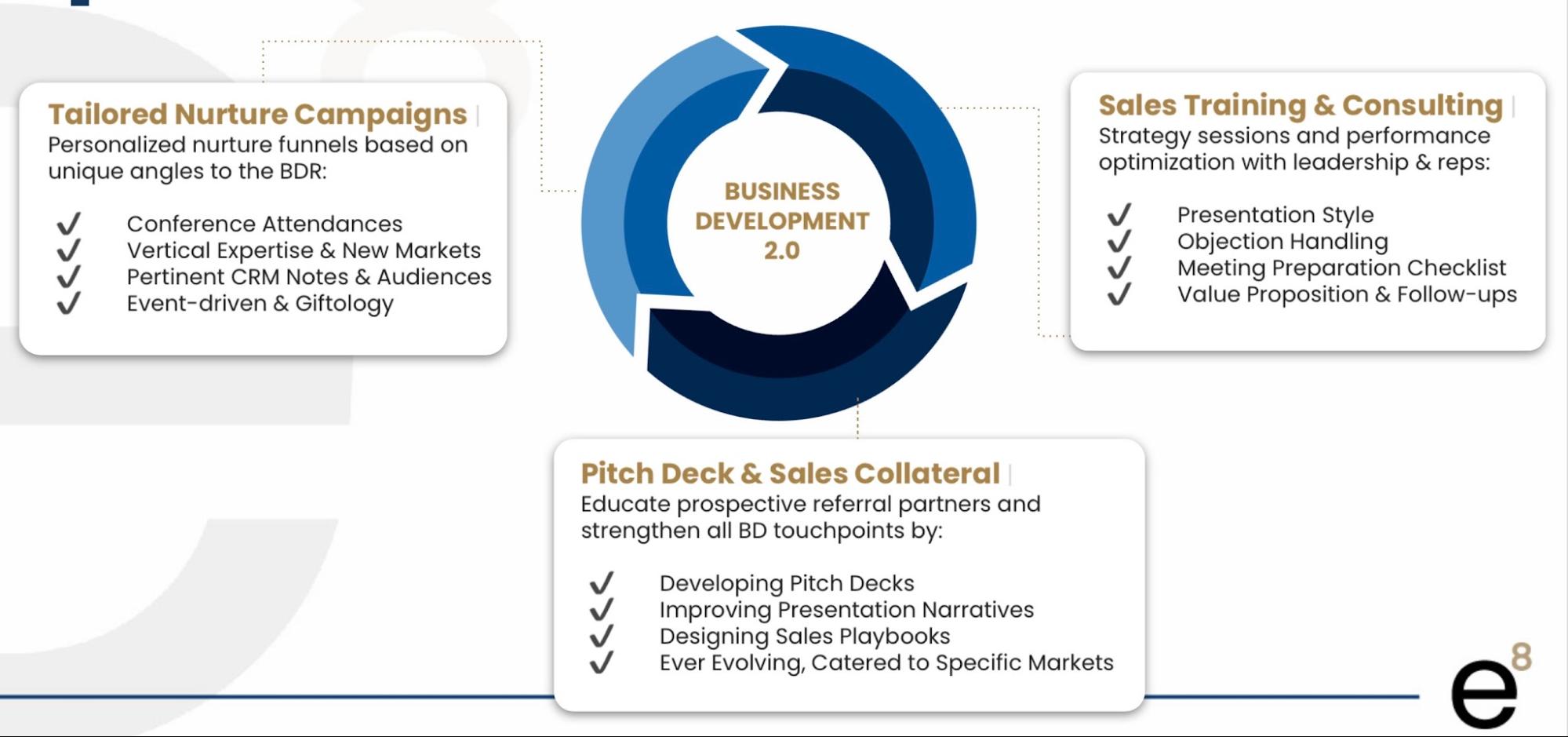
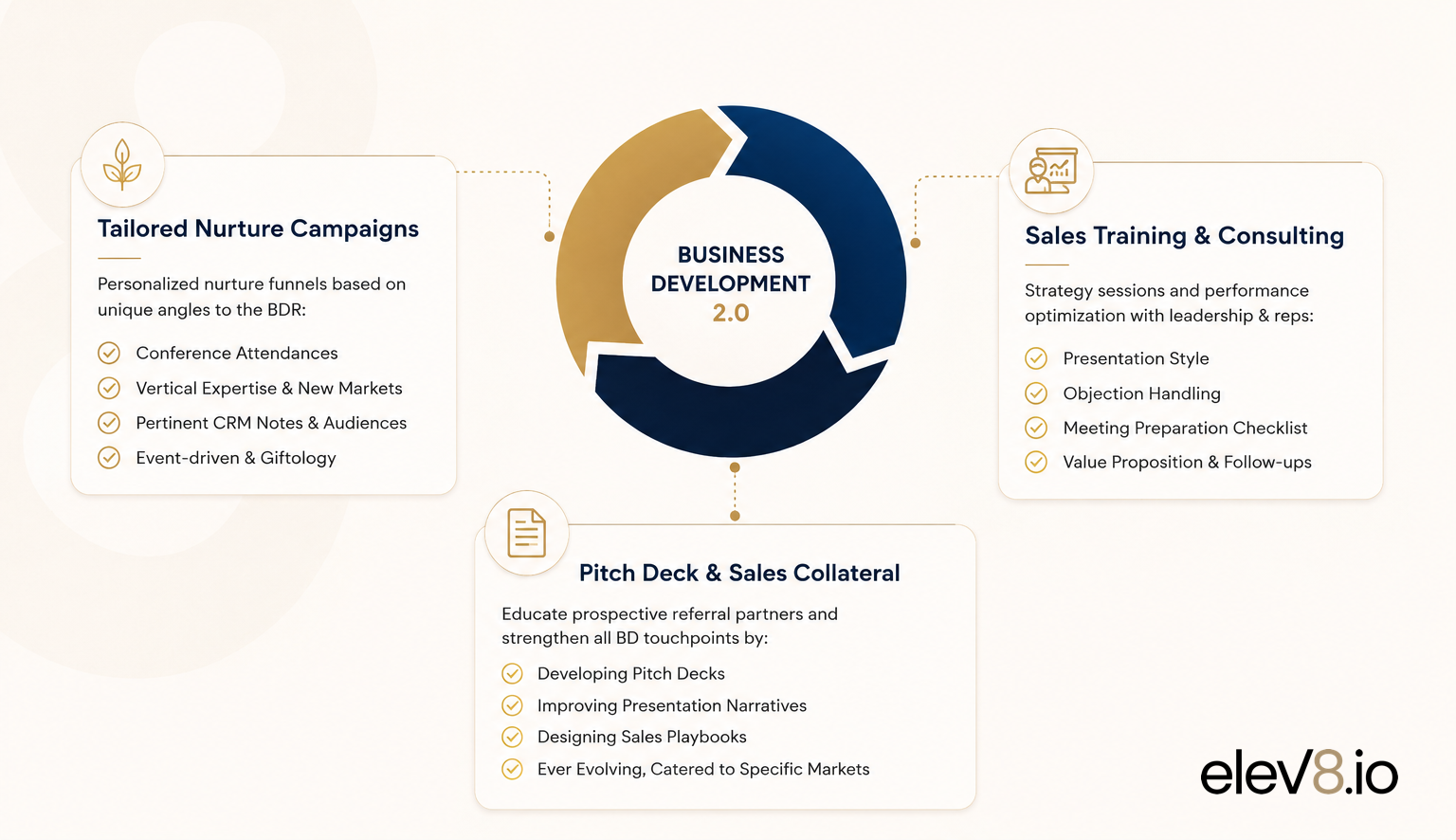
elev8 Smarketing model showing business development and marketing working as one system
The elev8 ‘Smarketing’ model — business development and marketing operating as one collaborative system.
Multi-touch attribution model distributing weight across every contributing touchpoint
Multi-touch attribution — weight distributed across every touchpoint in the acquisition journey rather than credited to a single channel.
08
The Approach

What elev8 Builds — and Why It Works

elev8 does not sell channels. We build patient acquisition systems for behavioral health facilities, and elev8.io focuses on the metrics that actually impact growth. That distinction matters because channels generate activity while systems produce census.

Our work starts with an audit of the existing marketing stack, the admissions funnel, the attribution infrastructure, and the competitive landscape. We do not assume we know your problems before we look at your data. What we find in that audit determines what we build.

From there, we integrate SEO and AEO, paid media, referral development, and admissions consulting into a single system with unified attribution. Every channel we manage reports to the same outcome metric: verified admissions. We help facilities understand their true cost per admit by channel, optimize spend toward the channels producing the highest-value admits, and fix the conversion infrastructure issues that leak qualified leads before they ever reach a bed.

★
Behavioral health is not generic marketing

We work exclusively in behavioral health — LegitScript certification requirements, Google’s healthcare advertising policies, HIPAA-compliant tracking architecture, and the specific conversion dynamics of a family in crisis evaluating options under time pressure. That context does not come from a general-purpose agency that picked up a few behavioral health clients.

09
The Roadmap

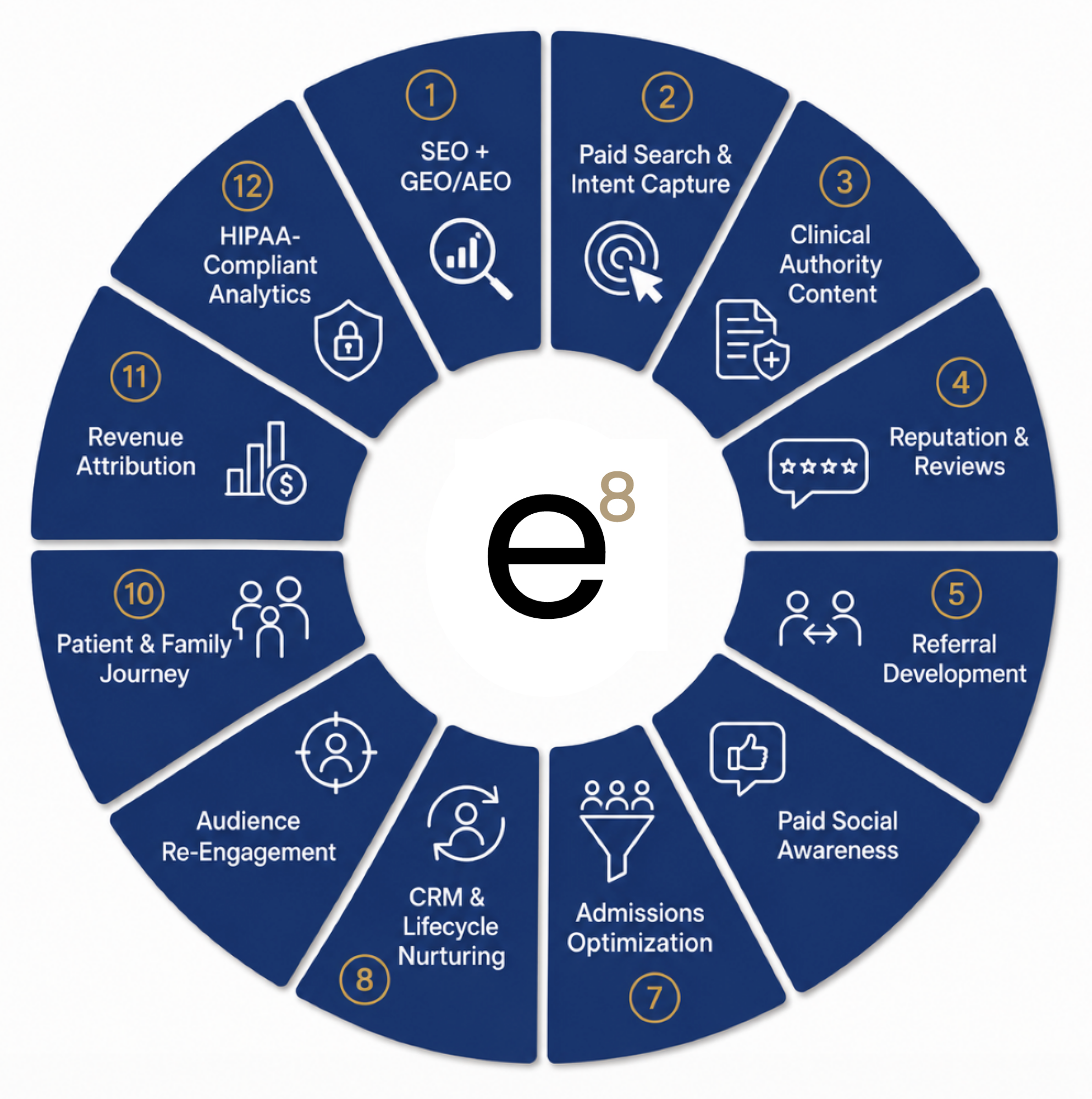
The elev8.io 8-Step Patient Acquisition Roadmap

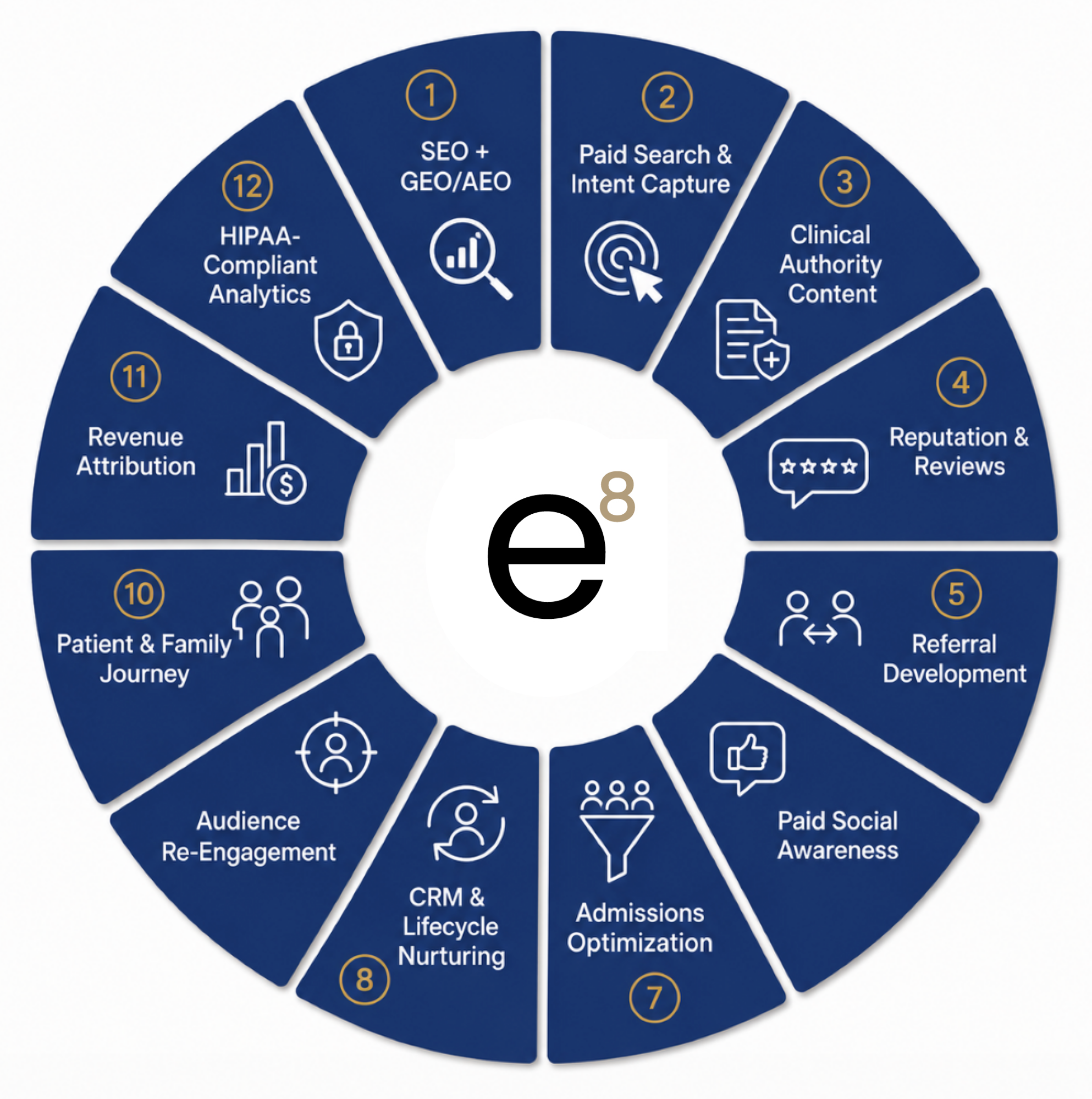
Patient acquisition, when done strategically, comes down to eight key elements — each one feeding the next.
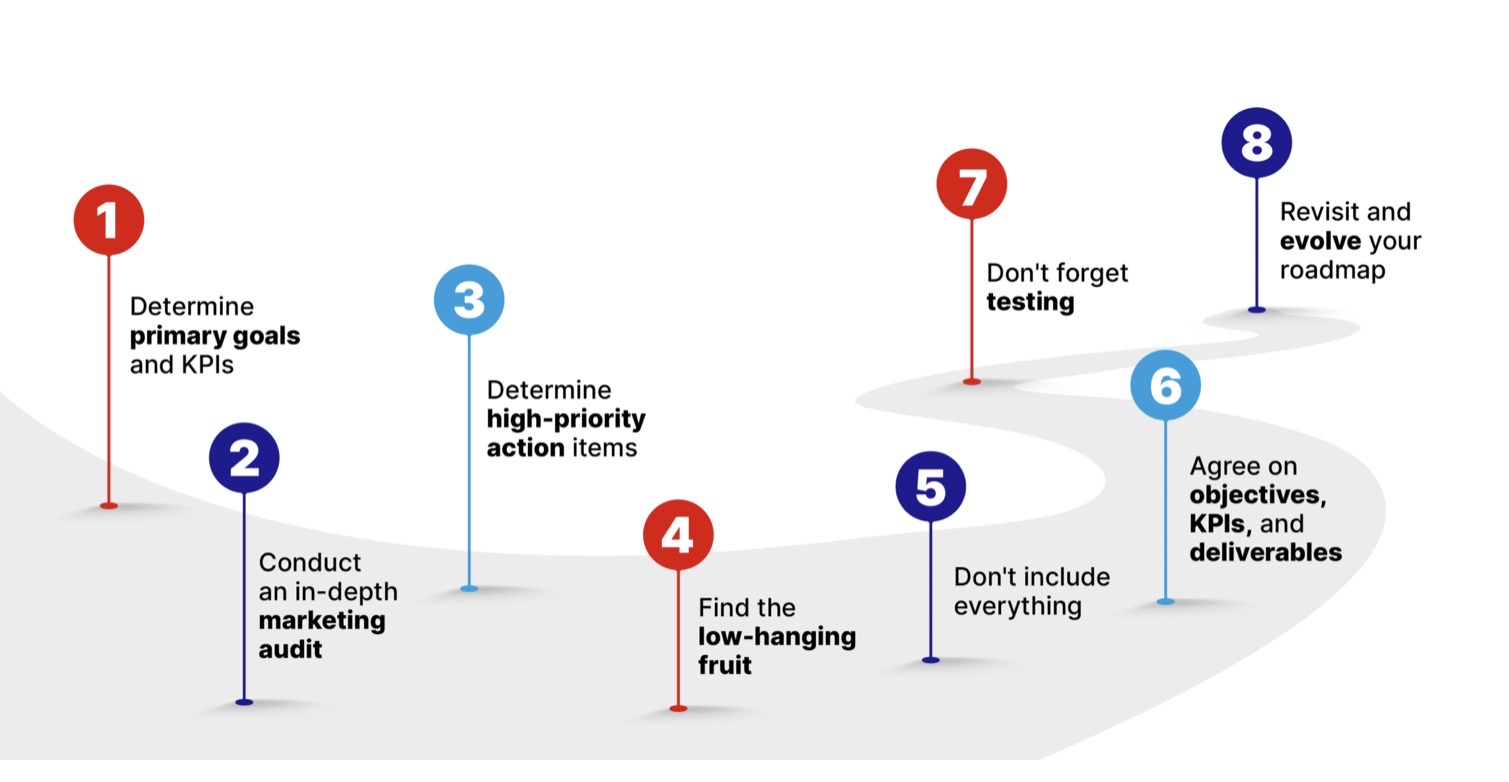
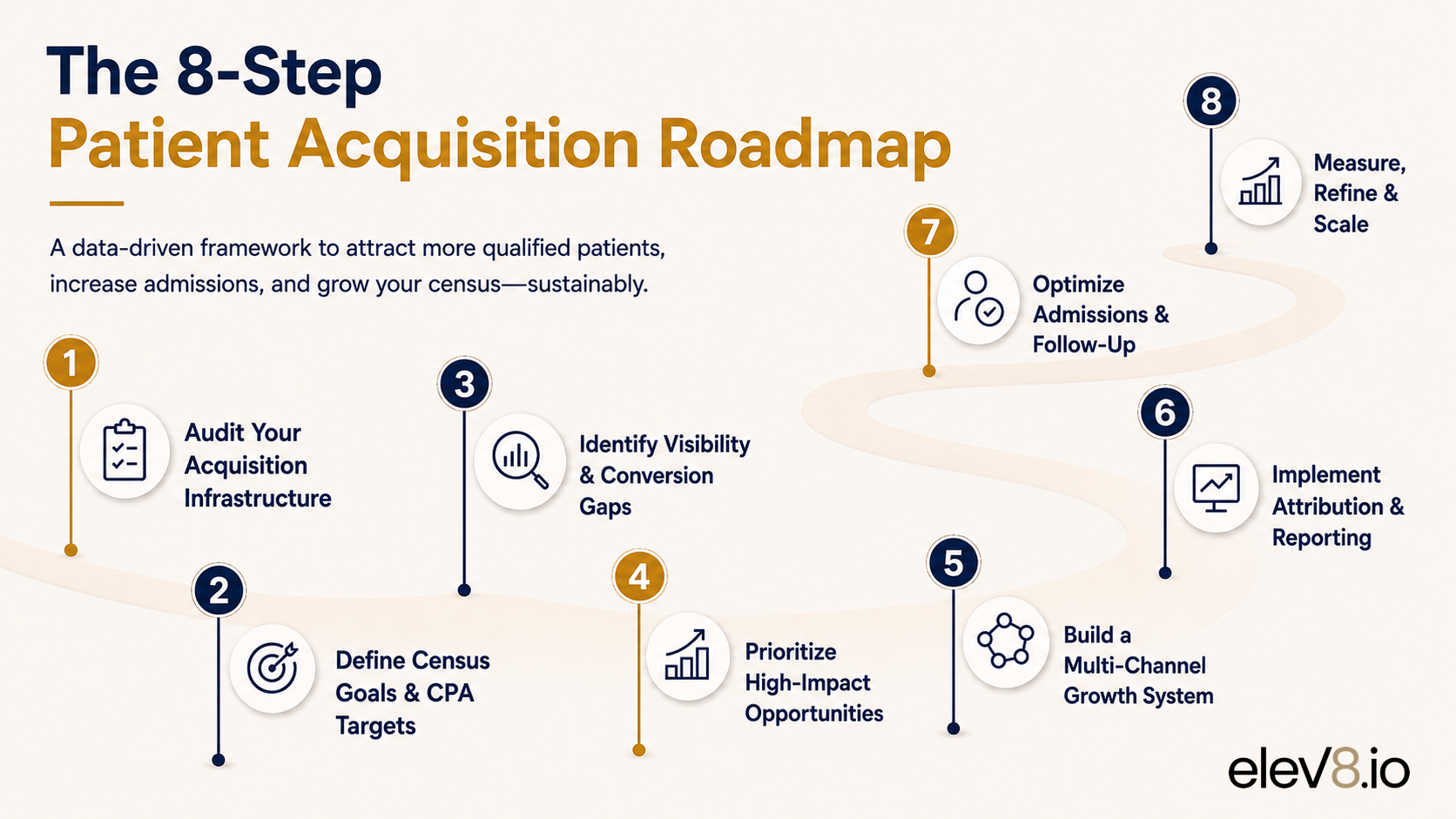
Eight Steps, One System
Step 01
Audit Your Acquisition Infrastructure
Review marketing, admissions, CRM, tracking, and referral systems.
Step 02
Define Census Goals & CPA Targets
Align growth objectives with capacity, payer mix, and ROI goals.
Step 03
Identify Visibility & Conversion Gaps
Evaluate SEO, GEO/AEO, admissions workflows, and lead leakage.
Step 04
Prioritize High-Impact Opportunities
Focus on the channels and operational fixes that move census fastest.
Step 05
Build a Multi-Channel Growth System
Integrate search, referrals, reputation, content, and admissions.
Step 06
Implement Attribution & Reporting
Track calls, forms, admits, ROI, and channel performance with clarity.
Step 07
Optimize Admissions & Follow-Up
Improve lead response speed, call handling, nurturing, and intake flow.
Step 08
Measure, Refine & Scale
Continuously improve using data, testing, and forecasting.
Each step compounds the last — which is why acquisition works as a system, not a checklist run once and set aside.
elev8.io 8-step patient acquisition roadmap illustrated as a continuous cycle
The elev8.io 8-step patient acquisition roadmap — a continuous loop of audit, build, measure, and scale.
elev8 patient acquisition roadmap detail showing channels feeding verified admissions
Every step of the roadmap points back to one metric that matters: verified admissions.
10
The Bottom Line

The Executive Mandate

Patient acquisition in 2026 is not a marketing department problem. It is a CEO problem. The decision about which agency to trust with this function, which channels to prioritize, how much to invest, and how to hold that investment accountable — those are executive decisions. They determine valuation.

Valuations in this space are often shaped by payer mix, census stability, licensure, and accreditation, with integrated multi-site operators attracting higher multiples10. Census is not incidental to enterprise value. It is the primary driver of it.

Operators who treat patient acquisition as a back-office function — something to delegate and check on quarterly — will continue to face census pressure regardless of how strong the underlying demand is. The treatment gap documented by SAMHSA is not an argument to sit back and wait for patients to find you11. It is an argument to build the infrastructure that finds them first.

The facilities that grow census consistently in 2026 will be the ones whose CEOs treat acquisition as a core operational competency — governed by data, structured as a system, and resourced accordingly. Everything else is hope.
Gary Garth · Founder & CEO · elev8.io
11
References

Sources

  1. Substance Abuse and Mental Health Services Administration (2025). Release of the 2024 National Survey on Drug Use and Health. SAMHSA.
  2. Behavioral Health Business (2025). SAMHSA: Mental health treatment stalls for youth and adults.
  3. Towards Healthcare (2026). U.S. behavioral health market size, shares and trends.
  4. Definitive Healthcare (2026). 8 things to watch in behavioral health in 2026.
  5. Brighter Click (2026). Healthcare patient acquisition cost in 2026: CAC benchmarks by specialty.
  6. Axis MH (2026). 5 marketing trends mental health practices need to know in 2026.
  7. A-Train Marketing (2026). 2026 behavioral health marketing trends.
  8. Mally, C. (2026). What “Good” Looks Like in Behavioral Health Marketing: Spend, Mix, and Conversion Benchmarks. Recovery.com.
  9. Revenue Memo (2026). Healthcare marketing statistics for 2026: A comprehensive analysis.
  10. Health FMV (2025). Valuing SUD/addiction treatment services providers in 2025: A comprehensive guide.
  11. Navis Clinical Laboratories (2025). SAMHSA releases results of 2024 National Survey on Drug Use and Health.

🎙️On the PodcastGary Garth goes deeper on this — Episode 2: “The Big WHY Behind The elev8.io Podcast”Watch, listen, and read the full transcript →

Table of Contents

IntroductionMarket ContextDemand vs. UtilizationCompetitive EnvironmentSearch Has ChangedWhat a System IsThe Four DecisionsThe elev8 BD ModelWhat elev8 Builds8-Step RoadmapThe Executive MandateSources

Get Your Strategy Session Today

Is your census growth predictable?

A 30-minute review of your channels, admissions funnel, and attribution against the metrics that actually move census.

Share this article

Gary Garth

Gary Garth

Founder & CEO · elev8.io

Gary Garth is the Founder & CEO of elev8.io, where he helps behavioral health organizations achieve full census through integrated marketing, admissions, and technology-driven growth systems.

With more than a decade of experience working alongside Google, Microsoft, and high-growth technology companies, Gary has built and implemented scalable growth frameworks now used by 55+ treatment centers across the United States to drive admissions and operational efficiency.

As a speaker, Gary focuses on the intersection of patient acquisition, AI-driven search, and admissions performance, helping founders, operators, and investors identify the hidden bottlenecks limiting growth—and how to fix them.

The author of The Zero to 100 Million Sales Blueprint and The Goals, Grit & Greatness Planner™, Gary is driven by a mission to close the gap between the millions of people struggling with addiction and mental health and the care they need.
Connect on LinkedIn
More from elev8 Insights
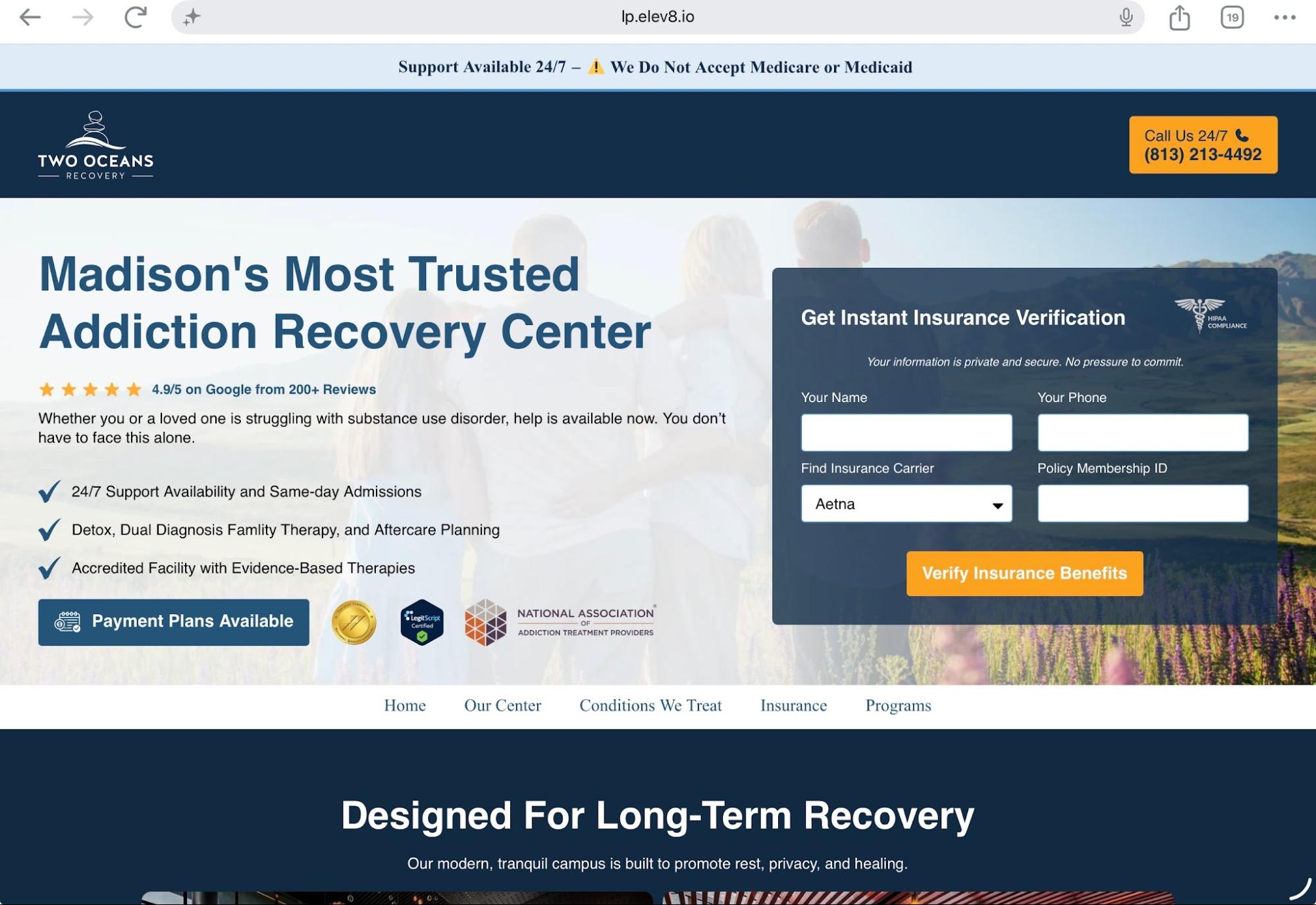
From Fear to First Call: How to Build a High-Converting, VOB-Optimized Landing Page
From Fear to First Call: How to Build a High-Converting, VOB-Optimized Landing Page

May 28, 2026 · 9 min readRead →
How AI Visibility and Search Is Changing Rehab Marketing
How AI Visibility and Search Is Changing Rehab Marketing

May 19, 2026 · 12 min readRead →
Why Alumni Programs Are the Best Revenue Drivers for SUD Treatment Centers

Why Alumni Programs Are the Best Revenue Drivers for SUD Treatment Centers

Jul 21, 2026 · 9 min readRead →
elev8.io

Empowering behavioral health with reliable, scalable growth operating system solutions.

Newsletter

  • [email protected]
  • 300 W Tyler Street, Tampa, FL 33602

elev8media™

  • SEO & LLM Visibility
  • Paid Media Management
  • Content & Authority Engine
  • Web Dev & CRO

elev8tech™

  • CRM & Tech Enhancement
  • Attribution & Call Tracking
  • Reporting & Analytics
  • Alumni & Advocacy Systems

elev8sales™

  • Alumni Planner
  • Admission Enablement
  • Referral & Partner Growth
  • Fractional CMO

Company

  • About
  • Media & Events
  • Partners
  • Careers

Certified Partners

Microsoft Advertising
Salesforce Partner
Kipu Vendor
Vendor
Google Partner
NAATP Affiliate Member
Recovery.com Partner
CTM Partner
AWS Partner
Microsoft Advertising
Salesforce Partner
Kipu Vendor
Vendor
Google Partner
NAATP Affiliate Member
Recovery.com Partner
CTM Partner
AWS Partner
Microsoft Advertising
Salesforce Partner
Kipu Vendor
Vendor
Google Partner
Certified Partners
NAATP Affiliate Member
Recovery.com Partner
CTM Partner
AWS Partner

© 2026 Made withbyelev8

Terms of Service|Privacy Policy|Cookie Policy|HIPAA|Security|Accessibility|Your Privacy Choices