Why Alumni Programs Are the Best Revenue Drivers for SUD Treatment Centers
Alumni programs cut acquisition costs and drive readmissions for SUD treatment centers. See how alumni engagement can be leveraged into a measurable revenue channel.
Key Takeaways
- Alumni programs are a revenue system, not an aftercare courtesy. Treated correctly, they function as a lower-cost, higher-trust admissions channel.
- Acquiring a new customer can cost five to 25 times more than retaining an existing relationship, and the same math applies to keeping former patients engaged versus buying every new lead.
- Relapse rates of 40% to 60% mean many alumni will need care again. Facilities without a structured alumni relationship lose that admission to a competitor.
- A revenue-driving alumni program needs an owner, a defined touchpoint cadence, and a technology layer that tracks engagement back to admissions.
- Referrals sourced through alumni and family networks convert faster and arrive with more trust than paid or organic leads, because the referrer has already done the persuading.
- Most facilities cannot answer the question, “How many admissions did our alumni program generate last quarter?” That gap is the business case for building one.
- Building the case to leadership works best as an attribution argument, not a goodwill argument. Frame alumni engagement as a marketing channel with a cost per admission, and it competes for budget on equal footing with paid media.
What Is an Alumni Program and Why Should Treatment Centers Invest In One?
An alumni program is a structured set of post-discharge engagement activities — events, support groups, check-in calls, and community platforms — that keep recovering patients connected to the facility and to each other after treatment ends.
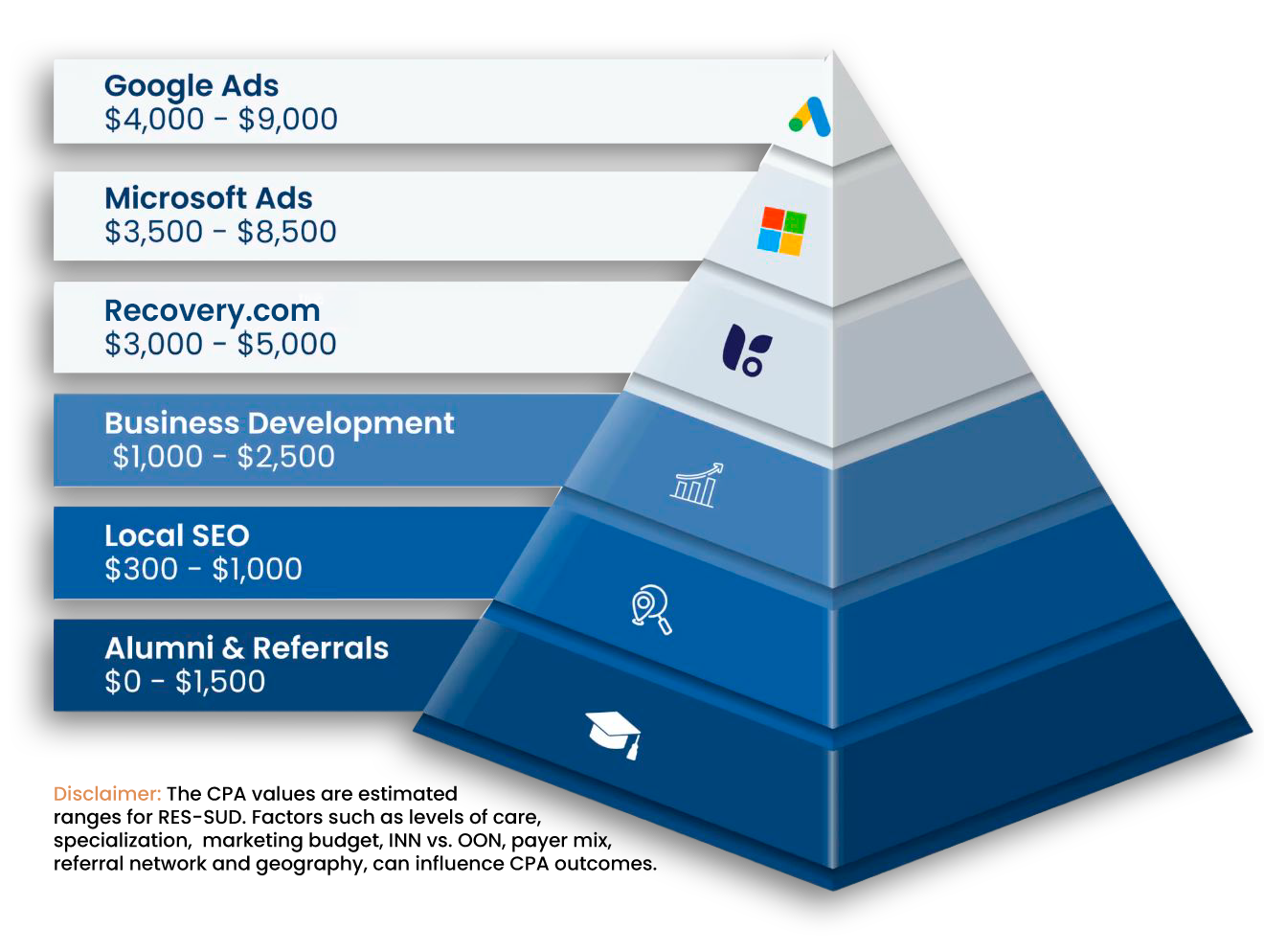
Research by Treatment Professionals in Alumni Services (TPAS) shows facilities with strong alumni programs can generate over 50% of their referrals from alumni at $800–$1,100 per admission, vs. $10,000+ for traditional business development.
This article covers why alumni engagement belongs in the revenue conversation, what a program built for admissions actually requires, and how to build the case internally when alumni services have historically competed for scraps of the marketing budget.
Alumni-sourced admissions run $800–$1,100 each. Traditional business development runs $10,000+. Few line items in a facility’s budget carry a 10x efficiency gap.
Alumni: The Lowest-cost, Highest-trust Admissions Channel
Most treatment centers fund alumni programs out of obligation. A monthly meeting, a Facebook group, maybe a coordinator who also answers phones for admissions. It gets budgeted like a courtesy and measured like nothing whatsoever.
That framing costs facilities real revenue. As the below graphic clearly illustrates, an alumni program, run with the same discipline as a paid media campaign, functions as the lowest-cost, highest-trust admissions channel a facility owns.
It reduces churn on the back end and drives new admissions on the front end through referrals from people who already vouch for the program with their own recovery.
The Hidden Cost of Treating Alumni as an Afterthought
Substance use disorder carries relapse rates of 40% to 60%, comparable to other chronic illnesses such as hypertension and asthma1.
Relapse is not a program failure. It is a predictable part of a chronic condition, and it means many alumni will need a higher level of care again at some point.
The facility that stays connected to that alumnus is the facility that gets the readmission, the referral for a family member, or the recommendation to a friend in crisis. The facility that let the relationship lapse gets none of it.
This is not a clinical afterthought either; SAMHSA’s own continuum of care framework places recovery support alongside treatment, promotion, and prevention as a core pillar of behavioral health service delivery, not an optional add-on2.
Facilities that already offer discharge planning and continuing care, which the large majority do, have the clinical infrastructure in place3. What most are missing is the marketing and operational discipline to turn that infrastructure into a revenue channel.
The economics support this strategic shift.
Acquiring a new customer can cost five to 25 times more than retaining an existing one, depending on the industry.
Behavioral health marketing carries its own version of that math. Every dollar spent keeping an alumnus engaged is a dollar that can return as a readmission or a warm referral, at a fraction of the cost per admission that a facility pays for a cold paid media lead.
Alumni Programs Are a Referral Engine, Not a Nice-to-Have
Word of mouth already drives a meaningful share of admissions at most facilities. Alumni programs simply make that channel intentional instead of accidental.
An engaged alumnus refers friends, family members, and even acquaintances in crisis because they trust the program in a way no ad campaign can replicate.
In elev8’s work across facility clients, admissions sourced through alumni and family referral consistently show a shorter path from first contact to admission than paid or organic leads, because the referrer has already done the work of building trust before the phone call happens5.
This matters most in a market where LegitScript compliance, rising cost per click, and shrinking organic visibility have made every paid admission more expensive to earn.
A referral from a trusted alumnus arrives pre-sold on the facility’s credibility. Admissions teams close these leads faster, with fewer objections, because they have already built trust, the hardest part of the sale.
The Census: The elev8 Newsletter
Join 2,000+ behavioral health leaders. Get notified when we publish new articles — the strategies, data, and insights shaping behavioral health marketing.
2,000+ executives already subscribed
Unsubscribe anytime. Just one newsletter a month — no spam.
What a Revenue-Driving Alumni Program Actually Includes
Most facilities have some version of an alumni program already. Few have a business model built to generate revenue. The difference comes down to three things: ownership, cadence, and tracking.
Turning Alumni Engagement Into an Attribution Model
Measurement creates the gap between an alumni program that feels good and one that drives revenue.
Every inquiry should capture a referral source field that distinguishes alumni and family referrals from paid, organic, and other channels. Every alumni event, call, or campaign should carry a way to trace forward to an admission, even months later.
Once that data exists, elev8 can help facilities calculate a real cost per admission for the alumni channel and set it against paid media spend, which is usually the moment leadership stops treating alumni services as a cost center5.
Patient lifetime value is the second half of this model. A single admission is one revenue event. An engaged alumnus who refers two friends over three years, and who may return for a higher level of care himself, represents several times that value.
Engagement rates for facilities that have been operating for 5 to 10 years should be between 20–25% as a start. Ultimately you want to get your referral benchmarks up to 40–45%, usually achieved by programs that have been around for ages. Some of these have reached 60%.
Facilities that only measure the first admission are undercounting what alumni engagement is actually worth.
Common Mistakes That Kill Alumni Program ROI
Three mistakes show up repeatedly.
Each of these is fixable, and none require a large budget increase. They require reframing alumni engagement as a channel with an owner, a cadence, and a number attached to it, the same standard applied to every other line in the marketing plan.
Treatment Professionals in Alumni Services (TPAS) was founded specifically to solve the lack of frameworks and training for alumni staff — providing training, standards, and infrastructure for alumni professionals so they can build programs that actually work.
What Is the Difference Between an Alumni Referral and a Traditional BD Referral?
Alumni referrals carry social proof, emotional trust, and lived experience that no sales conversation can replicate. The cost per admission is $800–$1,100 vs. $10,000+ for traditional business development. The trade-off is time — building a genuine alumni community takes 6–12+ months, but the channel compounds and costs virtually nothing to maintain at scale.
Your alumni are your natural brand ambassadors.
How Do Alumni Programs Affect Insurance Reimbursement Rates?
When treatment centers can demonstrate measurable post-discharge outcomes — low recidivism, sustained recovery, alumni staying engaged — third-party payers use those outcomes to justify higher reimbursement rates per day. Alumni programming creates the data trail that supports payer renegotiations.
Building the Business Case for Leadership
The strongest pitch to a CEO or CFO is not “alumni matter to recovery,” though they do. It is “here is what our alumni channel costs per admission, and here is how that compares to what we pay for a paid search lead.”
Framed as attribution rather than goodwill, alumni engagement competes for budget on the same terms as every other channel and, often, wins that comparison outright.
Hear how operators are turning alumni engagement into census on the elev8 podcast.
The Bottom Line
Alumni programs sit at the intersection of clinical responsibility and revenue opportunity.
The clinical case for staying connected to former patients has always been strong.
The revenue case is just as strong and far less often made.
Facilities that build alumni engagement with an owner, a cadence, and a measurement system in place turn a cost center into one of the most efficient admissions channels available to them. Facilities that do not will keep paying full price for admissions they could have earned for a fraction of the cost.
The elev8 Alumni Planner™
Check out our customized Alumni Planner and ask elev8 how to build an alumni engagement program that supports census.
Sources
- National Institute on Drug Abuse. (2018). Principles of Drug Addiction Treatment: A Research-Based Guide (3rd ed.).
- Substance Abuse and Mental Health Services Administration. (2024). Recovery and Support. SAMHSA.
- Substance Abuse and Mental Health Services Administration. (2014). The N-SSATS Report: Recovery Services Provided by Substance Abuse Treatment Facilities in the United States.
- Reichheld, F. (2014). The Value of Keeping the Right Customers. Harvard Business Review.
- elev8. (2026). Internal performance data. elev8.io
Is Your Growth Engineered—or Accidental?
We map your channels, admissions funnel, and attribution against the metrics that actually move census.

Founder & CEO · elev8.io
Gary Garth is the Founder & CEO of elev8.io, where he helps behavioral health organizations achieve full census through integrated marketing, admissions, and technology-driven growth systems.
With more than a decade of experience working alongside Google, Microsoft, and high-growth technology companies, Gary has built and implemented scalable growth frameworks now used by 55+ treatment centers across the United States to drive admissions and operational efficiency.
As a speaker, Gary focuses on the intersection of patient acquisition, AI-driven search, and admissions performance, helping founders, operators, and investors identify the hidden bottlenecks limiting growth—and how to fix them.
The author of The Zero to 100 Million Sales Blueprint and The Goals, Grit & Greatness Planner™, Gary is driven by a mission to close the gap between the millions of people struggling with addiction and mental health and the care they need.