SEO vs. PPC for Addiction Treatment Centers: Which Delivers Better ROI?
Compare SEO vs. PPC for addiction treatment centers, including cost, timelines, conversion rates, attribution, and how to measure true cost per admission.
Key Takeaways
- The addiction treatment vertical converts organic search visitors at roughly double the rate of paid search: 2.1 percent for SEO versus 1.1 percent for PPC.
- SEO’s cost per lead runs about six times lower than PPC industry-wide, 31 dollars versus 181 dollars, though the payoff builds over six to twelve months rather than overnight.
- LegitScript certification, a mandatory 1,995 dollar annual cost, is the price of entry before a facility can spend a single dollar on Google or Meta paid search.
- Of the 48.5 million Americans who needed substance use treatment in 2023, only 15.6 percent received it, meaning treatment centers are competing for a small, high-intent slice of a much larger population.
- Real ROI depends not on channel preference but on attribution. A facility that cannot trace a lead from first click to admitted patient will misjudge which channel is actually working.
- Choosing between SEO and PPC is not a best practice of the highest-performing facilities. Instead, they sequence them with PPC for immediate census pressure, SEO for compounding, and lower-cost admissions over time.
Is SEO or PPC Better for Addiction Treatment Centers?
PPC is generally better for capturing immediate demand, while SEO can produce stronger long-term acquisition economics. For most treatment centers, the strongest strategy is not choosing one over the other. PPC can generate immediate demand and keyword intelligence while SEO compounds visibility over time. Both channels should ultimately be measured against cost per admission.
Asking the Right Question is Key
Every facility CEO has had this conversation with their marketing team: should the next dollar go to SEO or PPC? This is the wrong question, and it costs providers money every time they ask it that way.
Comparing channels by cost per click or keyword rank does not reveal what really matters: cost per admission.
This article breaks down what SEO and PPC each really cost, how their conversion rates and timelines differ for addiction treatment specifically, and why most programs cannot answer the one question that determines real ROI: which channel is actually filling beds.
Why the SEO Versus PPC Question Is Usually Asked Wrong
Operators tend to evaluate SEO and PPC the way a procurement team evaluates a vendor quote, by price. PPC gets judged on cost per click while SEO gets judged on ranking position. Neither number tells you what you are paying for an admitted patient.
A campaign with a low cost per click but a poor admissions conversion rate can cost more per bed filled than a campaign with a higher cost per click and a tighter intake process behind it.
Real ROI for a treatment center is admissions per dollar spent, tracked from the first search to a signed intake, not clicks, not leads, and not rank.
What PPC Actually Costs a Treatment Center
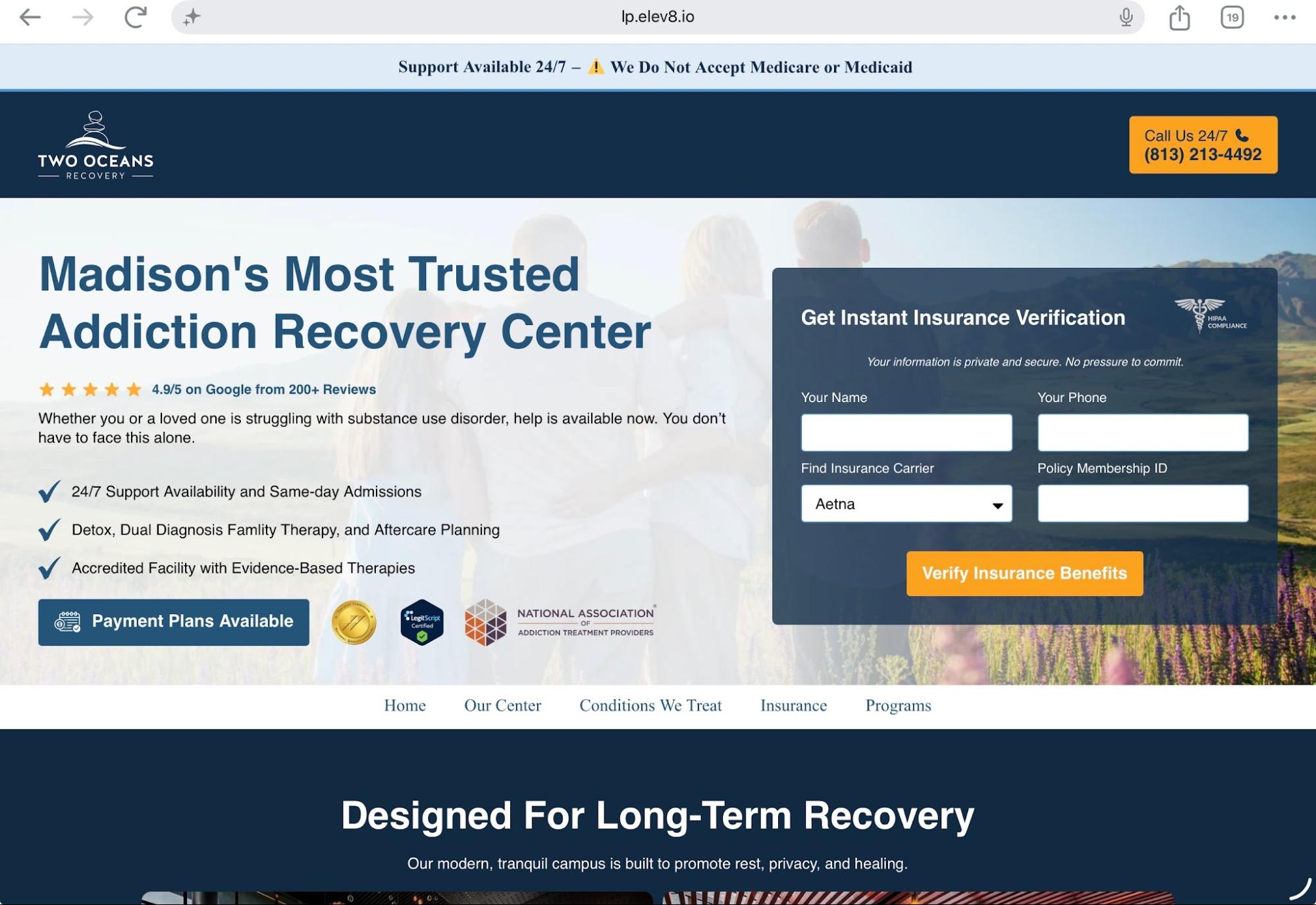
Paid search is not optional infrastructure for most behavioral health organizations, and it is not cheap infrastructure either. Before a facility can run a single Google or Meta ad for addiction treatment services, it needs LegitScript certification, which costs $1,995 a year and takes two to four weeks to complete.1 That is the entry fee, not the ad spend.
On top of that, addiction treatment is one of the most competitive and heavily regulated verticals in paid search.
Across industries, PPC campaigns convert at an average of 3.75 percent, but in the addiction treatment vertical specifically, that number drops to roughly 1.1 percent, well below the category average.2
HubSpot’s 2025 benchmark research puts the average industry-wide cost per lead for PPC at 181 dollars, compared with 31 dollars for SEO, a 5.8x gap.3
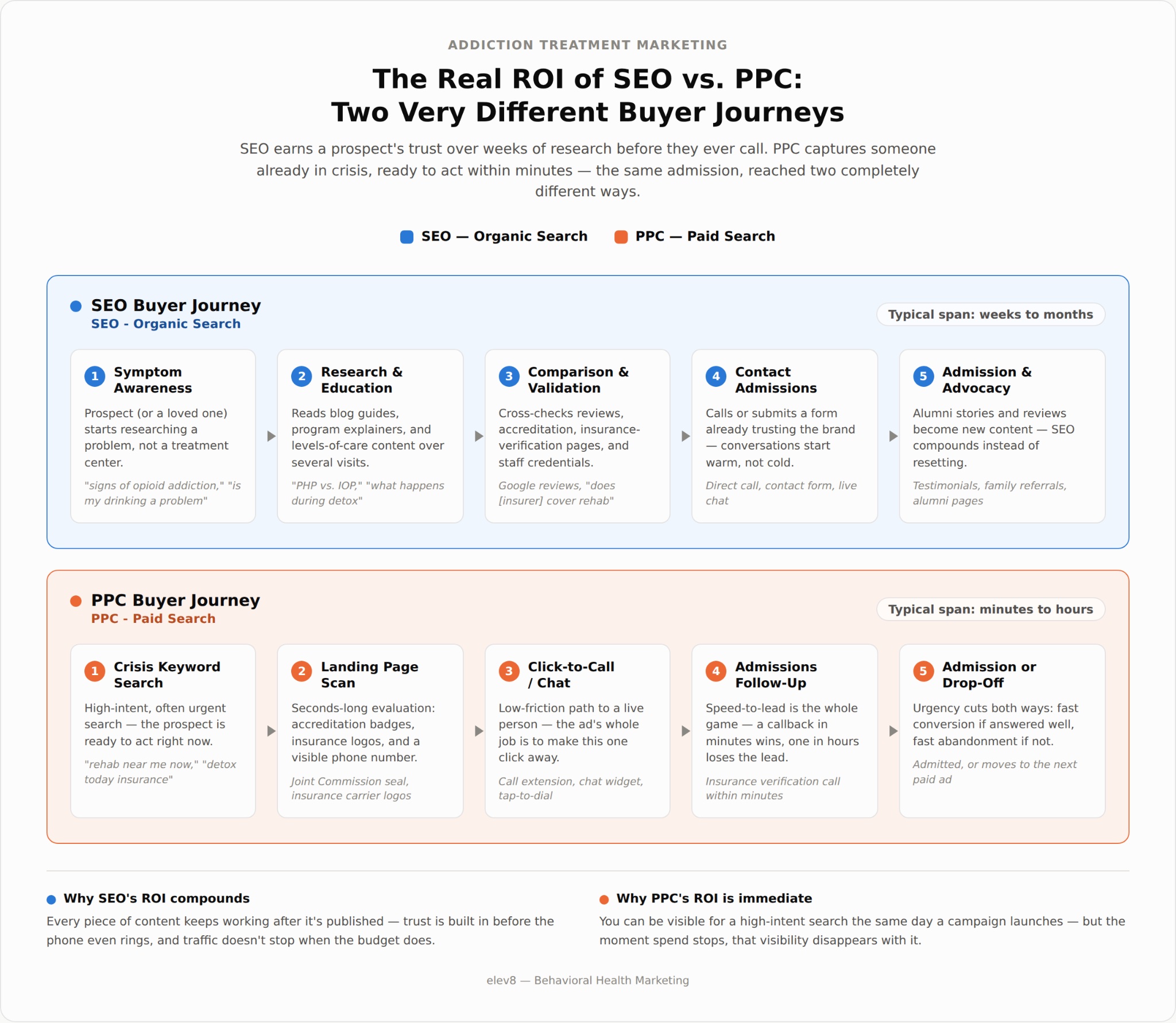
PPC’s advantage is speed. A facility with a census gap this month cannot wait six months for organic rankings to mature, and PPC remains the fastest lever available for filling that gap.
Cost also shifts by level of care. Detox and residential campaigns tend to draw higher bids than outpatient or alumni-facing terms, since the lifetime value of a residential admission is higher and competitors bid accordingly.
A treatment center running PPC across multiple levels of care needs a budget model that reflects those differences, not a single blended cost-per-click target applied evenly across every campaign.
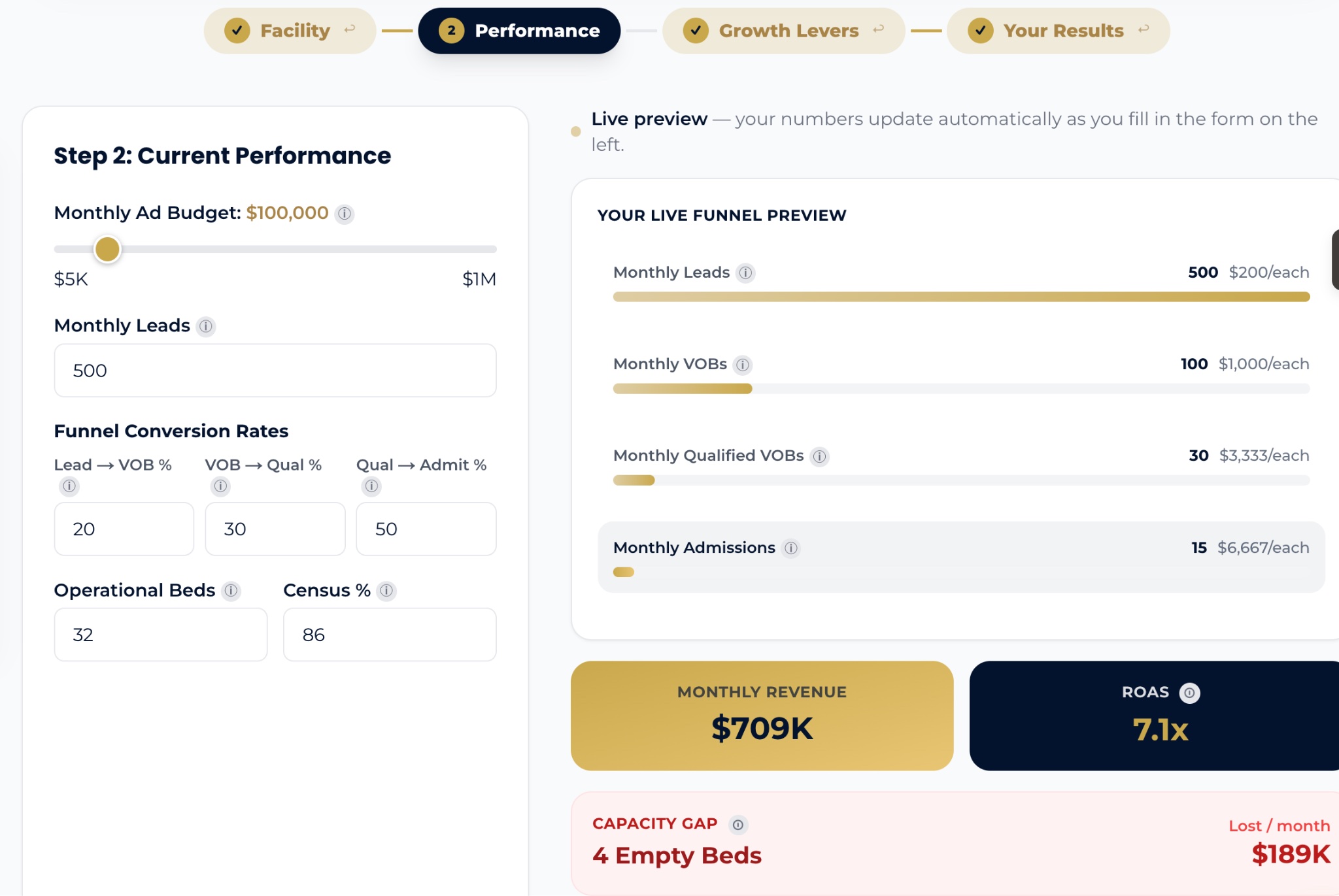
In this anonymized scenario, a treatment center investing $100,000 per month in PPC generates a modeled 7.1x return on ad spend (ROAS) using elev8’s ROI Calculator. The most important variable is not cost per click. It is how many marketing-generated opportunities ultimately become admitted patients.
What SEO Actually Returns Over Time
SEO operates under different rules. In the addiction treatment vertical, organic search converts visitors at roughly 2.1 percent, nearly double the paid search rate.2
Customer acquisition cost tells a similar story: across all industries, SEO-driven acquisition runs close to 300 dollars per customer against roughly 600 dollars for PPC, and broader ROI research puts SEO’s return near 12 dollars for every dollar spent, compared with roughly 2 dollars for PPC.2
The tradeoff is time. SEO is a slow build. The first three months are mostly indexing and early ranking movement with limited return.
Ranking and authority typically strengthen between months three and twelve, and the compounding effect—where content built once keeps producing admissions without new spend—does not fully show up until a facility has consistently invested for a year or more.
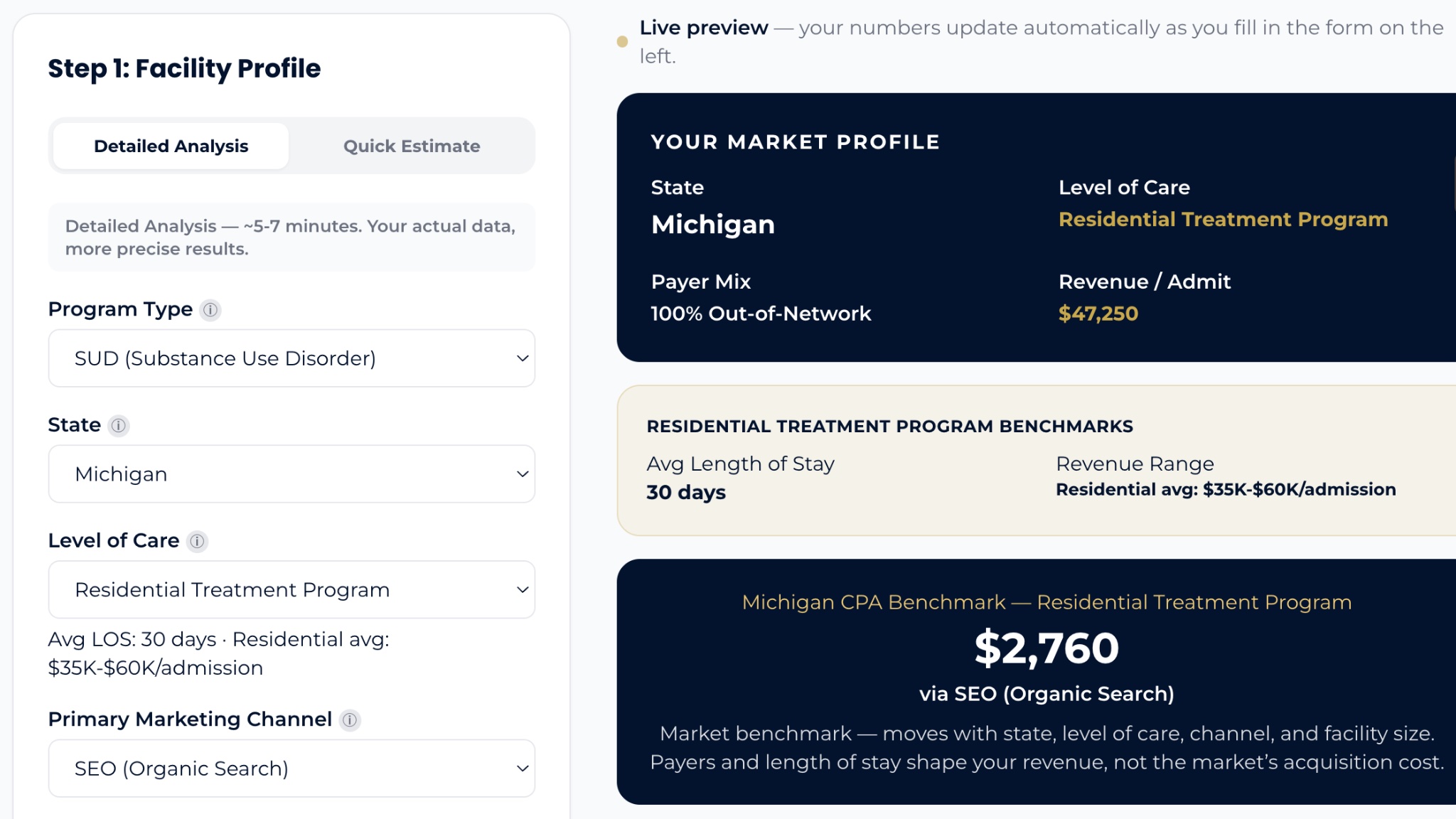
Below is an example of the resulting Cost Per Admit (CPA) from an SEO program.
SEO vs. PPC for Addiction Treatment: Quick Comparison
| Factor | SEO | PPC |
|---|---|---|
| Speed | Slower build | Immediate traffic |
| Typical evaluation period | 6–12+ months | Weeks |
| Cost structure | Compounding investment | Pay per click |
| Best use case | Sustainable patient acquisition | Immediate census needs |
| Main limitation | Time and authority | Budget and compliance |
| Primary KPI | Cost per admission | Cost per admission |
The Market Context That Makes This Math Matter
The stakes behind this comparison are not abstract. An estimated 48.5 million people in the United States met criteria for a substance use disorder in 2023, and only 15.6 percent, about 7.1 million people, received treatment. The remaining 85.4 percent, more than 41 million people, did not.4
That treatment gap is why the SEO versus PPC decision carries real weight. Operators are not just competing with each other for the visible slice of people actively searching for help.
They are also trying to reach a much larger population that may not yet be searching in ways either channel can easily capture. A single-channel strategy leaves both segments underserved.
The Census: The elev8 Newsletter
Join 2,000+ behavioral health leaders. Get notified when we publish new articles — the strategies, data, and insights shaping behavioral health marketing.
2,000+ executives already subscribed
Unsubscribe anytime. Just one newsletter a month — no spam.
The Real ROI Problem Is Attribution, Not Channel Choice
This is where most executives miss the connection. A prospective patient’s family might click a PPC ad on a challenging night, research the center for two weeks through organic search and word of mouth, and then call and ask for the facility by name.
Standard last-click reporting hands that admission entirely to organic or direct traffic, erasing the PPC ad that started the journey.
Without call tracking, CRM integration, and admission-level attribution, an operator cannot actually tell which channel deserves credit, and incomplete data leads to marketing decisions based on that lack of insight. It is a measurement problem, not a marketing problem, solvable with the right tech stack, provided that stack is built with HIPAA-compliant tracking from day one.
In practice, this means dynamic number insertion so every call can be traced to its source, a CRM that logs the full touchpoint history for each admitted patient, and reporting that rolls up to admissions rather than stopping at form fills or calls.
Operators who build this stack before scaling spend and end up with a much clearer picture of which channel, or which combination of channels, produced each admission.
What elev8 Sees Across Behavioral Health Campaigns
Common patterns elev8 sees among its clients include:
- Paid search can reveal high-intent keywords before SEO rankings mature.
- Admissions team performance can materially change reported marketing ROI.
- Poor call handling can make an otherwise strong PPC campaign appear inefficient.
- Branded organic searches may originate from an earlier PPC, referral, or other marketing touchpoint.
- Detox, residential, PHP, IOP, and outpatient programs may have very different acquisition economics.
- Cost per lead alone does not tell executives whether a campaign is profitable.
Building a Budget Around Cost Per Admission
In the behavioral health accounts we see perform best, SEO and PPC rarely operate as completely separate programs. They are sequencing PPC and SEO around a shared measurement system.
PPC generates fast, trackable data on which keywords convert, which ad copy resonates, and which landing pages hold attention, and that data feeds directly into an SEO content strategy built around proven demand instead of guesses.
Over time, SEO absorbs more of the volume PPC used to carry alone, and the blended cost per admission drops. None of this works without attribution tied to the admissions record, not just the marketing dashboard.
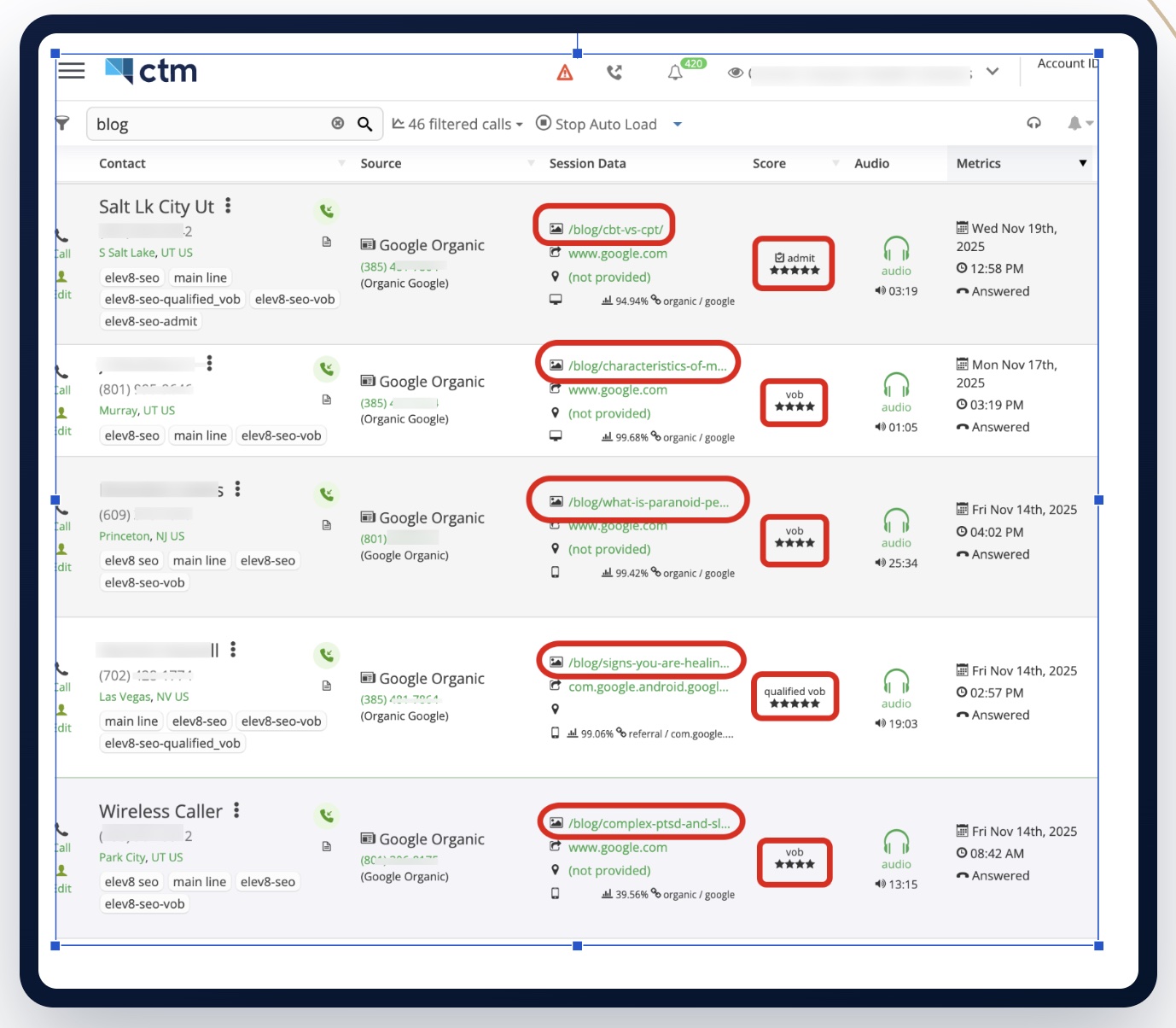
The below screenshot from Call Tracking Metrics shows an example of blog performance scoring and conversion to admissions.
The Bottom Line
SEO and PPC are not competing strategies. They are two different cost structures solving two different timelines, and the only number that tells you whether either one is working is cost per admission, not cost per click or keyword rank.
Behavioral health organizations that measure channels in isolation, without attribution back to the intake record, will continue to make budget decisions based on incomplete information.
The operators winning this year are the ones who built the measurement system first and let the channel mix follow the data.
Frequently Asked Questions
How Long Does SEO Take for an Addiction Treatment Center?
Most SEO programs for addiction treatment should be evaluated over a 6–12 month period rather than a few weeks. Technical improvements and lower-competition keywords can gain traction sooner, but competitive treatment-related searches typically require sustained content, authority, and technical investment.
What Matters More Than Cost Per Lead?
Cost per admission is more useful than cost per lead because not every lead becomes an admitted patient. Treatment centers need attribution that connects the first marketing touchpoint to the intake and admissions record.
Should Treatment Centers Use SEO and PPC Together?
In most cases, yes. PPC can capture immediate demand while SEO builds organic visibility and lowers dependence on paid acquisition over time. The strongest strategy uses both channels within one attribution framework.
Want to Know How Your CPA Stacks Up?
See how your cost per admission compares to other facilities in your market, by channel.
Sources
- LegitScript. (2026). Addiction treatment certification. LegitScript.
- CLICKVISION Digital. (2026). 130+ SEO vs. PPC statistics in 2026: ROI, CR, and traffic.
- HubSpot. (2025). 2025 CPL and CAC benchmarks.
- Substance Abuse and Mental Health Services Administration. (2024). Key substance use and mental health indicators in the United States: Results from the 2023 National Survey on Drug Use and Health. SAMHSA.

VP, Marketing Operations · elev8.io
Elizabeth Navas is VP of Marketing Operations at elev8.io, where she leads the execution and optimization of growth strategies for behavioral health organizations. She oversees the teams, systems, and processes that align marketing, admissions, CRM, and operational performance to help clients achieve sustainable census growth.
Known for her technology-driven and results-oriented approach, Elizabeth specializes in turning strategy into execution, ensuring every initiative is measured, optimized, and aligned with business objectives. Her expertise spans marketing operations, patient acquisition, CRM optimization, reporting, and performance management, helping behavioral health organizations build scalable systems that drive long-term success.