How to Scale a Behavioral Health Center Sustainably
Scaling a behavioral health center is a sequencing problem, not a marketing problem — see what admissions, staffing, and measurement need to look like before you add a location.

Key Takeaways
- Demand is not the bottleneck. Roughly 48.4 million people aged twelve and older had a substance use disorder in the past year, and only about one in five received treatment. Growth stalls on operations, not on whether enough people need care.
- Marketing that outruns admissions capacity backfires. Scaling inquiry volume before scaling intake staffing, verification, and bed management just multiplies the strain on a process that was already stretched.
- The market is fragmented, and that is an advantage for disciplined operators. Industry-wide revenue sits near 5.8 billion dollars, with no operator holding more than five percent of market share, which rewards facilities that systematize ahead of competitors and still run growth by instinct.
- Private equity is already moving. Behavioral health M&A grew 47% year over year through the first three quarters of 2025, and 40 deals closed in H12026. Operators who build operational discipline themselves can compete with consolidators instead of becoming a target.
- Referral relationships belong to people, not organizations. A new location needs a diversified demand engine, organic visibility, portable paid media, and documented referral development in place before it opens, not rebuilt after.
- Attribution has to exist before the second site, not after. Facilities that build channel-level, HIPAA-compliant measurement ahead of a new location typically reach break-even census faster than those that figure out what is working once they are already open.
The Scaling Challenge
It is not on purpose that most behavioral health operators lose control of growth. They add a location, launch a new service line, or push harder on paid media, and within two quarters something breaks.
Admissions coordinators fall behind on callbacks. Clinical staff carry caseloads that were manageable at one site and unmanageable at three. Census climbs for a month and then falls back to where it started.
Scaling a treatment center is not the same problem as scaling a software company or a retail chain. Every additional bed represents a real person in crisis, and every rushed hire touches patient care directly.
Growth that outpaces operational readiness does not just hurt margins. It can compromise the clinical experience that built the facility’s reputation in the first place.
This article covers what elev8 has seen work across multi-site behavioral health operators:
- How to sequence demand generation against clinical capacity
- Why market fragmentation changes the calculus on expansion
- What measurement infrastructure needs to exist before a facility adds a second or third location
Growth Exposes What Admissions Already Knew
The demand side of this equation is not in question. Roughly 48.4 million people aged twelve and older had a substance use disorder in the past year, and only about one in five of them received treatment1.
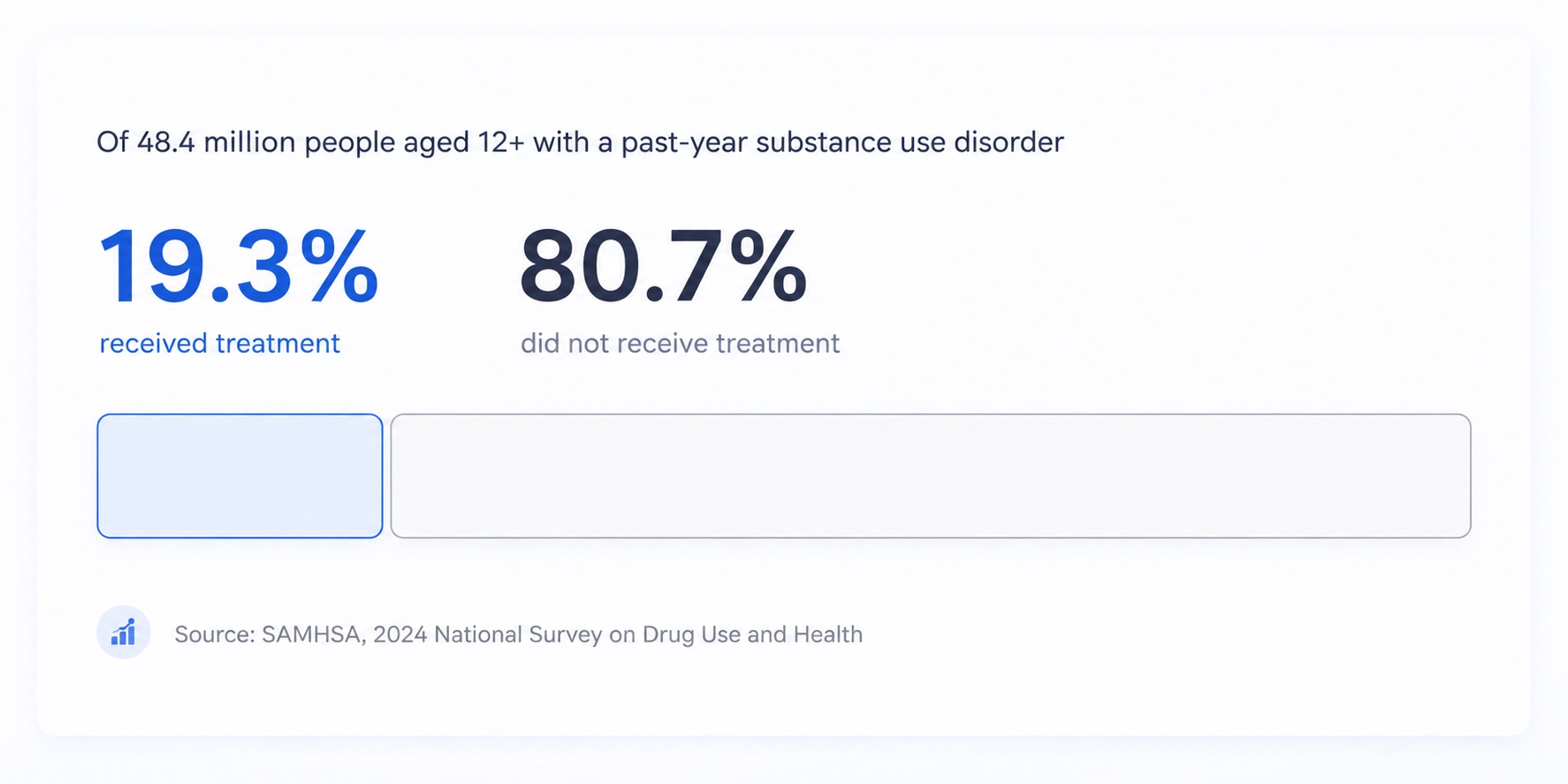
That gap is not closing on its own. For most facilities, the constraint on growth is not whether enough people need care. It is whether the organization can absorb more inquiries without the admissions process buckling.
Marketing systems that generate 50 qualified inquiries a month for one facility can generate 150 for three. If intake staffing, insurance verification, and bed management were already stretched at one site, growth multiplies the strain rather than the revenue.
A facility that scales its marketing before it scales its admissions infrastructure usually sees the same result: response times slip, verification queues back up, and prospective patients drop off before they ever reach clinical intake.
A Fragmented Market Rewards Operators Who Move Deliberately
The addiction treatment segment of behavioral health remains highly fragmented. Industry-wide revenue sits near 5.8 billion dollars, and no single operator holds more than five percent of market share2.
That fragmentation creates an opportunity for operators who systematize their acquisition and admissions processes, allowing them to get ahead of competitors who are still relying on instinct to drive growth.
Private equity has noticed the same opening. Behavioral health mergers and acquisitions grew 47% year over year through the first three quarters of 20253. 40 deals closed in H12026.
Multi-site consolidators are buying the operational discipline that many independent operators lack: standardized admissions workflows, centralized verification, and marketing systems built to scale rather than systems built for a single site.
Operators who build that discipline themselves can compete with acquirers instead of becoming one of their targets.
Build the Demand Engine Before Adding Beds
A common mistake is opening a second location and expecting the first facility’s referral relationships to carry it. Referral relationships are personal. They belong to the clinician or the business development director who built them, not to the organization.
A demand engine that depends on one person’s relationships is not a system. It is a liability with a name attached to it.
Sustainable scaling requires a diversified acquisition mix before a new location opens, not after:
- Organic search visibility built around each market’s actual search behavior
- Paid media that can be turned on and off by location without breaking compliance
- A referral development process that documents relationships rather than relying on memory.
Facilities that build this mix in advance can open a new site and see inquiries within weeks. Facilities that wait spend the first two quarters rebuilding what they should have brought with them.
The Census: The elev8 Newsletter
Join 2,000+ behavioral health leaders. Get notified when we publish new articles — the strategies, data, and insights shaping behavioral health marketing.
2,000+ executives already subscribed
Unsubscribe anytime. Just one newsletter a month — no spam.
Match Admissions Volume to Clinical Throughput
Marketing that outperforms clinical capacity is not a win. It is a scheduling problem that shows up as patient churn. Before increasing spend or launching a new market, an operator should be able to answer a short list of questions with real numbers, not estimates.
- What is current utilization by level of care, and how much true capacity remains?
- What staffing ratios are required to open additional beds safely, and how long does hiring and credentialing actually take?
- What is the average length of stay by program, and how does that affect how quickly beds turn over?
- Which referral sources or campaigns are driving admits to programs that are already at capacity?
Facilities that scale successfully treat marketing spend as a variable tied to bed availability, not a fixed budget line. Such moves may mean shifting spend away from a program at capacity toward one with open beds, even when the first program has better unit economics.
Census growth that respects clinical throughput compounds. Census growth that ignores clinical throughput creates a wait list, and a wait list in behavioral health often results in a lost patient.
Treat Measurement As a Scaling Prerequisite
An operator running one facility can sometimes get by on instinct. An operator running three sites cannot. Multi-site growth requires attribution that ties spend to admits by channel and location, using HIPAA-compliant tracking rather than default analytics settings.
Without it, an operator scaling to a new market is guessing which parts of the marketing mix are portable and which were specific to the first site.
In elev8’s experience working with multi-location clients, facilities that build channel-level attribution before opening a second site typically reach break-even census at the new location faster than those that wait until after launch to figure out what is working4.
Measurement is not a reporting exercise added after the fact. It is part of the infrastructure that makes the next location’s marketing spend efficient from day one.
What Sustainable Scaling Looks Like In Year Two
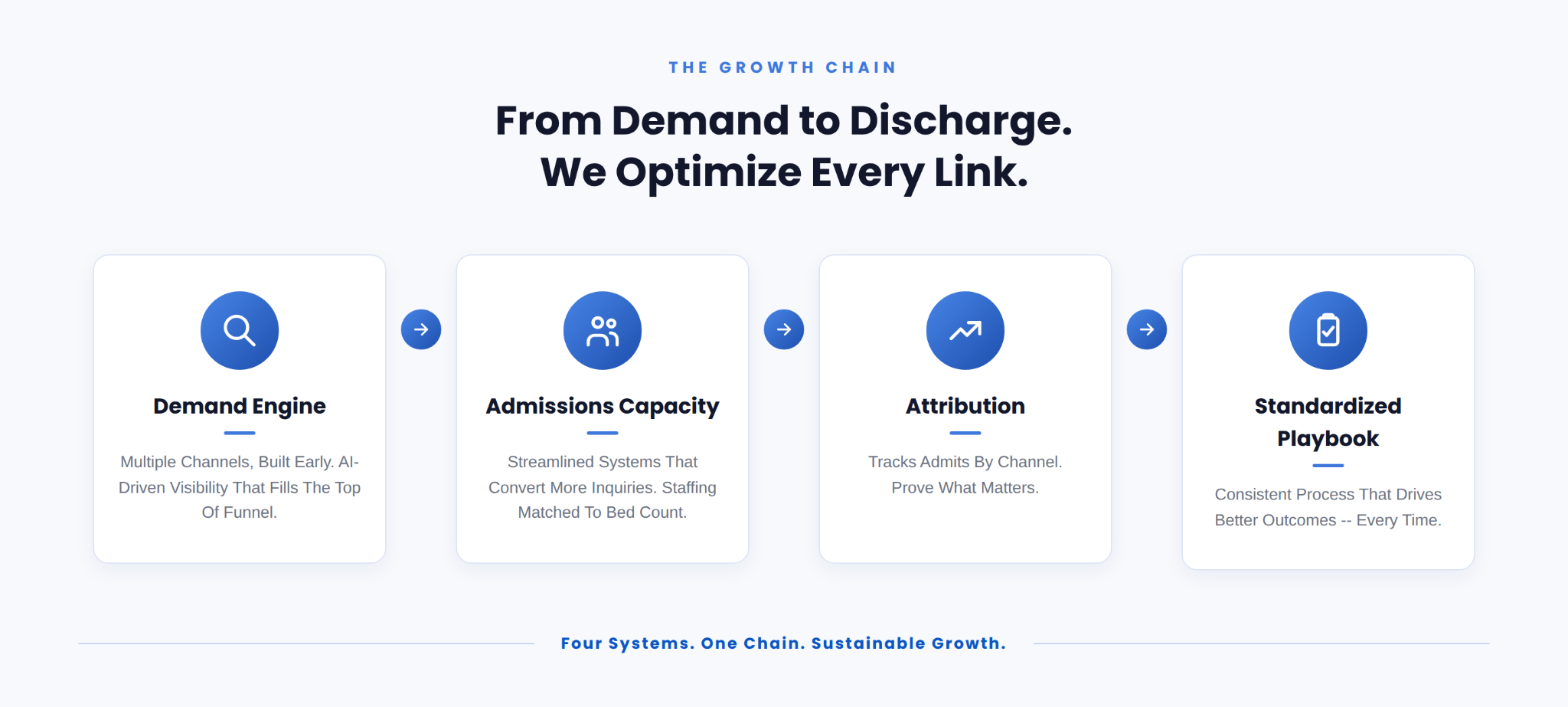
Operators who scale well tend to converge on the same operating pattern. They run one standardized admissions playbook across every location instead of letting each site develop its own process.
They centralize reporting so leadership can see census, utilization, and cost per admit by location in one view rather than reconciling spreadsheets from each facility.
They set staffing plans against census targets a quarter in advance instead of hiring reactively when a unit is already understaffed.
They reassess the acquisition mix by market every quarter, because what works in one region rarely transfers exactly to another.
None of this requires slowing down. It requires sequencing growth so that demand, staffing, and measurement move together instead of one running ahead of the others.
Conclusion
Scaling a behavioral health center sustainably is a sequencing problem before it is a marketing problem. The demand exists, the market is fragmented enough to reward disciplined operators, and the capital entering the space is already betting on consolidation.
What separates operators who scale well from those who stall is whether admissions capacity, staffing, and measurement are built out ahead of growth rather than patched together after it.
A facility that gets this sequence right can add locations without diluting the quality of care that made the first one work.
Sources
- Substance Abuse and Mental Health Services Administration. (2025). Key substance use and mental health indicators in the United States: Results from the 2024 National Survey on Drug Use and Health. samhsa.gov
- IBISWorld. (2026). Drug & alcohol rehabilitation clinics in the US: Market size statistics. ibisworld.com
- Acuity News. (2026). Why private equity is betting big on behavioral health in 2026. acuity.news
- elev8. (2026). Internal client performance data. elev8.io
What Would a Second Location Actually Return?
Run your facility’s numbers through elev8’s ROI Calculator to see projected admissions, revenue, and ROAS before you commit to expansion.

Head of Growth · elev8.io
Freddie Francis is Head of Growth at elev8.io, where he partners with behavioral health executives and industry leaders to uncover growth opportunities across the entire patient journey—from lead generation and admissions enablement to CRM optimization, operational efficiency, and long-term census growth.
Freddie holds nearly a decade in marketing and new business development, and has been focused on behavioral health since 2022 — four years — improving how clients leverage data-driven approaches to build predictable growth systems while improving the experience for both patients and admissions teams in behavioral healthcare organizations.
Freddie shares insights on patient acquisition, admissions performance, behavioral health marketing, AI-enabled growth systems, and revenue operations.