What the $1.6B Treatment Fraud Case Means for Ethical Treatment Center Marketing
The $1.6B treatment fraud case puts marketing under scrutiny. See what it alleges and what ethical treatment centers should review in vendor and lead practices.
Key Takeaways
- With more than $1.6 billion in alleged false claims, Federal prosecutors described the October 2026 Los Angeles case as the largest substance abuse treatment fraud scheme they have prosecuted1.
- The focus is on paid patient recruitment. An ancillary guilty plea is for a “marketing services” contract paid by patient count and insurance coverage1.
- The challenge for ethical facilities is that even when their practices are sound, there may be more attention by insurers and regulators on lead sources, vendor contracts, and verification.
- The best solution is marketing programs that show where each admit came from, making them easier to defend.
- Alumni and referral relationships leave a clear, consent-based record that supports reviews, referrals, and readmission when additional care is needed.
On October 22, 2026, the Justice Department announced charges in what it calls the largest fraud scheme related to substance abuse treatment that it has ever prosecuted. The indictment alleges more than $1.6 billion in false claims billed to commercial insurers1, 2. As of this writing, only one of five defendants had entered pleas, and an indictment is only an allegation.
For treatment center operators, the case raises an immediate question: Could your marketing agreements, lead sources, and admissions records withstand the same scrutiny? While the case involves a small group of defendants, the scrutiny from regulators and referral partners that follows may affect every treatment center.
The allegations may motivate insurers and referral partners to look at how treatment centers recruit patients and compensate marketing vendors. The challenge is for facilities to clearly show how they get patients, who the patient pays, if at all, and what promises the facility makes.
In this article, we review the allegations and how marketing is relevant to them. Then we propose recommendations for ethical operators to review.
What Prosecutors Allege
The defendants allegedly received more than $210 million in payments between May 2020 and May 2026 from billing $1,619,276,243 in false claims to commercial insurers3.
$210 million in payments between May 2020 and May 2026 from billing $1,619,276,243 in false claims
According to prosecutors, David and Nathan Young, father and son, controlled dozens of supposed treatment companies. They hired and directed body brokers to recruit people who were either unhoused, in poverty, or attending support groups1.
The brokers engaged in several illegal practices and allegedly looked for patients whose policies paid the highest reimbursements. In some cases, they enrolled them in policies for which they were not eligible1.
The indictment describes inducements that included free flights, cash, apartments, hotel stays, cars, gift cards, and drugs. It describes “therapy” that was offered, consisting of Zoom sessions with more than 100 attendees, in which patients only had to turn on their cameras. Patients were cut off from family according to the allegation. It also states that patients were physically blocked from leaving the facility so that billing could continue1.
18 of the 20 California locations also had different nominal owners tied to shell companies, according to the DOJ. This made it difficult for insurers to see that the claims came from one source3.
Nicholas Moore, a fifth defendant, managed several of the facilities. He has pleaded guilty to conspiracy to commit health care fraud and wire fraud. He admitted to helping submit $199 million in fraudulent claims1, 4.
The Impact on Marketing
There was a direct connection to marketing. Patient recruitment was central to the alleged scheme, and the charges include conspiracy to violate the Eliminating Kickbacks in Recovery Act (EKRA)1. Body brokers are a core element in the Young case.
Thomas Steven Mladinich, one of the body brokers, acknowledged he received illegal kickbacks for referring patients to a licensed rehabilitation facility. He and the facility owner signed a contract for “marketing services,” yet payment was based on the number of patients referred and their insurance coverage. Required to stay for at least 21 days before leaving, many patients left on day 21, against medical advice1.
Many legitimate marketing agreements use similar language that pays for work, such as placing ads, building web pages, answering calls, and completing admissions. However, regulators may view things differently when pay increases with each patient and with the patient’s insurance. Marketers should avoid any compensation structure that looks like body brokering, or else have it reviewed by counsel.
What Ethical Operators Should Expect
In June, before this case was announced, the DOJ filed charges in 39 cases of suspected behavioral health billing fraud. Addiction treatment providers accounted for 68.7% of the suspected fraud in those cases3.
Whether insurers introduce additional restrictions remains to be seen. Treatment centers should nevertheless be prepared to document their marketing arrangements, patient acquisition practices, and billing records.
Marvin Ventrell, CEO of the National Association of Addiction Treatment Providers (NAATP), has warned against that approach. He says restricting care as the answer to fraud is not an appropriate response, because broad cuts and restrictive utilization management would punish ethical providers and the patients they serve5.
Providers who meet a verified standard of ethics and quality should be recognized by insurers. For example, NAATP’s Code of Ethics prohibits patient brokering, paying for referrals, buying and selling patient leads, offering inducements to prospective patients, and misleading advertising5.
An ethics policy is a starting point. Operators should also be able to produce vendor agreements, identify lead sources, and explain how prospective patients reach their admissions teams.
Gary Garth, Founder & CEO of elev8.io, noted,
”The $1.6 billion figure is staggering, but unfortunately, I suspect it’s only the tip of the iceberg.
What’s most troubling isn’t just the financial fraud. It’s the damage these bad actors inflict on the entire behavioral healthcare system. They erode trust, contribute to greater scrutiny and reimbursement pressures, and ultimately make it harder for legitimate providers to deliver care to people who desperately need it.
That’s one of the reasons I entered this industry and founded elev8. We want to level the playing field by helping ethical, outcomes-driven treatment providers compete effectively, grow sustainably, and expand access to quality care.
The industry doesn’t need more aggressive patient brokers. It needs greater accountability, transparent marketing practices, and a stronger commitment to patient outcomes.
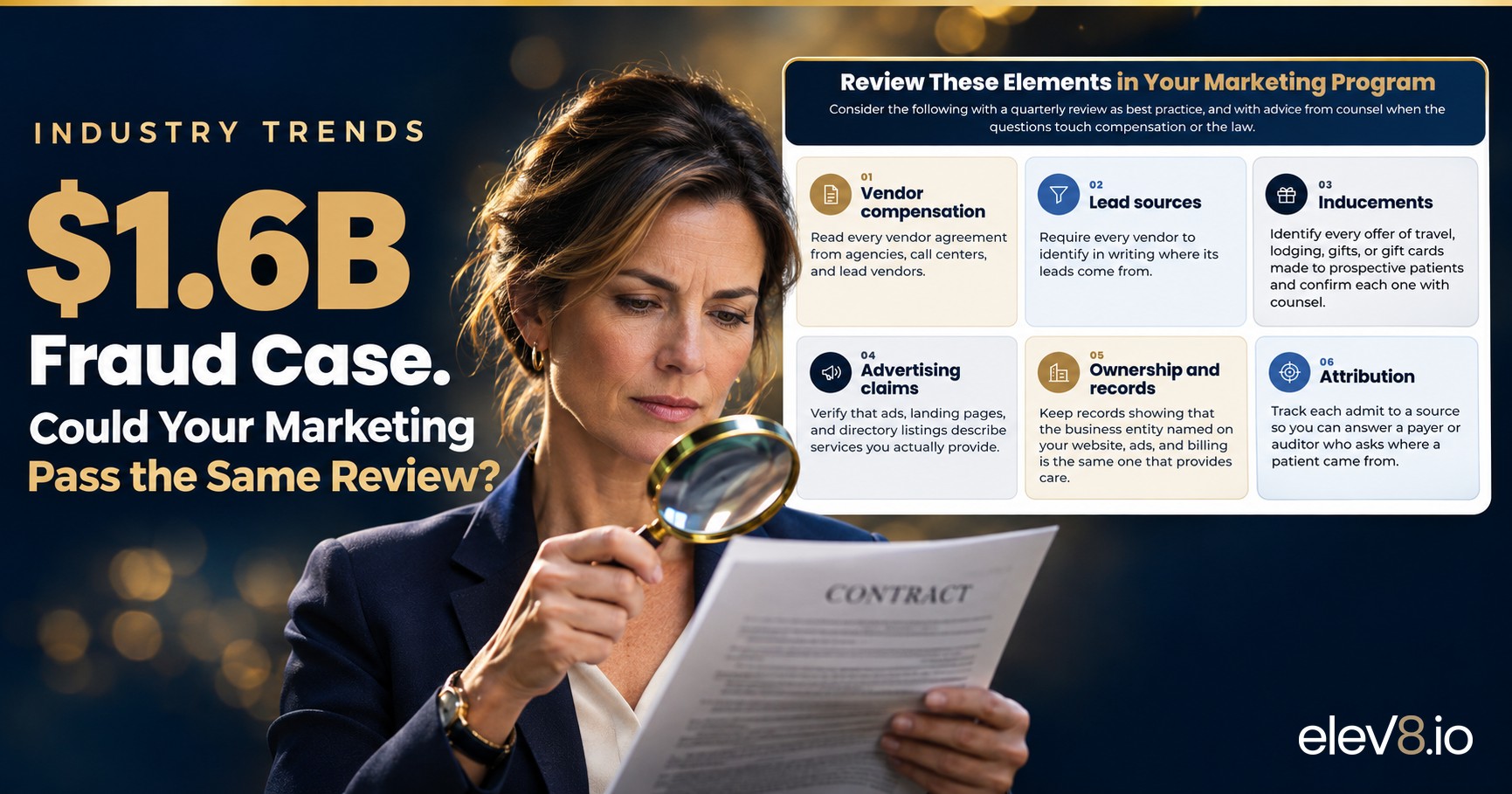
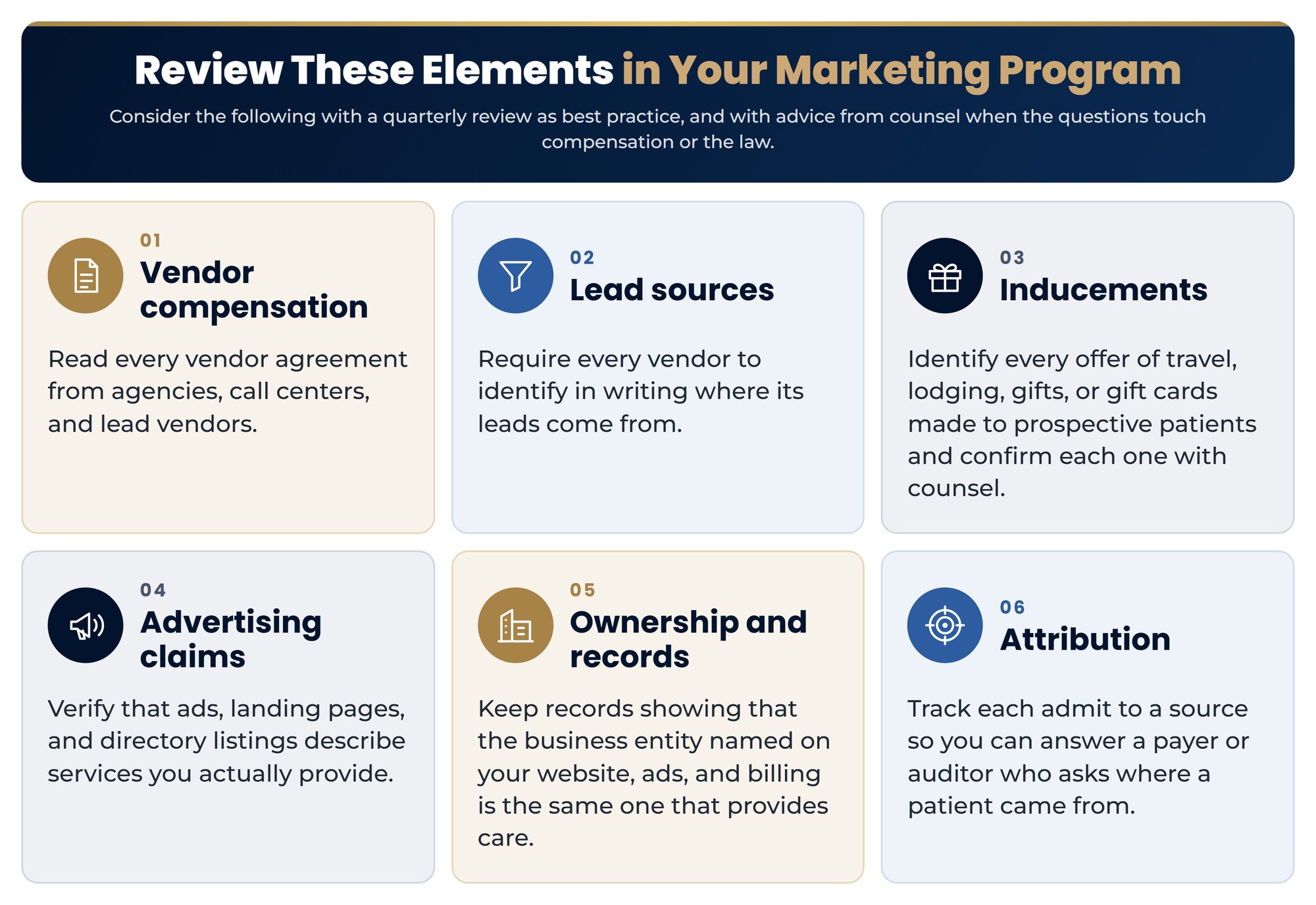
Review These Elements in Your Marketing Program
Consider the following with a quarterly review as best practice, and with advice from counsel when the questions touch compensation or the law.
- Vendor compensation. Read every vendor agreement from agencies, call centers, and lead vendors. Scrutinize any payment that increases with each patient, each admit, or the patient’s insurance plan and have counsel review them.
- Lead sources. The NAATP Code prohibits buying and selling patient leads5. Require every vendor to identify in writing where its leads come from.
- Inducements. Identify every offer of travel, lodging, gifts, or gift cards made to prospective patients and confirm each one with counsel.
- Advertising claims. Verify that ads, landing pages, and directory listings describe services you actually provide. No outcome promises and no insurance guarantees may be made.
- Ownership and records. Keep records showing that the business entity named on your website, ads, and billing is the same one that provides care.
- Attribution. Knowing the source of each admit is essential. Track each admit to a source so you can answer a payer or auditor who asks where a patient came from. A useful attribution record should contain the originating channel, referring organization where applicable, inquiry date, and relevant vendor or campaign.
Developing Demand You Can Trace
Paid advertising and SEO aren’t going away. But facilities should also invest in relationships with alumni and established referral partners. With appropriate consent and record keeping, these programs can make referral activity easier to document. Recruiting with a plane ticket or payment per head violates ethical rules of conduct.
This is one of the reasons we developed the e8 Alumni Advocacy System. It gives treatment centers a way to organize alumni outreach, maintain engagement records, and manage ongoing relationships by combining
- A white-labeled alumni app (oneway) under your brand
- A branded Alumni Planner with QR codes that connect to your app
- The e8 Platform your coordinator uses to run follow-ups, outreach, events, newsletters, and engagement tracking.
It supports three outcomes we call the three R’s: reviews, referrals, and readmission when additional care is needed. Results vary by facility, and we do not promise admissions.
We advise clients to keep alumni referral programs free of payments, gifts that exceed legislated guidelines, or rewards tied to admissions, and to confirm the program design with counsel.
The Census: The elev8 Newsletter
Join 2,000+ behavioral health leaders. Get notified when we publish new articles — the strategies, data, and insights shaping behavioral health marketing.
2,000+ executives already subscribed
Unsubscribe anytime. Just one newsletter a month — no spam.
Conclusion
The Young case will be decided in court. For treatment center operators, however, it raises questions worth addressing now.
The practical question for operators is straightforward: If an insurer or regulator requested your marketing agreements and patient acquisition records tomorrow, what could you produce?
Could you identify the source of every patient inquiry? Do your vendor agreements clearly describe the services being purchased and how compensation is determined? Can you substantiate the claims made in your advertising?
These are not questions that should require weeks of reconstructing records.
Facilities that maintain clear agreements, reliable attribution records, and well-documented referral relationships will be better prepared to explain their practices when questions arise.
A useful attribution record should contain:
- The originating channel
- Referring organization where applicable
- Inquiry date
- Relevant vendor or campaign.
As Gary Garth of elev8 noted, “Ultimately, the industry must do more than prevent fraudulent patient recruitment. It must create an environment where ethical, outcomes-driven treatment providers can thrive and where patients can access appropriate care without being exploited by those who prioritize reimbursement over recovery”.
At elev8, we help treatment centers strengthen lead attribution and develop alumni and referral programs that support ongoing relationships without relying on admission-based incentives.
The goal is straightforward: know how patients find your facility, understand how your marketing partners operate, and keep the records needed to demonstrate both.
The elev8 Alumni Planner™
Check out our customized Alumni Planner and ask elev8 how to build an alumni engagement program that supports census.
Sources
- U.S. Department of Justice, Office of Public Affairs. (2026, October 22). Los Angeles health care fraud takedown results in charges against 15 defendants, including 6 medical professionals, nearly $2 billion in loss [Press release].
- U.S. Department of Health and Human Services, Office of Inspector General. (2026, October 22). Los Angeles health care fraud takedown results in charges against 15 defendants, including 6 medical professionals, nearly $2 billion in loss.
- Hollowell, A. (2026, October 23). DOJ charges sham SUD network in $1.6B fraud scheme. Behavioral Health Business.
- Ruder, E. (2026, October 23). 4 charged in $1.6B California SUD treatment fraud case: Justice Department. Becker’s Behavioral Health.
- National Association of Addiction Treatment Providers. (2026, October 27). NAATP horrified by record fraud case, distinguishes excellent care from bad actors, and encourages systemic safeguards [Press release].

Founder & CEO · elev8.io
Gary Garth is the Founder & CEO of elev8.io, where he helps behavioral health organizations achieve full census through integrated marketing, admissions, and technology-driven growth systems.
With more than a decade of experience working alongside Google, Microsoft, and high-growth technology companies, Gary has built and implemented scalable growth frameworks now used by 45+ treatment centers across the United States to drive admissions and operational efficiency.
As a speaker, Gary focuses on the intersection of patient acquisition, AI-driven search, and admissions performance, helping founders, operators, and investors identify the hidden bottlenecks limiting growth—and how to fix them.
The author of The Zero to 100 Million Sales Blueprint and The Goals, Grit & Greatness Planner™, Gary is driven by a mission to close the gap between the millions of people struggling with addiction and mental health and the care they need.
The State of Behavioral Health in 2026: More Demand. Less Capacity. Higher Stakes.
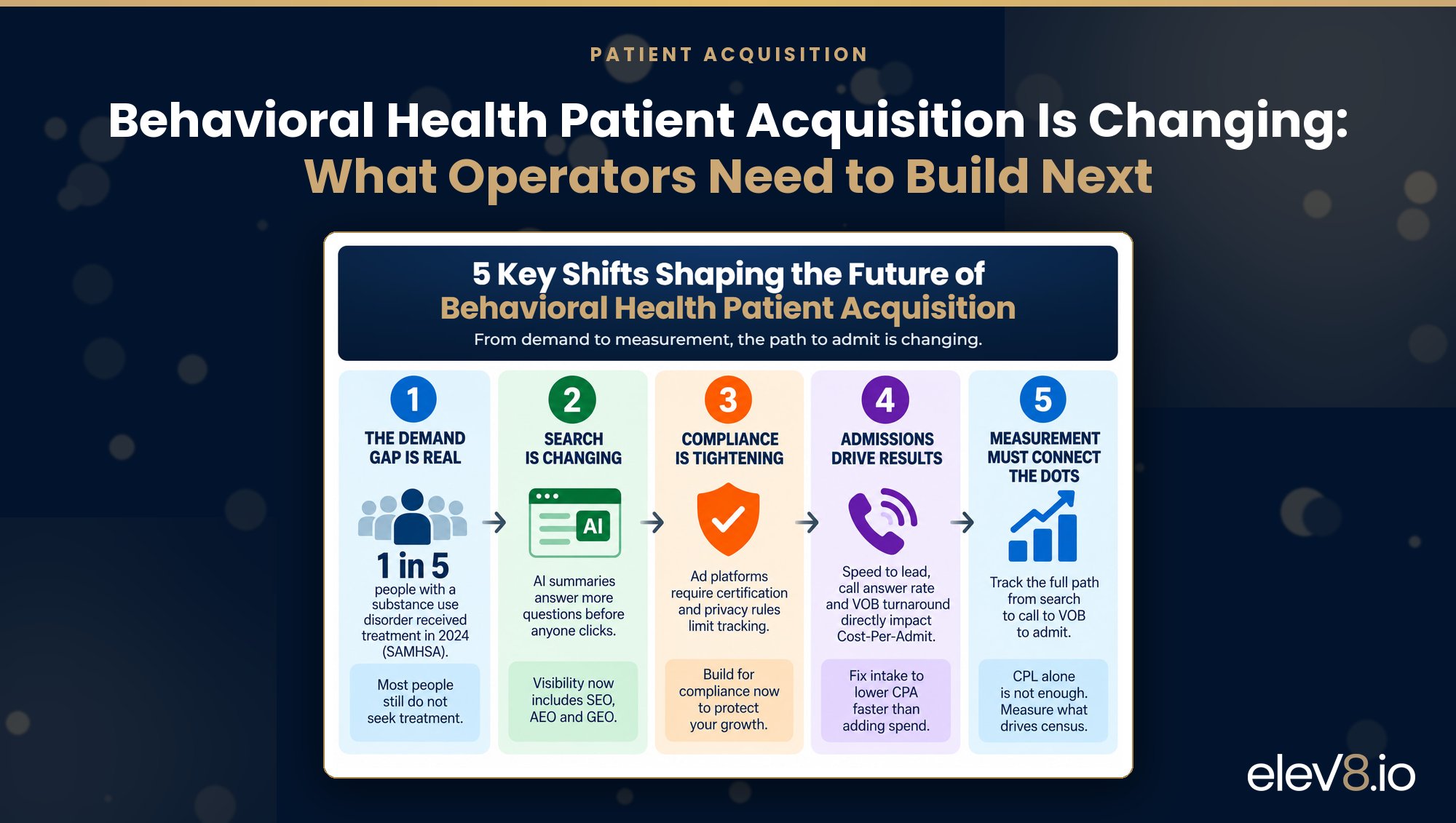
Behavioral Health Patient Acquisition Is Changing: What Operators Need to Build Next