How CEOs Should Think About Patient Acquisition in 2026
Demand is not the problem — systems are. How behavioral health CEOs should treat patient acquisition as a coordinated, accountable system in 2026, not a list of disconnected marketing activities.
Key Takeaways
- The gap between demand and census is a systems problem that sits in the CEO’s seat — not a clinical or marketing-department problem.
- A real patient acquisition system connects demand generation, conversion infrastructure, and attribution so every channel reports to one outcome: verified admissions.
- The three failure points are channel concentration, the admissions gap, and attribution blind spots — and they show up in that order.
- Measure cost-per-admit and revenue-per-admit, not clicks or leads; the difference between cost-per-lead and cost-per-admit is where census falls apart.
- Census is the primary driver of enterprise value, which makes patient acquisition an executive competency, not a back-office function.
The demand is not the problem. Roughly 80% of people who needed treatment for a substance use disorder in 2024 did not get care1. An estimated 61.5 million Americans — about 1 in 4 adults — experienced some form of mental illness in 2024, and 48.4 million people aged 12 and older met criteria for a substance use disorder1.
The market is enormous. The need is unambiguous. And yet most treatment facilities are not running at capacity. The gap between demand and census is not a clinical problem. It is a patient acquisition problem — more specifically, a systems problem — and it sits squarely in the CEO’s seat.
Most operators elev8 encounters have a collection of marketing activities: a website, an SEO vendor, a PPC account, and maybe a business development team to cultivate reciprocal and non-reciprocal partnerships. What they do not have is a coordinated patient acquisition system.
In a real system, every channel feeds the same funnel, every lead is tracked to an outcome, and the executive team can look at a number and know whether census will be up or down next month.
2026 will separate facilities with systems from those still running on activity. Here is how CEOs should be thinking about it.
The Market Context CEOs Need to Understand First
Before building a patient acquisition strategy, you need an accurate read on the environment you are operating in. Three structural shifts define the 2026 market.
Demand Is High, but Treatment Utilization Is Falling
Past-year substance use disorder remained roughly constant at 16.8% of the population — about 48.4 million people — yet fewer people received substance use treatment in 2024 (10.2 million, or 3.5%) compared to 13.1 million in 20231.
That is not a population getting healthier. That is a population losing the pathway to care.
There were also 3 million fewer adults and 300,000 fewer adolescents who received any mental health treatment in 2024 compared to 2023. The treatment gap is widening2. For well-run facilities with a functioning acquisition system, that represents a growth opportunity. For facilities lacking one, it signals ongoing census pressure with no natural relief.
The Competitive Environment Is Not Getting Easier
The U.S. behavioral health market was valued at approximately $96.9 billion in 2025 and is projected to reach $159.35 billion by 2035, expanding at a compound annual growth rate of 5.1%3.
Private equity continues to consolidate the space. Multi-site operators with capital and infrastructure are investing heavily in digital channels. That raises the cost of visibility and intensifies competition for every qualified lead4.
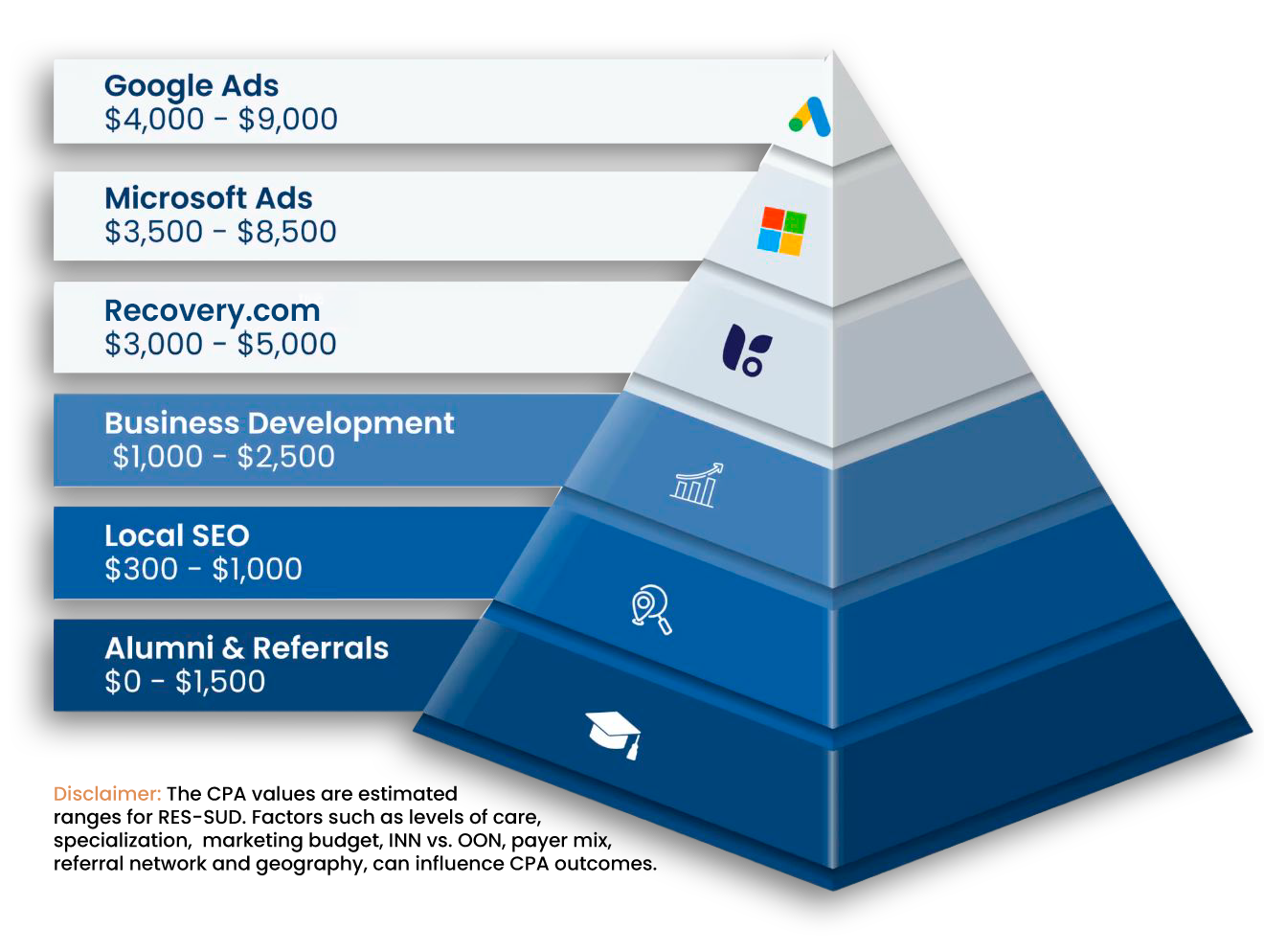
Patient acquisition costs in behavioral health are 30–40% higher than just a few years ago. Depending on payer mix and region, they can vary from a few thousand dollars to upward of $10,000 for out-of-network California facilities — and that figure assumes you are measuring correctly5. Most facilities are not.
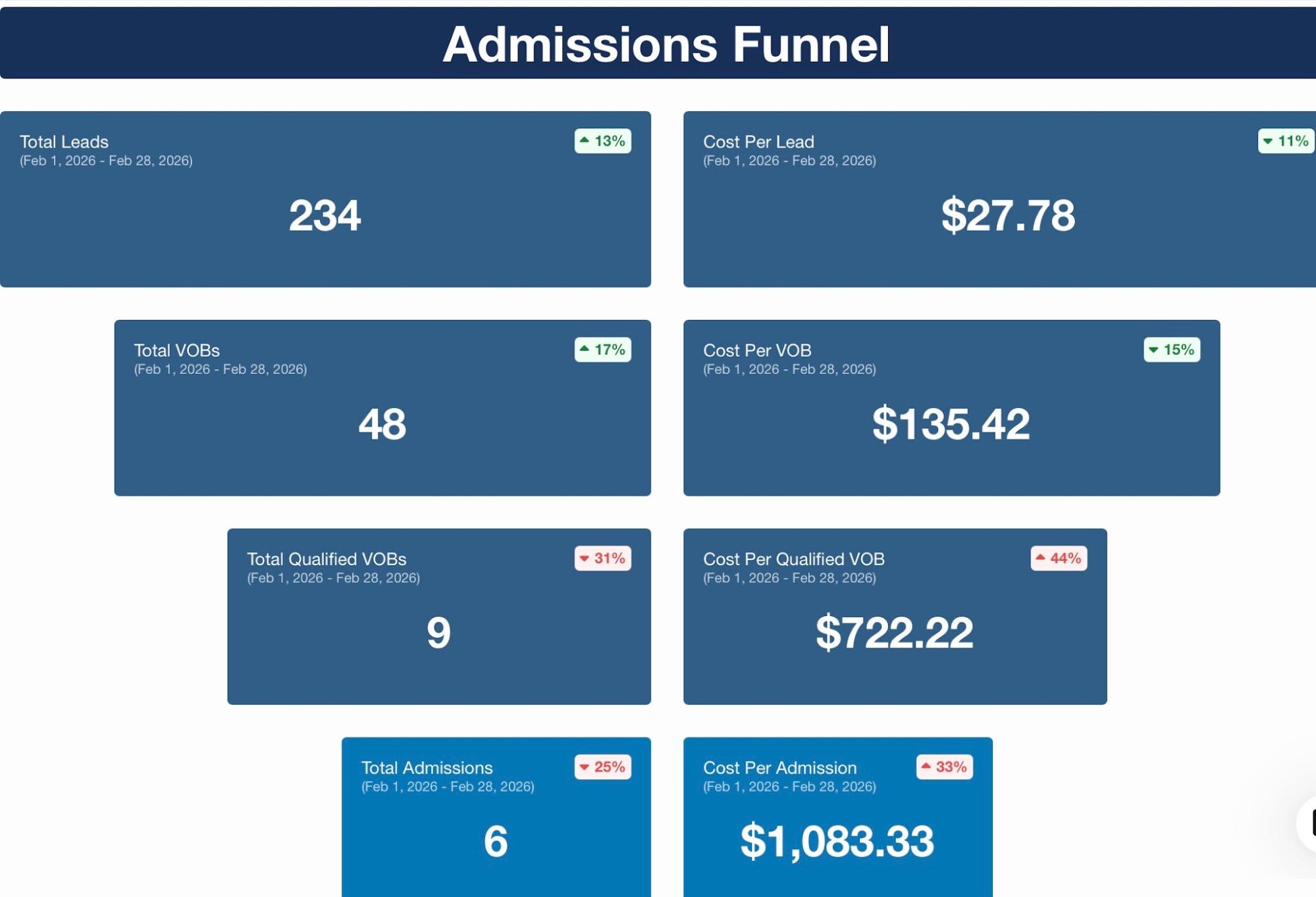
They track cost per click or cost per lead, not cost-per-VOB, cost-per-viable-VOB, and cost-per-admit. The difference between those numbers is exactly where the census falls apart.
The dashboard below shows how elev8 helps behavioral health facilities understand their funnel across every channel and focus on the metrics that truly matter from a patient acquisition standpoint.
The Search Environment Has Changed Structurally
Patients now get a significant portion of their information directly from Google’s AI Overviews. Nearly 60% of U.S. searches end without a click to any website, as AI-generated answer boxes on tools such as ChatGPT, Perplexity, Copilot, Gemini, and Claude surface more information at the top of results6.
Facilities that built their acquisition strategy entirely on organic traffic from traditional SEO are seeing that traffic erode. Search is still critical — but what it takes to win in search has changed.
The facilities capturing intent in 2026 are the ones building authoritative, structured content that gets cited by AI systems, not just indexed by crawlers7.
What a Patient Acquisition System Actually Is
Most CEOs in this industry have been sold a version of patient acquisition that looks like a channel list: SEO, PPC, social, referrals. That framing produces fragmented activity, not outcomes. A patient acquisition system is something different.
A system connects three layers, and every component has to function and feed the next one: demand generation (awareness, search visibility, referral outreach), conversion infrastructure (admissions processes, call handling, lead response time), and attribution (the ability to trace a specific admit back to a specific channel and a specific spend).
When elev8 audits a facility’s acquisition operation, we typically find the same failure points in the same order.
The image below shows a snapshot of elev8’s dashboards focused on the key conversion metrics inside an admissions funnel — the kind of view that requires close collaboration between Marketing and Admissions to optimize effectively.

Demand generation, conversion infrastructure, and attribution are not three projects. They are one system — and a CEO is the only person positioned to make them report to a single outcome.
Is your growth engineered—or accidental?
We map your channels, admissions funnel, and attribution against the metrics that actually move census.
The Four Decisions That Determine Your Census in 2026
elev8’s experience working with facilities across the U.S. highlights four strategic decisions that separate facilities running at capacity from those perpetually chasing census.
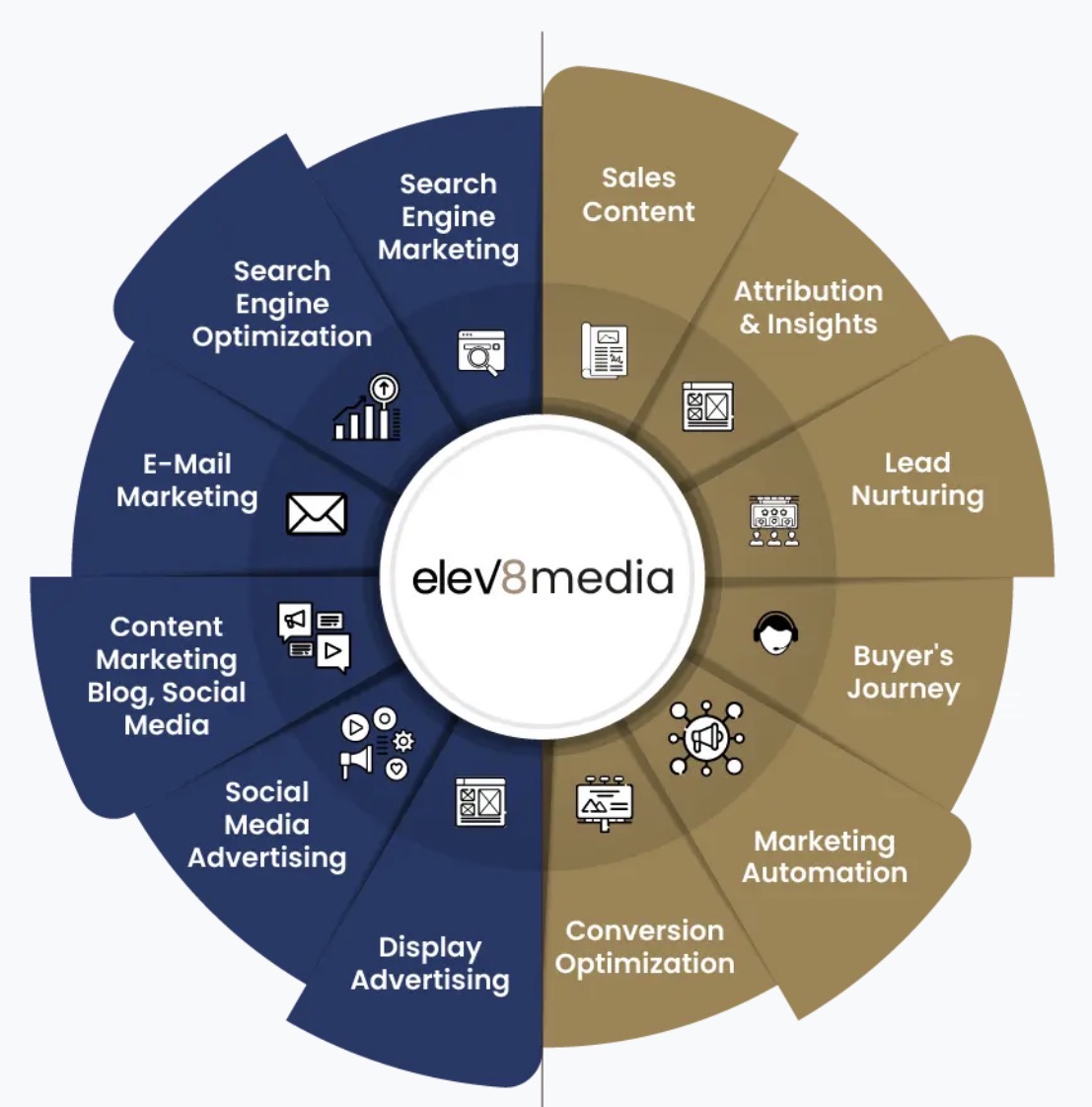
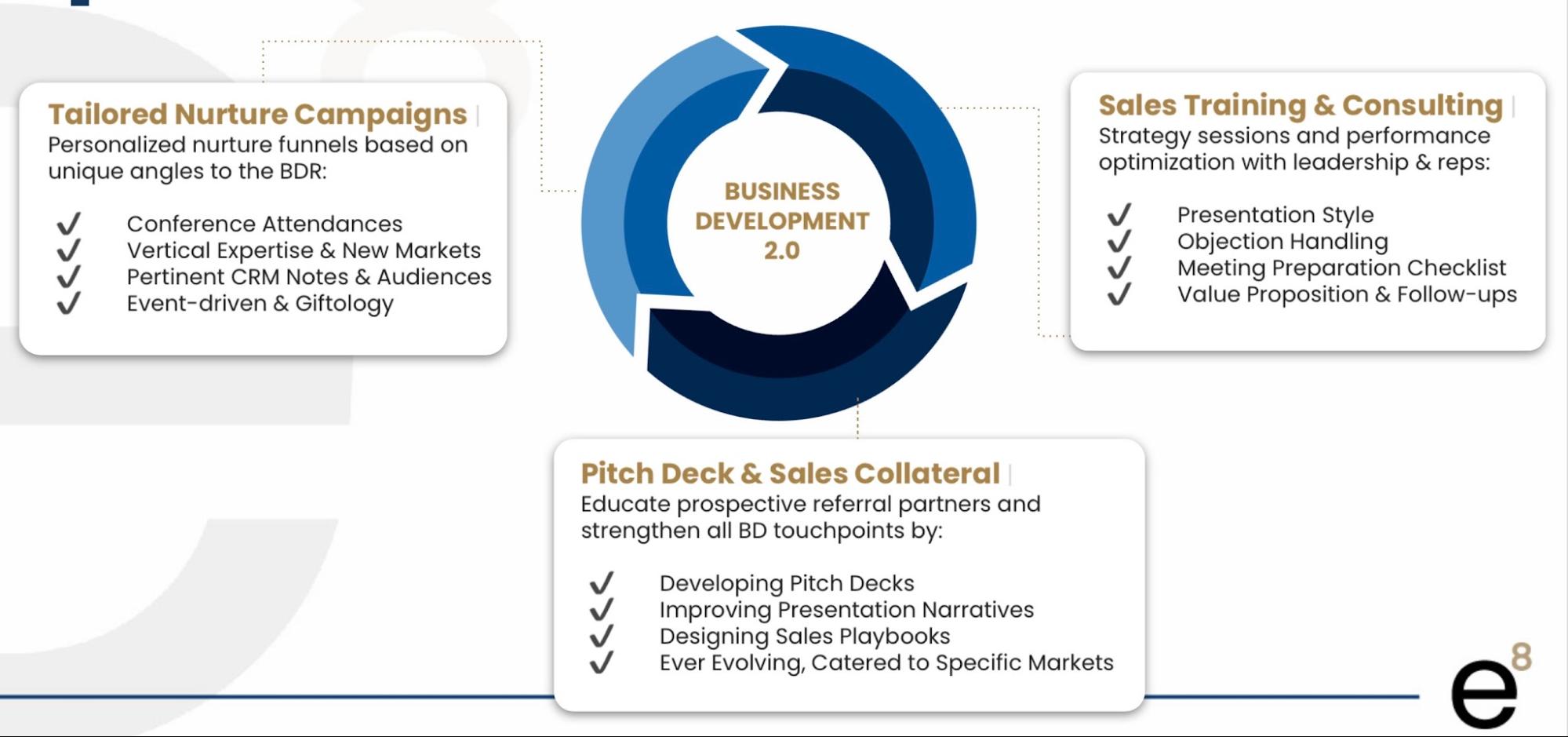
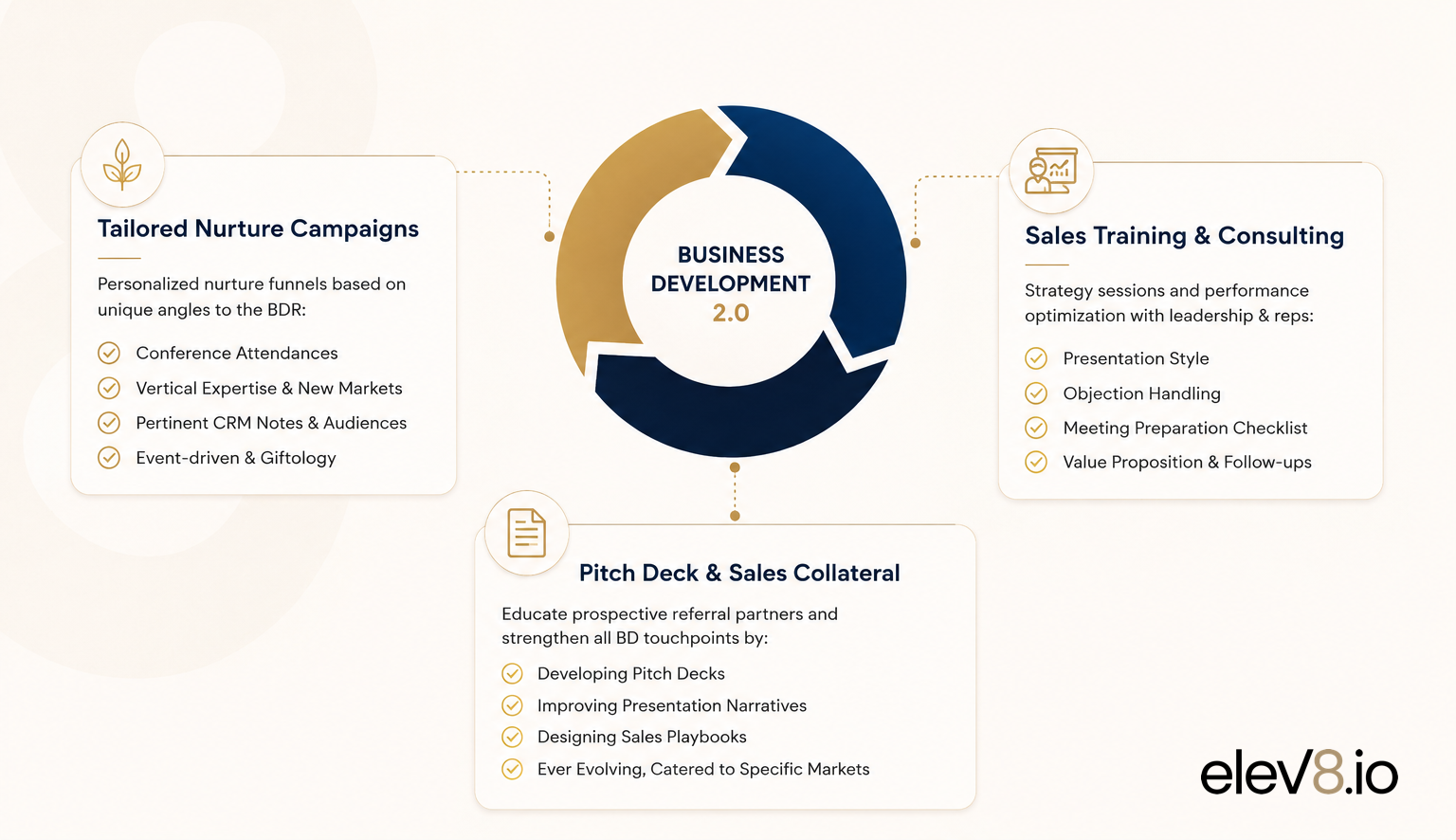
The elev8 Business Development Model
Today’s leading facilities treat business development and marketing as a uniform, collaborative ‘Smarketing’ strategy. The elements complement one another instead of cannibalizing resources and negatively impacting outcomes.
A patient acquisition journey often requires multiple touchpoints. Attribution should never be isolated — it should distribute weight among all contributing touchpoints.
What elev8 Builds — and Why It Works
elev8 does not sell channels. We build patient acquisition systems for behavioral health facilities, and elev8.io focuses on the metrics that actually impact growth. That distinction matters because channels generate activity while systems produce census.
Our work starts with an audit of the existing marketing stack, the admissions funnel, the attribution infrastructure, and the competitive landscape. We do not assume we know your problems before we look at your data. What we find in that audit determines what we build.
From there, we integrate SEO and AEO, paid media, referral development, and admissions consulting into a single system with unified attribution. Every channel we manage reports to the same outcome metric: verified admissions. We help facilities understand their true cost per admit by channel, optimize spend toward the channels producing the highest-value admits, and fix the conversion infrastructure issues that leak qualified leads before they ever reach a bed.
We work exclusively in behavioral health — LegitScript certification requirements, Google’s healthcare advertising policies, HIPAA-compliant tracking architecture, and the specific conversion dynamics of a family in crisis evaluating options under time pressure. That context does not come from a general-purpose agency that picked up a few behavioral health clients.
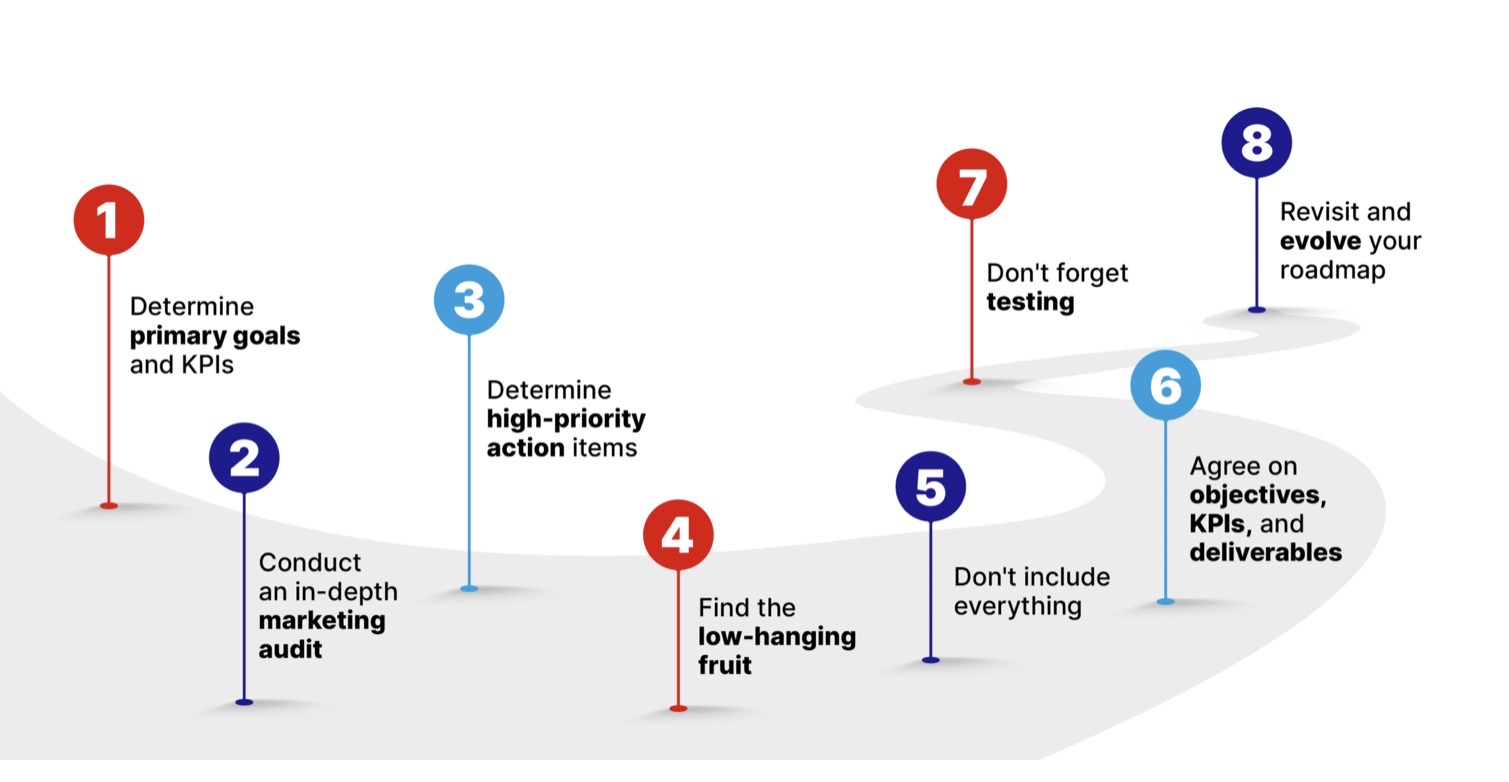
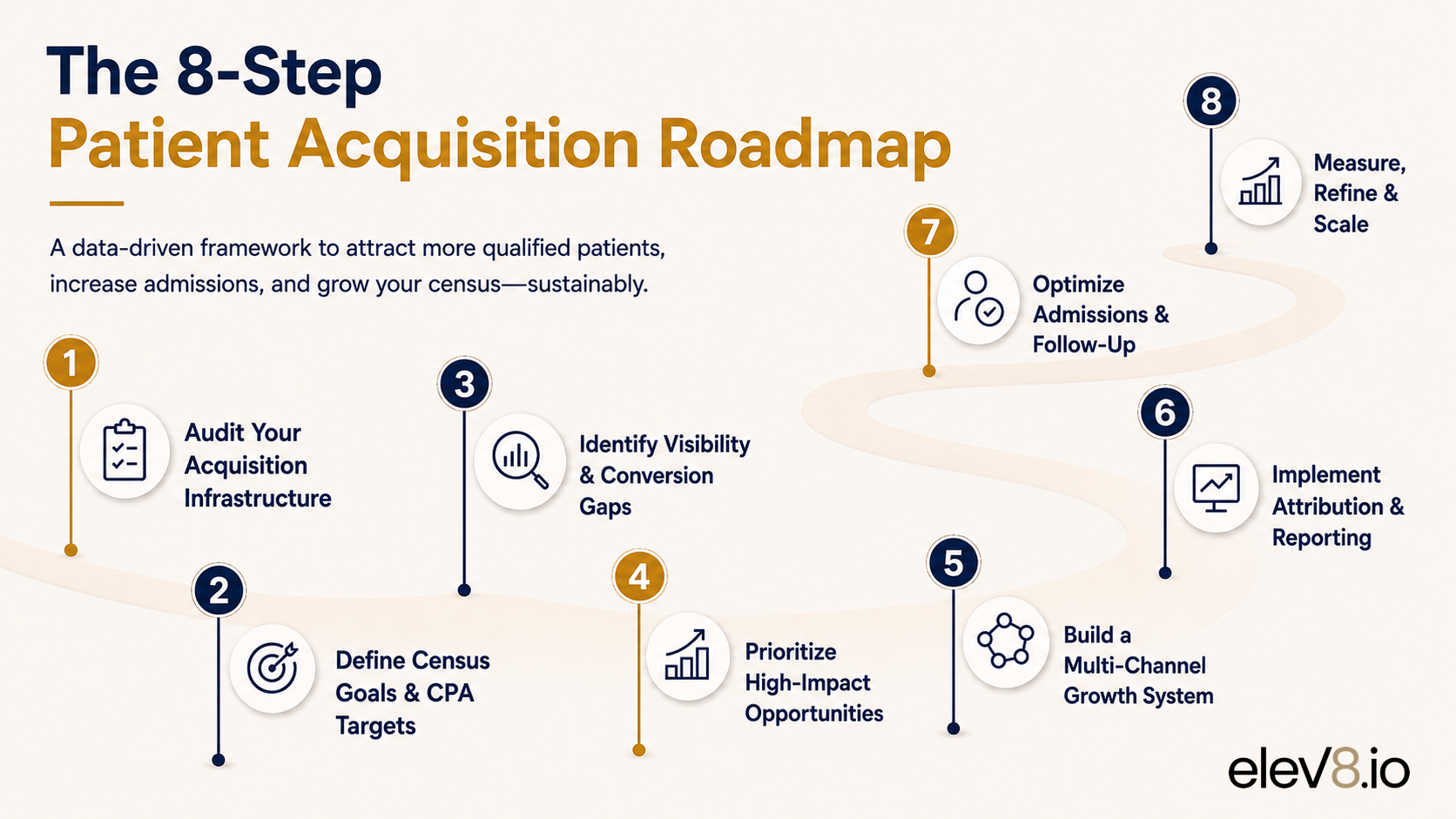
The elev8.io 8-Step Patient Acquisition Roadmap
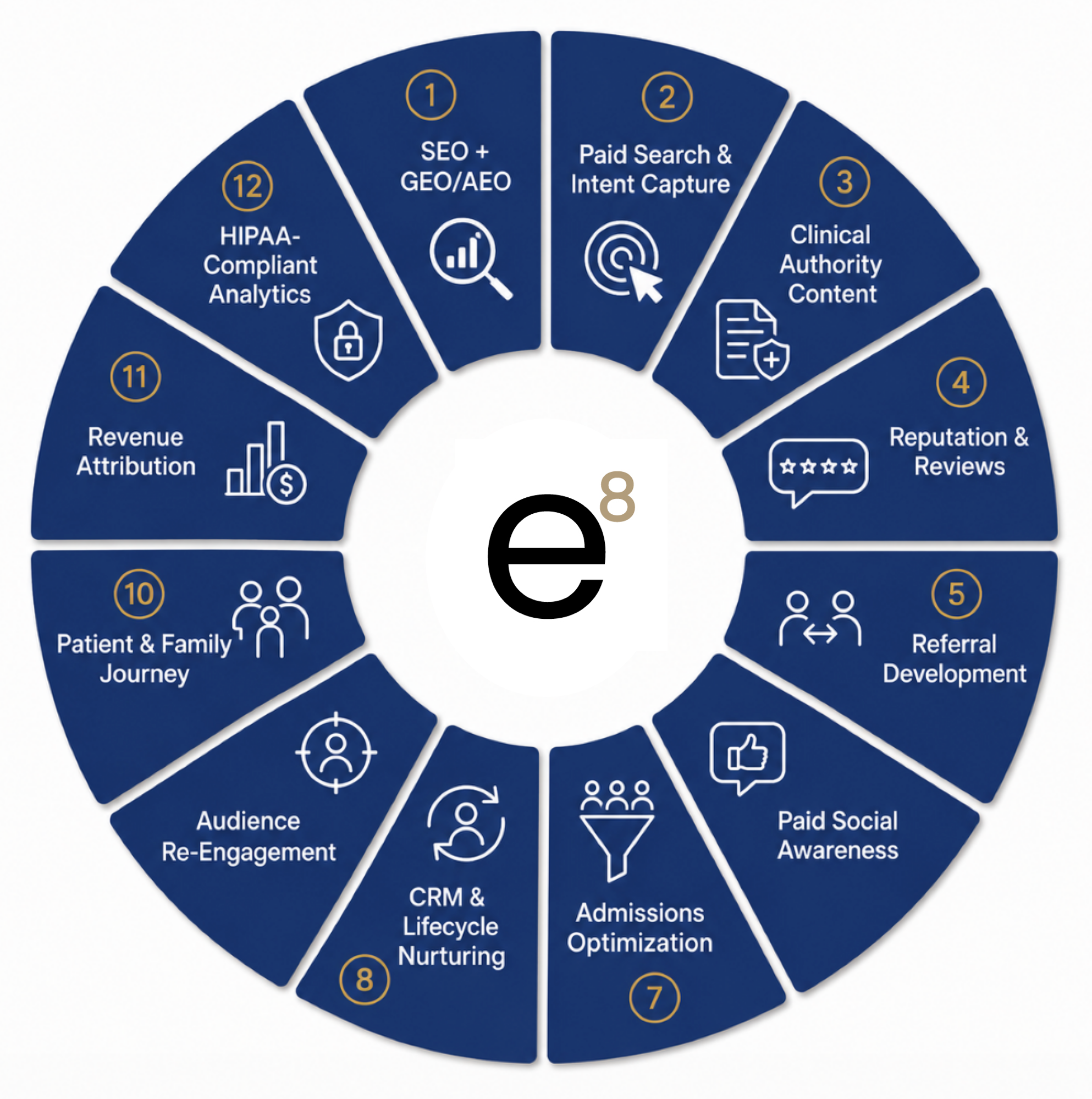
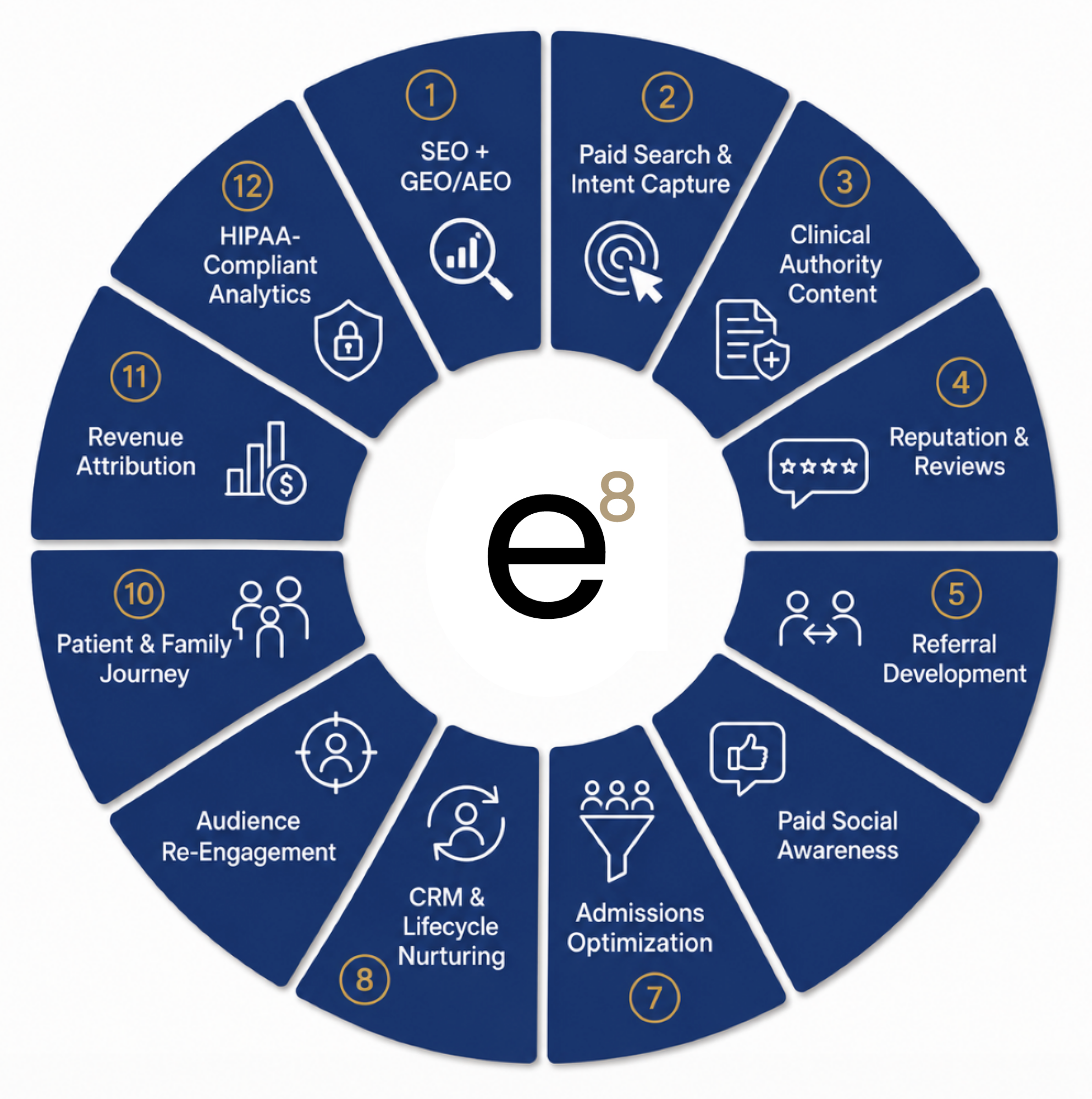
Patient acquisition, when done strategically, comes down to eight key elements — each one feeding the next.
The Executive Mandate
Patient acquisition in 2026 is not a marketing department problem. It is a CEO problem. The decision about which agency to trust with this function, which channels to prioritize, how much to invest, and how to hold that investment accountable — those are executive decisions. They determine valuation.
Valuations in this space are often shaped by payer mix, census stability, licensure, and accreditation, with integrated multi-site operators attracting higher multiples10. Census is not incidental to enterprise value. It is the primary driver of it.
Operators who treat patient acquisition as a back-office function — something to delegate and check on quarterly — will continue to face census pressure regardless of how strong the underlying demand is. The treatment gap documented by SAMHSA is not an argument to sit back and wait for patients to find you11. It is an argument to build the infrastructure that finds them first.
The facilities that grow census consistently in 2026 will be the ones whose CEOs treat acquisition as a core operational competency — governed by data, structured as a system, and resourced accordingly. Everything else is hope.
Sources
- Substance Abuse and Mental Health Services Administration (2025). Release of the 2024 National Survey on Drug Use and Health. SAMHSA.
- Behavioral Health Business (2025). SAMHSA: Mental health treatment stalls for youth and adults.
- Towards Healthcare (2026). U.S. behavioral health market size, shares and trends.
- Definitive Healthcare (2026). 8 things to watch in behavioral health in 2026.
- Brighter Click (2026). Healthcare patient acquisition cost in 2026: CAC benchmarks by specialty.
- Axis MH (2026). 5 marketing trends mental health practices need to know in 2026.
- A-Train Marketing (2026). 2026 behavioral health marketing trends.
- Mally, C. (2026). What “Good” Looks Like in Behavioral Health Marketing: Spend, Mix, and Conversion Benchmarks. Recovery.com.
- Revenue Memo (2026). Healthcare marketing statistics for 2026: A comprehensive analysis.
- Health FMV (2025). Valuing SUD/addiction treatment services providers in 2025: A comprehensive guide.
- Navis Clinical Laboratories (2025). SAMHSA releases results of 2024 National Survey on Drug Use and Health.

Founder & CEO · elev8.io
Gary Garth is the Founder & CEO of elev8.io, where he helps behavioral health organizations achieve full census through integrated marketing, admissions, and technology-driven growth systems.
With more than a decade of experience working alongside Google, Microsoft, and high-growth technology companies, Gary has built and implemented scalable growth frameworks now used by 45+ treatment centers across the United States to drive admissions and operational efficiency.
As a speaker, Gary focuses on the intersection of patient acquisition, AI-driven search, and admissions performance, helping founders, operators, and investors identify the hidden bottlenecks limiting growth—and how to fix them.
The author of The Zero to 100 Million Sales Blueprint and The Goals, Grit & Greatness Planner™, Gary is driven by a mission to close the gap between the millions of people struggling with addiction and mental health and the care they need.
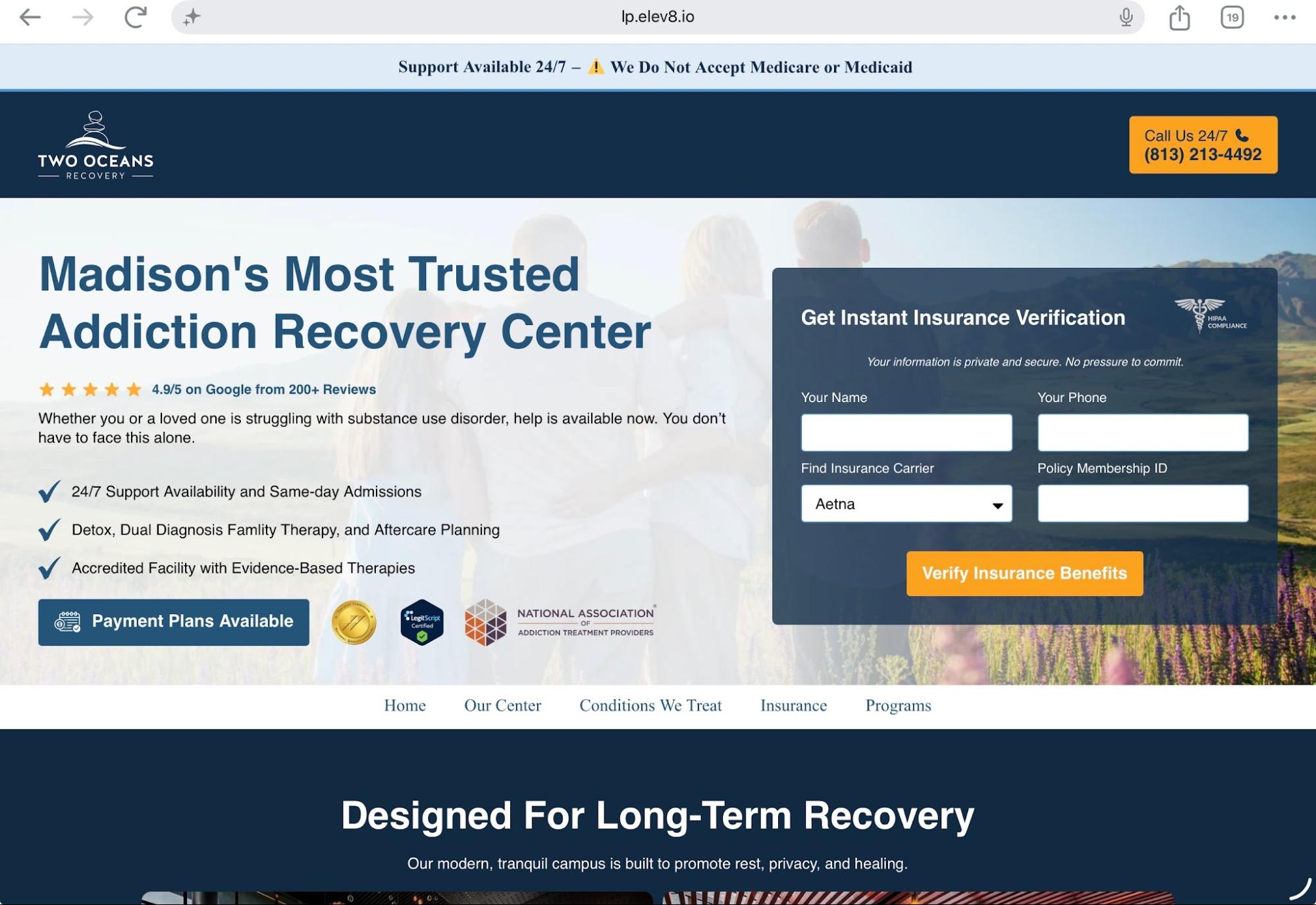
From Fear to First Call: How to Build a High-Converting, VOB-Optimized Landing Page
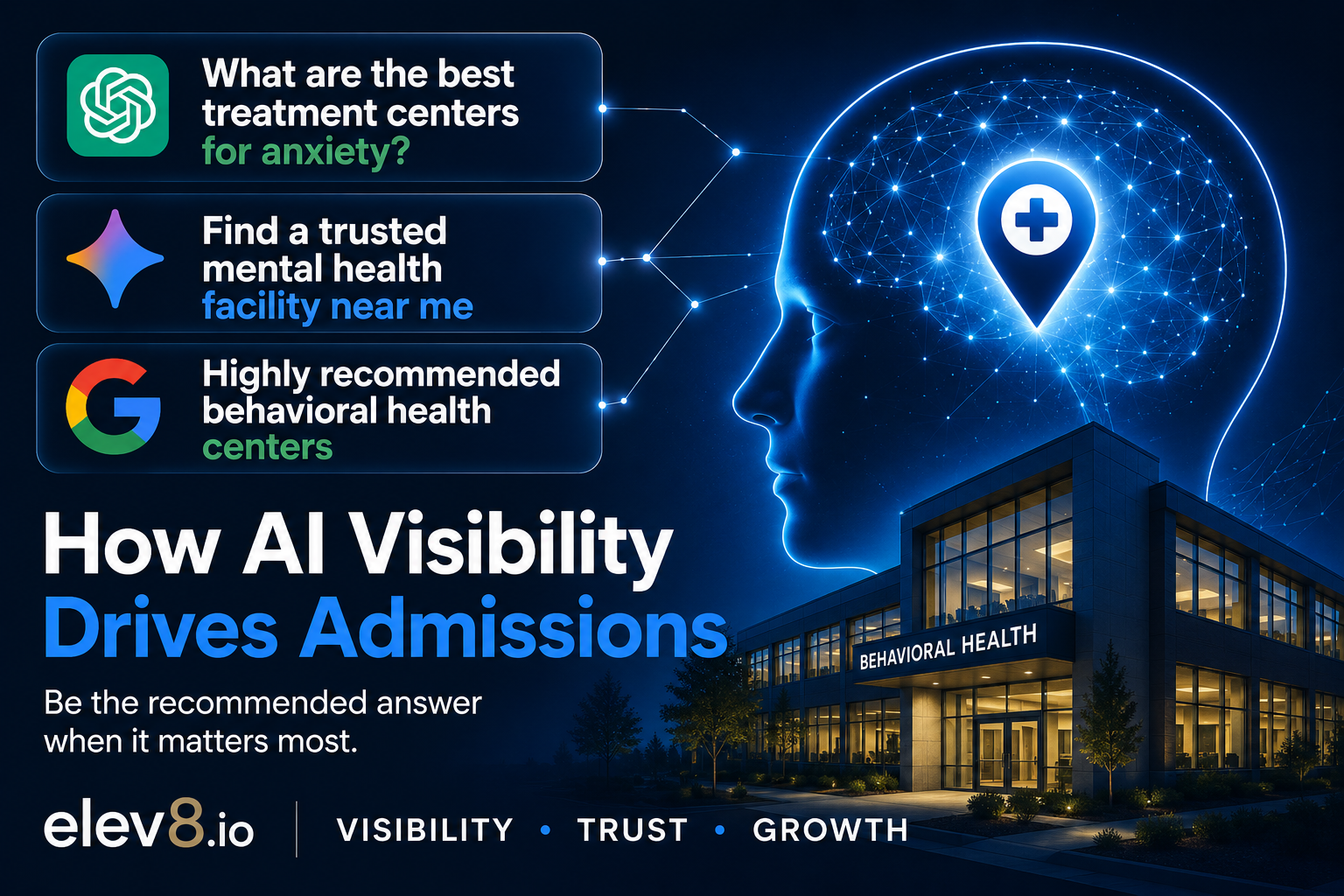
How AI Visibility and Search Is Changing Rehab Marketing