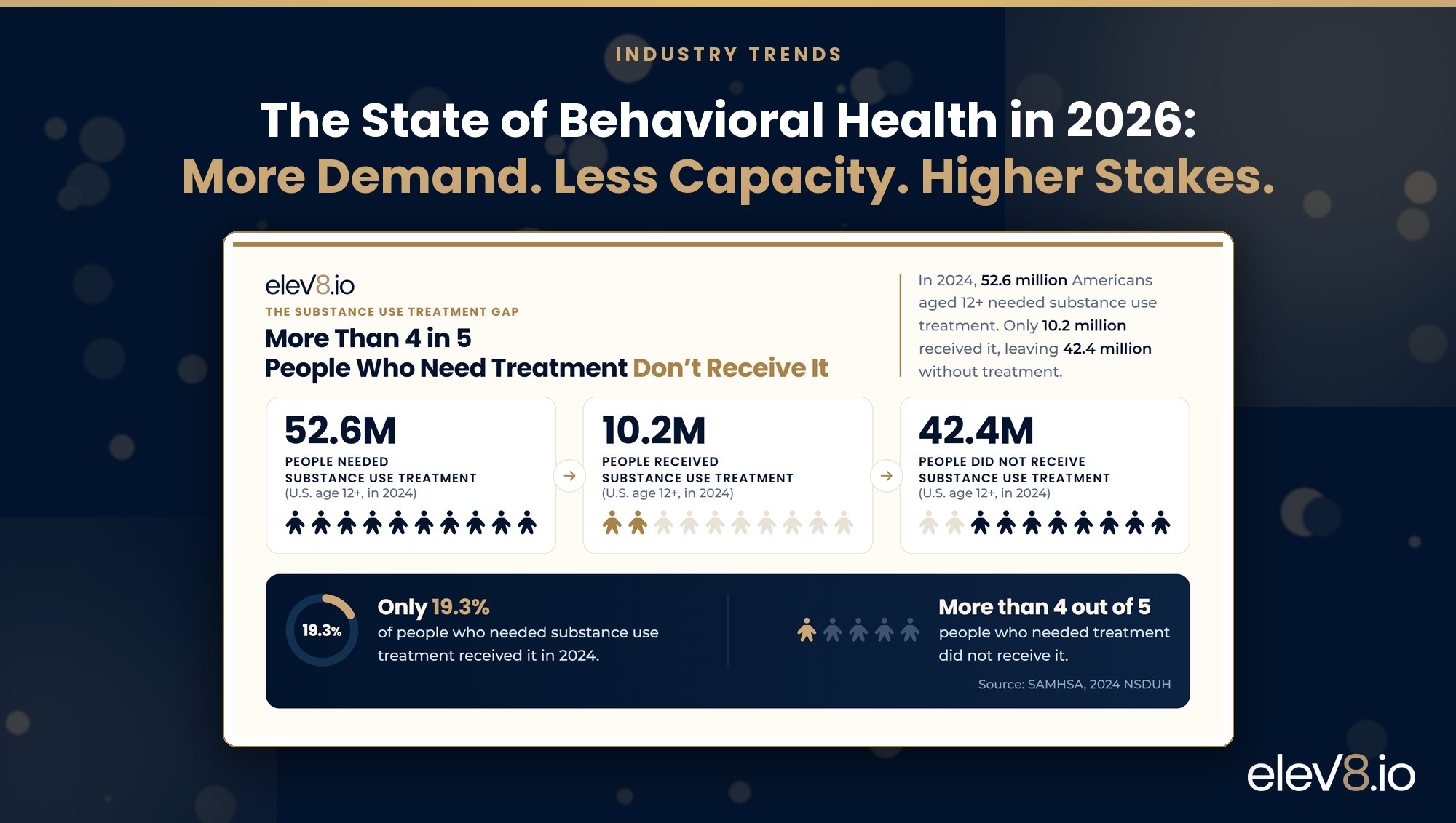
Google AI Overviews and Behavioral Health
Google AI Overviews now answer 48.7% of health searches before a click ever happens. See how they are generated and what behavioral health marketers must do.
A prospective patient searches “outpatient program for anxiety and alcohol use,” or a parent searches “how to help my son who won’t stop using fentanyl.” Increasingly, Google answers that question itself before anyone clicks a website.
Nearly seven in ten Google searches in the U.S. now end without a click, up from about six in ten just two years earlier1.
AI Overviews, the AI-generated summaries that sit above the traditional list of search results, are a major driver of that shift, and health searches trigger these summaries more than almost any other topic.
Behavioral health queries sit squarely inside that category. For treatment center marketers, this shift changes their job. Ranking on page one no longer guarantees a visit. Getting cited inside the answer does.
This article explains what an AI Overview is, how Google builds one, why the stakes are higher in behavioral health than in most industries, and where this technology is headed next.

What a Google AI Overview Actually Is
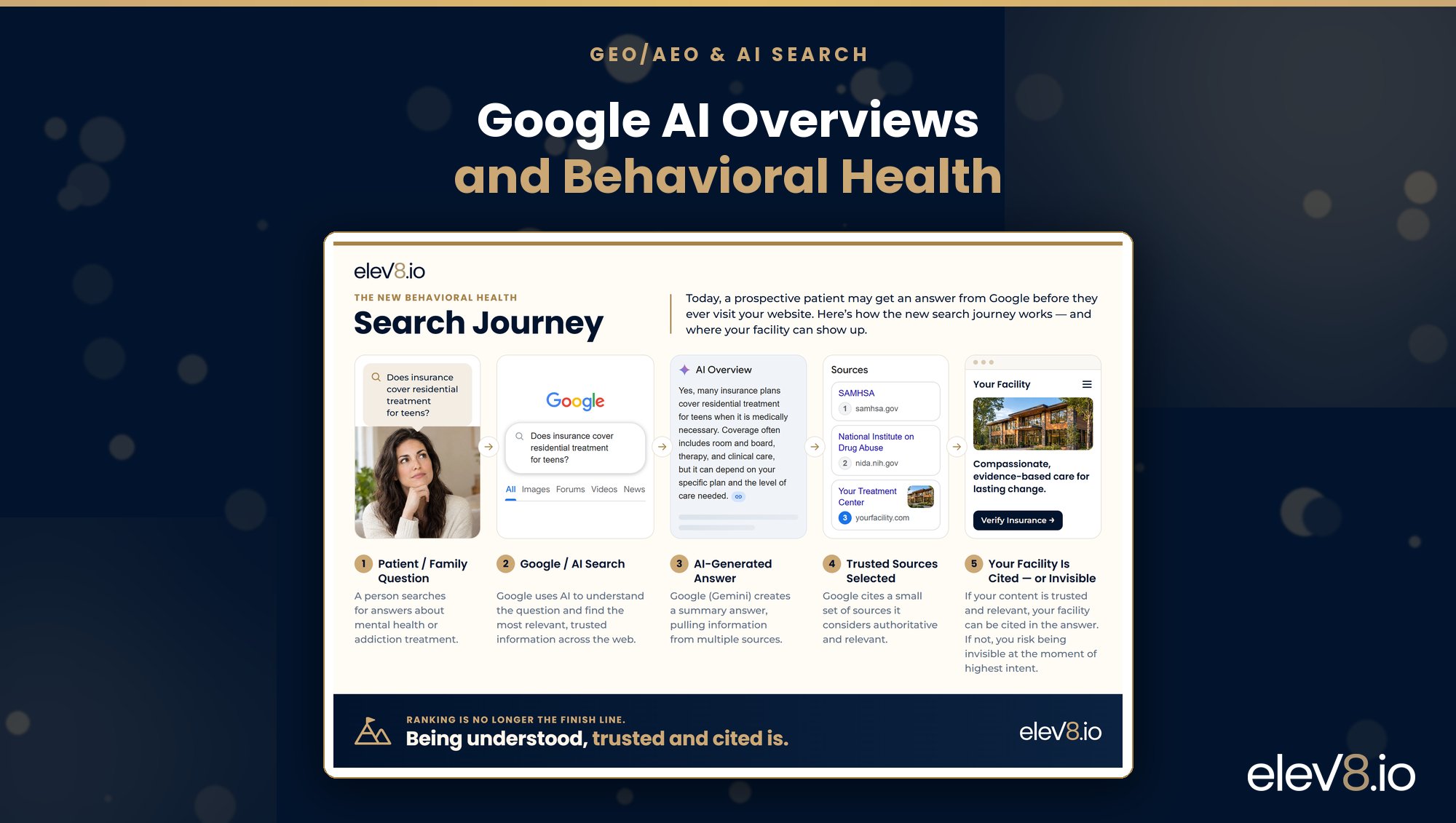
An AI Overview is a short, AI-written summary that appears at the top of a Google results page, above the traditional blue links. Google generates it with Gemini, the company’s AI model, drawing from web pages already indexed in Google Search2.
Google states plainly that there is no special file, markup, or schema a website needs to add to appear in an AI Overview2. The pages a facility already has, if they rank well and read as trustworthy, are the same pages the AI draws from to write the summary.
AI Overviews are not a separate channel to chase. They are a new lens on the same organic content, so facilities that already do search engine optimization well hold a real advantage, and facilities with thin, generic content carry a real disadvantage.
How Google Builds the Summary
Google uses a technique it calls query fan-out. Instead of answering only the searcher’s exact words, Google breaks the question into several related sub-questions, searches for each one, and synthesizes the results into a single answer2.
A search for “does insurance cover residential treatment for teens” might quietly also trigger searches on how insurance verification works, what residential treatment includes, and the typical length of stay. The final AI Overview blends findings from all of those searches into one short paragraph, with a small set of source links beside it.
AI Overviews, AI Mode, and AI Chat Assistants Are Not the Same Thing
Operators often use these terms interchangeably. They are not the same feature, and the difference affects strategy.
An AI Overview is a static summary that appears automatically for a qualifying search, without the user asking for it3.
AI Mode is a separate, conversational search experience the user opts into, built for multi-turn questions where someone might ask a follow-up or request a comparison3.
Google reported at its 2026 developer conference that AI Mode had passed 1 billion monthly users, with query volume roughly doubling every few months1.
ChatGPT, Claude, and Perplexity are a third category entirely: general-purpose AI assistants that sit outside Google Search altogether, and a growing share of health information seekers now use one of them as a first stop instead of a search engine.
Each surface pulls from different signals and rewards different content decisions, but all three share one trait that matters to every treatment center. They answer the question directly, and a website appears only as a supporting citation, not the destination.

Why Behavioral Health Carries More Exposure Than Most Categories
Health queries overall trigger AI Overviews more than any other topic Google tracks, appearing on roughly 48.7 percent of page-one health searches, more than double the 20 percent baseline rate across all search categories combined4.
Addiction treatment and mental health searches carry an added layer of risk beyond lost traffic. A 2026 investigation into Google’s AI Overviews found the summaries gave dangerous or incorrect guidance across several health categories5.
The mental health charity Mind reported that AI Overviews had, in some cases, produced advice about psychosis and eating disorders that was incorrect, harmful, or likely to discourage someone from seeking help5.
For behavioral health operators, that finding is significant. Google’s AI is actively synthesizing answers to the exact questions a person in crisis, or a parent searching on their behalf, might type into a search bar. When the AI gets those answers wrong, and a facility’s clinically accurate content was not part of what it drew from, the cost is more than a missed lead. It could be a life.
The Census: The elev8 Newsletter
Join 2,000+ behavioral health leaders. Get notified when we publish new articles — the strategies, data, and insights shaping behavioral health marketing.
2,000+ executives already subscribed
Unsubscribe anytime. Just one newsletter a month — no spam.
What Actually Earns a Citation
Google’s own guidance is consistent. There is no special markup for AI Overviews, but the ordinary fundamentals of trustworthy content matter more, not less2. For “your money or your life” (YMYL) topics like addiction and mental health treatment, research on AI search performance points to a specific set of practices6:
- Named clinical or clinical-adjacent authors, not a generic “team” byline, on any page discussing treatment approaches, medications, or outcomes.
- A visible “medically reviewed by” line with a linked credential, updated whenever the underlying page is updated.
- An answer-first structure, within 40-80 words, where the first two to four sentences under a heading plainly answer the question before any additional context follows. Such directive introductions also benefit from having relevant sourced statistics within the first few sentences, ideally sentence two.
- Citations to primary sources, including SAMHSA, NIDA, or peer-reviewed research, rather than only other marketing content.
- Consistency, so a facility’s level of care, accreditation, and admissions process read the same way across every page, since contradictions undermine the trust signals these systems try to measure.
None of this is exotic. It is the same editorial discipline that has always separated a credible treatment center website from a thin one. AI Overviews simply raised the cost of skipping it.

Where AI Overviews Are Headed
AI Overviews are not the finish line. A roundup of 2026 predictions from search industry leaders points to a few shifts operators should watch, offered here with the caution that this space is still moving quickly7:
- Rather than ranked, search is becoming personalized. Evidence suggests two people searching the identical phrase may already see different AI-generated answers based on their own history and context, which means holding “position one” stops being a stable goal7.
- Search engine optimization is splitting into two disciplines, one (traditional SEO) aimed at earning a human click and one aimed at supplying the facts an AI system chooses to cite7. Facilities will likely need both for some time.
- Agentic search, where an AI system takes action instead of just answering questions, is still in its early stages but is expected to grow. In behavioral health, that could eventually mean an AI assistant helping a family compare levels of care or check insurance eligibility directly, which raises the importance of clean, accurate data wherever a facility’s information lives7.
- Original data becomes a differentiator. Facilities that publish their own outcomes information, alumni survey results, or admissions benchmarks create a fact set AI systems cannot find anywhere else, and early evidence indicates this increases the odds of being the cited source rather than a paraphrased one7.
AI Overviews: A Content and Trust Challenge
None of these trends replace clinical judgment or admissions expertise. They describe the infrastructure decisions that determine whether a facility’s expertise actually reaches the person who needs it.
AI Overviews are not a passing feature. They are becoming the default way Google answers the questions patients and families ask first, and behavioral health sits at the center of that shift because so many of those questions get typed in at a moment of real urgency.
Facilities that treat this as a content and trust problem, not only a rankings problem, put themselves in position to be the source Google’s AI actually cites.
Facilities that wait will find their expertise summarized by someone else’s content, or in some documented cases, replaced by a simply wrong answer. The organic fundamentals still matter. What has changed is how much is riding on getting them right.
Test Our Website Assessment Tool
Try the tool now to gauge your AI visibility, Core Web Vitals, HIPAA compliance, security, and overall performance.
Sources
- Search Engine Land. (2026). Google zero-click searches reach 68% in early 2026: Study.
- Google. (2026). AI features and your website. Google Search Central Documentation.
- Keyword.com. (2026). Google AI Mode vs. AI Overviews: What’s the difference?
- Conductor. (2026). Health care industry: 2026 AEO/GEO benchmarks.
- ALM Corp. (2026). Google AI Overviews health misinformation: 2026 Guardian investigation.
- Search Engine Journal. (2026). How to create health and YMYL content that performs in AI search.
- Search Engine Land. (2026). The future of AI search: What 6 SEO leaders predict for 2026.

VP, Marketing Operations · elev8.io
Elizabeth Navas is VP of Marketing Operations at elev8.io, where she leads the execution and optimization of growth strategies for behavioral health organizations. She oversees the teams, systems, and processes that align marketing, admissions, CRM, and operational performance to help clients achieve sustainable census growth.
Known for her technology-driven and results-oriented approach, Elizabeth specializes in turning strategy into execution, ensuring every initiative is measured, optimized, and aligned with business objectives. Her expertise spans marketing operations, patient acquisition, CRM optimization, reporting, and performance management, helping behavioral health organizations build scalable systems that drive long-term success.
How AI Visibility and Search Is Changing Rehab Marketing
SEO vs. PPC for Addiction Treatment Centers: Which Delivers Better ROI?