Behavioral Health Patient Acquisition Is Changing: What Operators Need to Build Next
Behavioral health patient acquisition is shifting. See how AI search, compliance, admissions, and attribution will shape census growth for treatment centers.
Key Takeaways
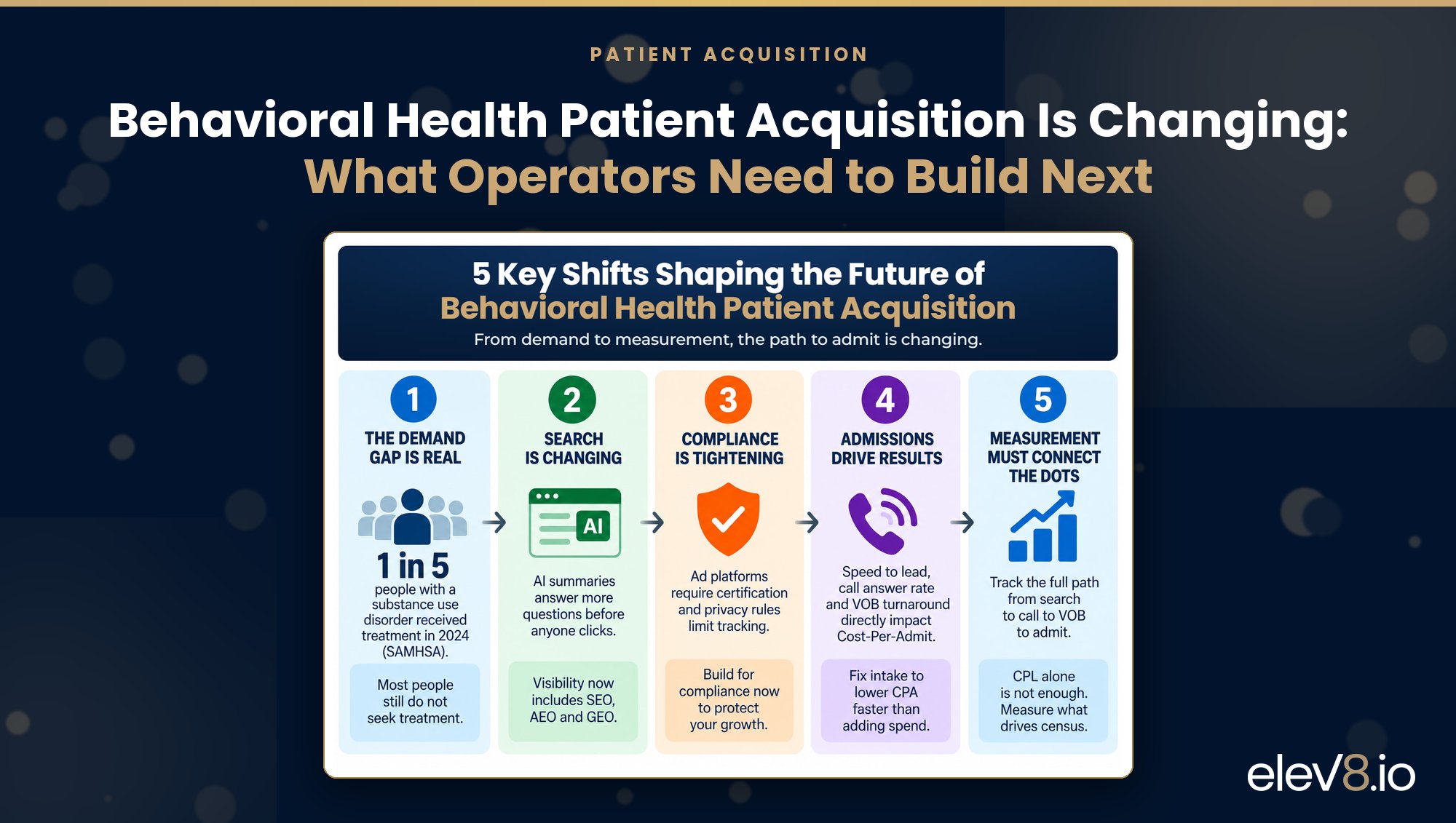
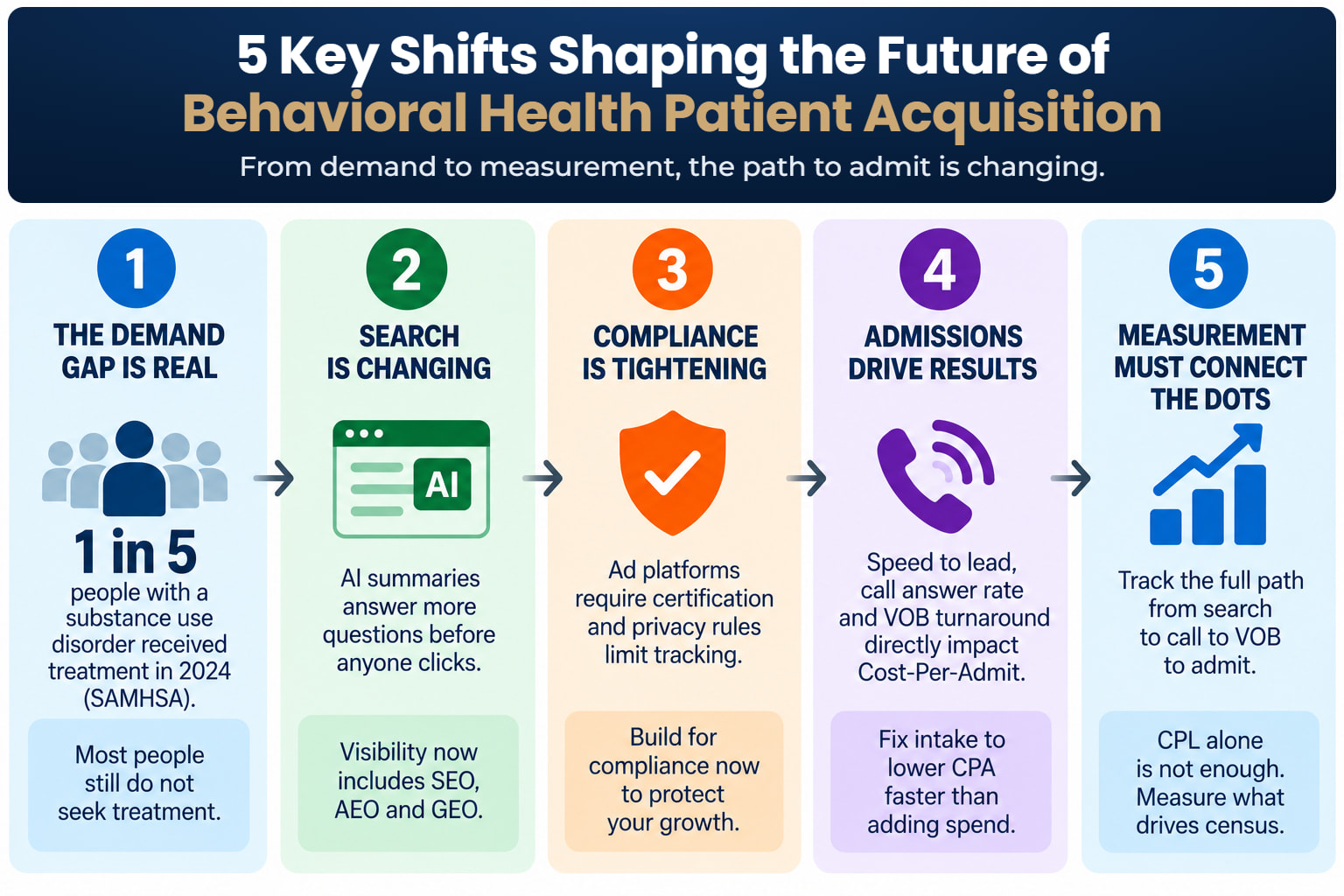
- About one in five people with a past-year substance use disorder received treatment in 2024 (SAMHSA). Most did not seek it, so reaching people at the moment they decide to act matters more than reach alone.
- When a Google AI summary appeared, users clicked a traditional result in 8% of visits, versus 15% without one (Pew). Informational content may now earn visibility without earning visits.
- GEO and AEO now sit alongside SEO. Specific content about programs, levels of care, and insurance gives AI answer engines something to cite.
- LegitScript certification and careful tracking are the minimum for running paid media. Facilities that build for compliance now are better placed when policies tighten.
- Speed to lead, call answer rate, and VOB turnaround are marketing metrics. Fixing intake can lower CPA faster than adding spend.
- CPL alone is not enough. Track search to call to VOB to admit.
The Future of Behavioral Health Patient Acquisition
Behavioral health demand isn't disappearing, but the route from initial search to admission is becoming harder to manage. Rising Cost-Per-Admit (CPA) or stagnant census may have as much to do with disconnected marketing and admissions processes as with the amount being spent.
Search results now answer questions before anyone clicks while ad platforms require certification. What facilities can track is governed by privacy rules. And the inquiries that do arrive still fall apart in intake when a call rings but goes unanswered or a VOB stalls.
This doesn’t mean demand is shrinking, but the path from need to admit is changing shape. Facilities that run marketing, admissions, and measurement as separate departments will likely feel that change as rising Cost-Per-Admit (CPA) and flat census. Those centers that run them as one system will be better positioned to grow.
This article covers five shifts we see shaping the next few years of patient acquisition for treatment centers: the demand gap, AI search, compliance, admissions, and measurement. It closes with elev8's view on what operators should build now.
The Demand Gap Is Still the Starting Point
In 2024, 48.4 million people aged 12 and older in the U.S. had a substance use disorder in the past year 1. About one in five, or 10.2 million people, received substance use treatment 1. Among adults with a substance use disorder who did not receive treatment, 95.6% did not seek it or think they should get it 1.
That gap shapes everything downstream since most people who could benefit from care are not actively looking for a facility. The people who are searching often do so in a narrow window. Many are searching for a family member and often are searching at night.
For operators, the implication is practical. Patient acquisition in the coming years depends less on reaching more people and more on being present, credible, and reachable at the moment someone decides to act. That puts more value on being visible and responsive during a relatively short decision window, rather than simply maximizing overall reach.
Search Is Splitting Into Clicks and Answers
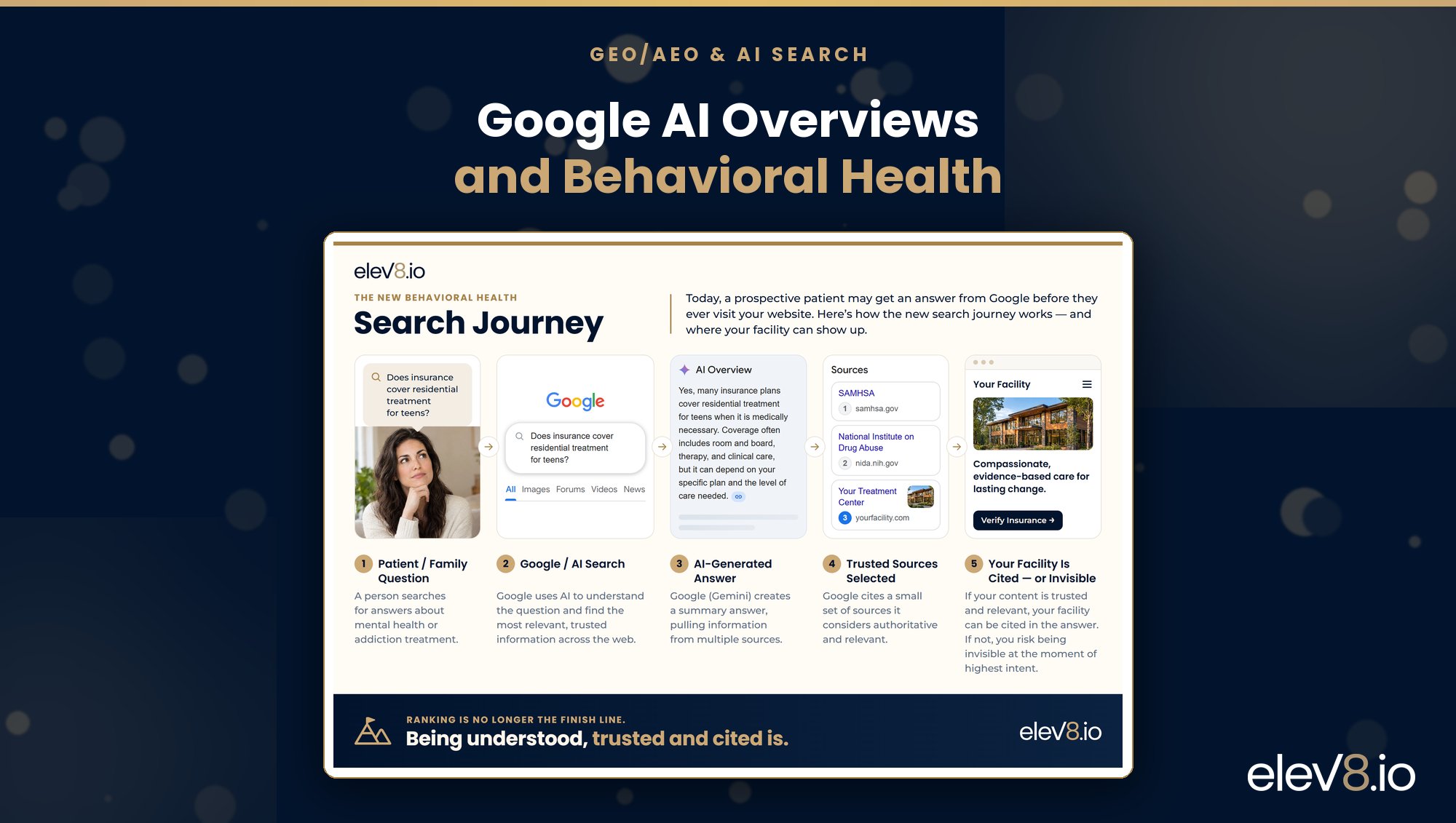
AI Summaries Are Absorbing Early-Stage Queries
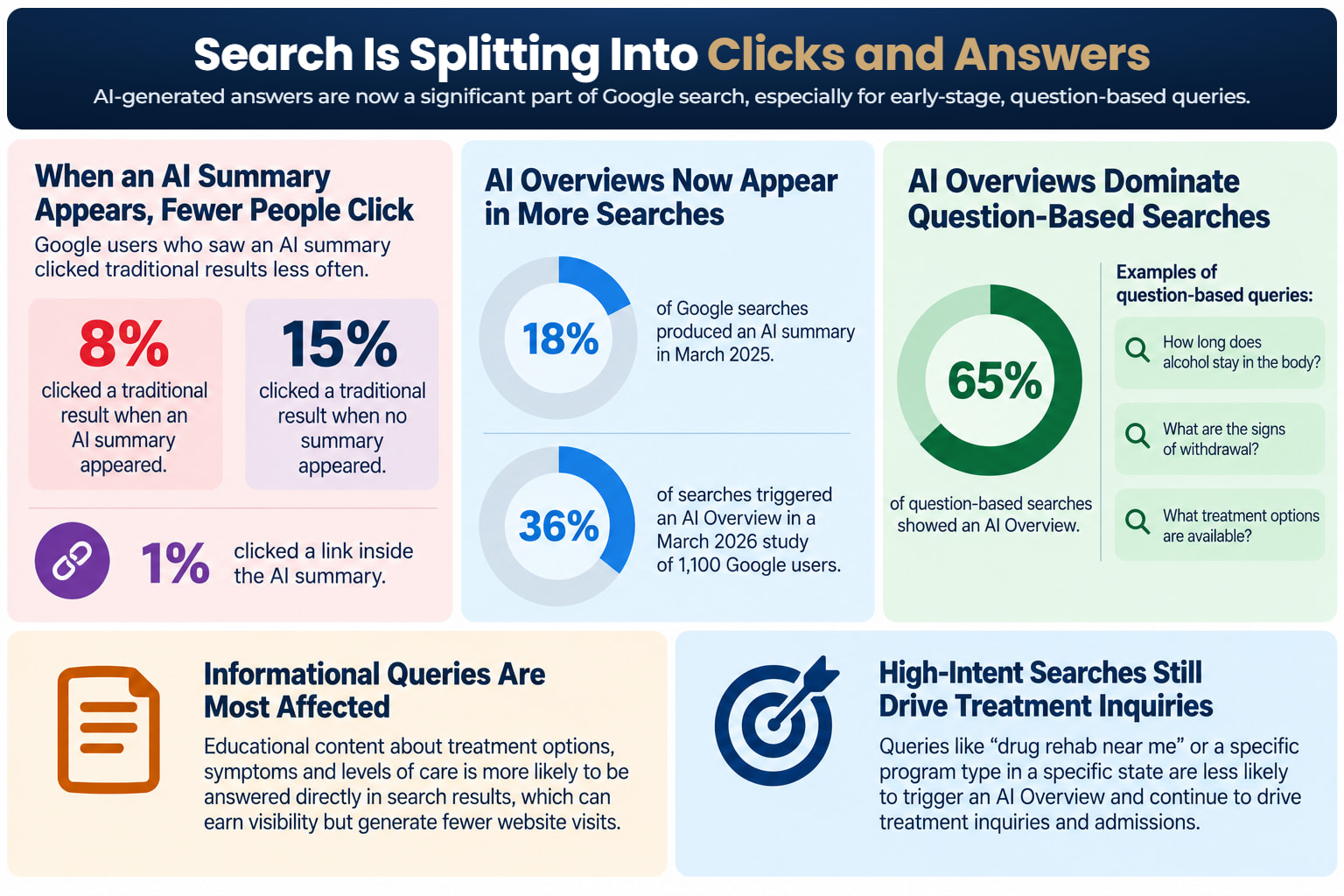
Pew Research Center found that Google users who saw an AI summary clicked a traditional result in 8% of visits, compared with 15% when no summary appeared 2. Users clicked a link inside the summary itself in 1% of visits. In March 2025, 18% of the Google searches in Pew's sample produced an AI summary.
AI-generated answers are becoming a significant part of search. A March 2026 study involving 1,100 Google users found that 36% of searches triggered an AI Overview. Separate research found that AI Overviews appeared in nearly 65% of question-based searches 3.
For behavioral health providers, this trend makes visibility within AI-generated answers increasingly relevant, particularly for educational content about treatment options, symptoms, and levels of care.
Early data indicates informational queries feel the impact most. Questions about how long a substance stays in the body or what withdrawal feels like are the ones most likely to be answered on the results page. Pages built around these informational queries may continue to earn search visibility while generating fewer site visits.
High-Intent Queries Still Drive Admits
Queries such as "drug rehab near me," or a specific program type in a specific state, carry different intent. The person searching is closer to a decision. elev8's SEO practice prioritizes these searches over high-volume informational terms and measures the work by admits, not rankings 4.
GEO and AEO Join Traditional SEO
Discovery now also happens in ChatGPT, Perplexity, Claude, and Gemini. elev8 treats SEO, answer engine optimization (AEO), and generative engine optimization (GEO) as three layers of one foundation 4. In our experience, facilities that show up in AI answers tend to publish clear, specific, well-structured content about their programs, levels of care, and accepted insurance. Generic content gives a language model little to cite.
Compliance Is Becoming a Competitive Advantage
Behavioral health is one of the most restricted ad categories online. Google and Meta recognize the requirement for LegitScript's addiction treatment certification for advertisers in this space 5. Facilities without it face real limits on where and how they can run paid media.
Tracking is the second constraint. HHS guidance on online tracking technologies sets out how HIPAA applies to pixels and analytics on healthcare websites 6. A 2024 federal court ruling found that part of that guidance exceeded HHS's authority 7. HIPAA obligations around protected health information still apply. For treatment centers, the safest assumption is that ad-platform pixels and patient data do not mix.
We believe compliance will separate operators over the next few years. Building certification and privacy requirements into the marketing infrastructure now reduces the risk of having campaigns interrupted later by policy changes, disapprovals, or account suspensions.
Admissions Becomes Part of Marketing
A lead that never reaches a coordinator costs the same as one that admits. That is why the future of patient acquisition runs straight through intake.
The failure points are familiar. Calls go unanswered or route to the wrong place. Voicemails sit. Follow-up speed goes unmeasured. VOBs stall between insurance collection, submission, and billing handoff 8. Individually these problems can look minor, which is why their cumulative effect on admissions is easy to miss.
In one elev8 review of more than 9,000 calls over 60 days, routing and system failures were affecting admissions 9. Findings like that rarely show up in a marketing report. They show up in the census.
Operators who grow consistently tend to treat speed to lead, call answer rate, and VOB turnaround as marketing metrics. They measure them, set standards, and hold the team to them. In our experience, fixing intake can lower CPA faster than adding spend.
The Census: The elev8 Newsletter
Join 2,000+ behavioral health leaders. Get notified when we publish new articles — the strategies, data, and insights shaping behavioral health marketing.
2,000+ executives already subscribed
Unsubscribe anytime. Just one newsletter a month — no spam.
Measurement Moves From Leads to Admits
Cost-Per-Lead (CPL) is easy to report and easy to game. Across the accounts and admissions systems we work with, these functions are becoming harder to manage independently. Search visibility affects the calls coming in. Compliance determines which channels can run. Intake determines whether that spend turns into a VOB, and attribution determines whether anyone knows what actually worked.
The next phase of patient acquisition belongs to measurement that follows the full path from search to call to VOB to admit 4.
That requires call tracking tied to the source, a CRM that records each handoff, and reporting that connects spend to admits instead of form fills. With that view, an operator can see which campaigns produce admits at an acceptable CPA and which produce noise.
For Rushton Recovery, a new facility, elev8 reported 885% growth in new users, 13,696 organic sessions, and approximately $1,500 cost per admit from SEO 10. More importantly, the CPA is tied to actual admits, which makes it useful for deciding where the next marketing dollar should go.
What We Believe Comes Next
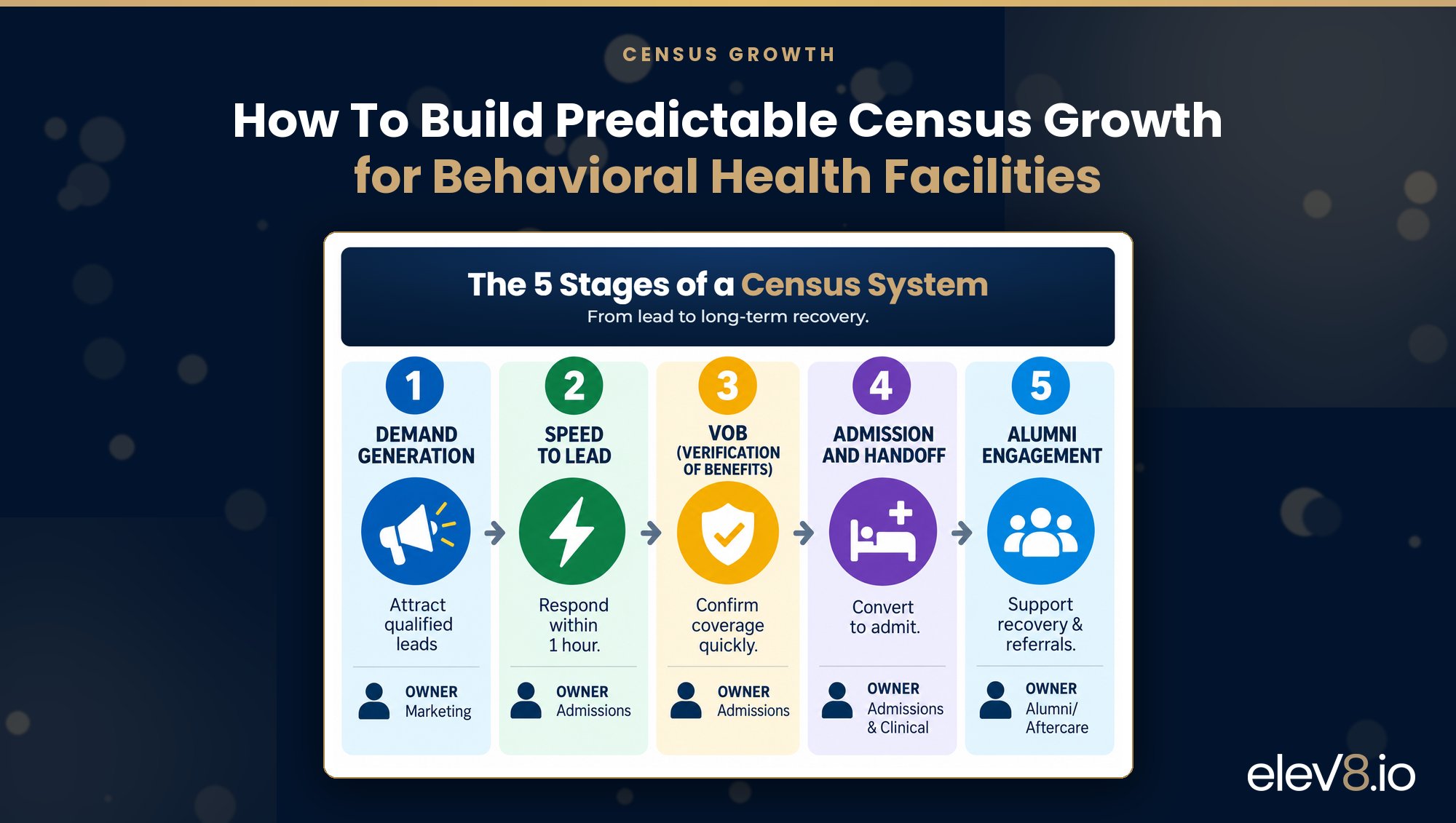
Our view is direct. Patient acquisition is consolidating into a single operating system. The facilities that grow over the next few years will connect five things:
- Visibility across Google, maps, and AI answer engines, built on specific, citable content
- Compliant paid media with certification, clean tracking, and policy-safe copy
- Admissions discipline with measured speed to lead, answer rate, and VOB turnaround
- Attribution that tracks spend to admits, not just to leads.
- Alumni engagement that keeps former patients connected to the facility after discharge.
Point solutions will still exist. But a facility running SEO with one vendor, paid media with another, and intake on a spreadsheet will struggle to see where admits are won and lost. That visibility gap is where CPA climbs.
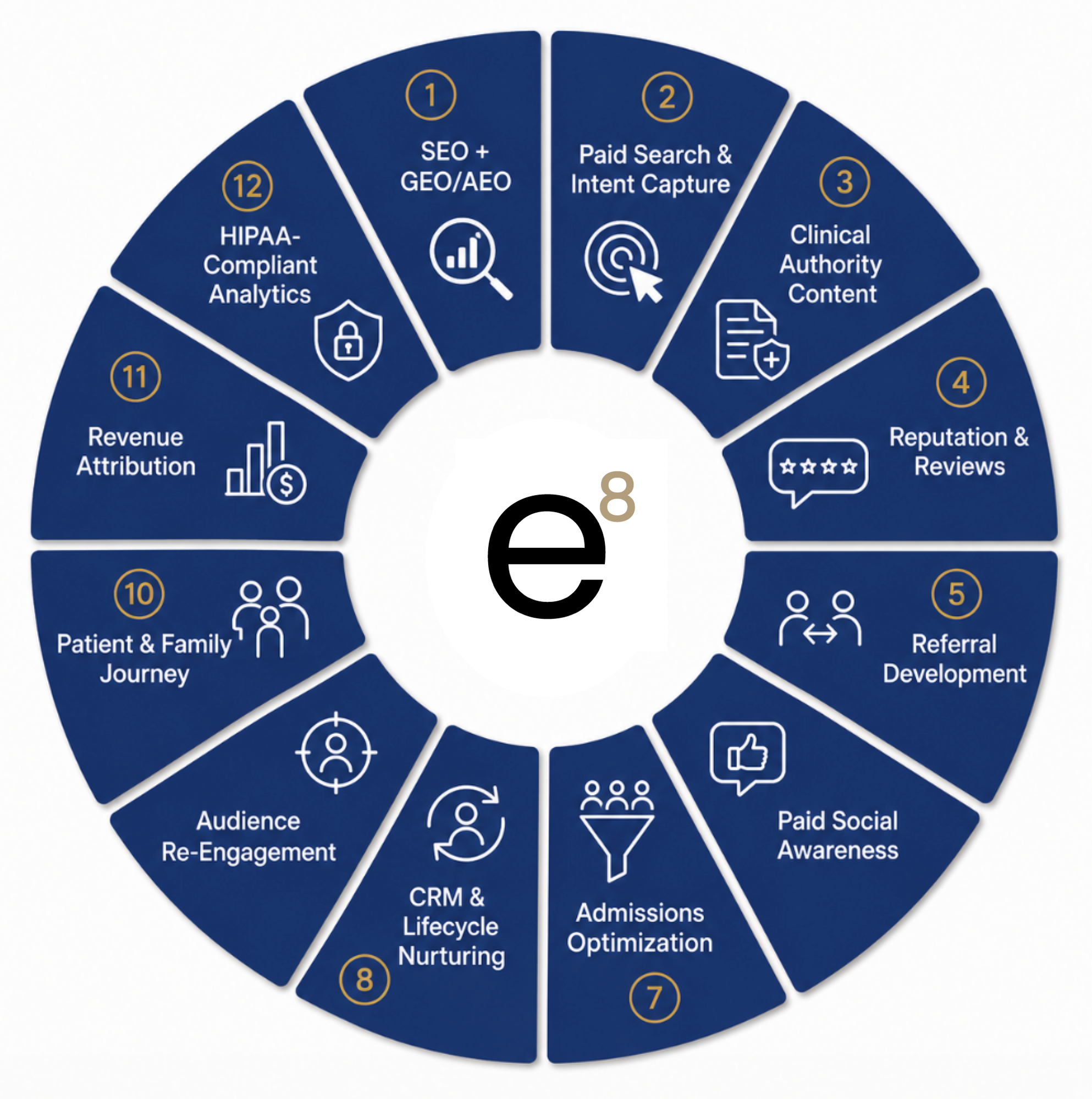
elev8's model brings marketing, admissions, technology, and alumni engagement into the same data environment. The practical benefit is visibility: operators can see where inquiries originate, where they stall, which ones become admits, and what those admits cost. We expect that level of integration to become increasingly important as acquisition costs rise and attribution becomes more difficult.
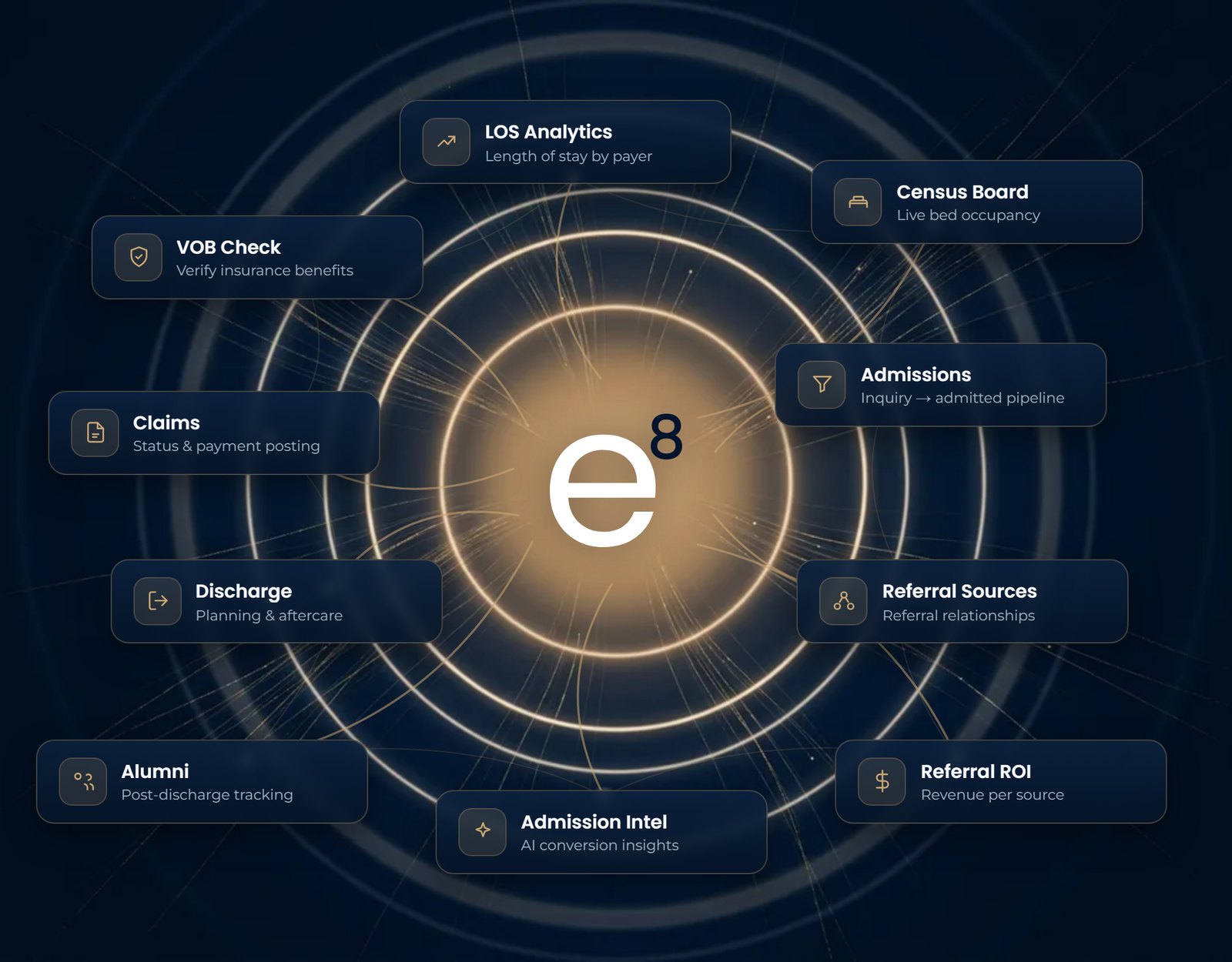
Operators who connect visibility, compliance, admissions, and attribution into one system will be positioned to grow census with less waste. Those who keep these functions separate may keep paying for leads they cannot convert or measure. The shifts are already underway. The decision now is how quickly to adopt them.
Conclusion
The next era of behavioral health patient acquisition will reward connection over volume. Demand remains large and largely untreated. Search is shifting toward answers. Platforms and regulators continue to raise the compliance bar.
Intake is where many admits are won or lost. The admit is the only metric that really holds up.
The channels will keep changing. Search will produce more answers without clicks, privacy requirements will continue to shape tracking, and acquisition costs will move with competition. What ultimately matters to an operator is whether the system produces appropriate admissions at a sustainable cost. That requires visibility beyond the marketing dashboard, through intake, VOB, and the final admit.
Want to Know How Your CPA Stacks Up?
See how your cost per admission compares to other facilities in your market, by channel.
Sources
- Substance Abuse and Mental Health Services Administration. (2025). Highlights for the 2024 National Survey on Drug Use and Health. SAMHSA.
- Chapekis, A., and Lieb, A. (2025, July 22). Google users are less likely to click on links when an AI summary appears in the results. Pew Research Center.
- Xu H, et al., 2026. Measuring Google AI Overviews: Activation, Source Quality, Claim Fidelity, and Publisher Impact. Proceedings of the 2026 ACM Internet Measurement Conference (IMC '26), 2026, pp. 529-546. https://arxiv.org/abs/2605.14021
- elev8.io (2026). SEO and LLM visibility. elev8.io
- LegitScript. (n.d.). Addiction treatment certification. LegitScript.
- U.S. Department of Health and Human Services. (n.d.). Use of online tracking technologies by HIPAA covered entities and business associates. HHS.
- Hunton Andrews Kurth. (2024). Federal judge rules that online tracking technologies guidance exceeded HHS' authority. Privacy and Cybersecurity Law Blog.
- elev8.io (2026). Admission enablement. elev8.io
- elev8.io (2026). Call tracking: what 9,000+ calls revealed in 60 days. elev8.io
- elev8.io (2026). Rushton Recovery case study. elev8.io

Founder & CEO · elev8.io
Gary Garth is the Founder & CEO of elev8.io, where he helps behavioral health organizations achieve full census through integrated marketing, admissions, and technology-driven growth systems.
With more than a decade of experience working alongside Google, Microsoft, and high-growth technology companies, Gary has built and implemented scalable growth frameworks now used by 45+ treatment centers across the United States to drive admissions and operational efficiency.
As a speaker, Gary focuses on the intersection of patient acquisition, AI-driven search, and admissions performance, helping founders, operators, and investors identify the hidden bottlenecks limiting growth—and how to fix them.
The author of The Zero to 100 Million Sales Blueprint and The Goals, Grit & Greatness Planner™, Gary is driven by a mission to close the gap between the millions of people struggling with addiction and mental health and the care they need.