How to Validate Product-Market Fit Before Opening or Expanding a Behavioral Health Program
Treatment center expansion should start with demand, not real estate. Validate search demand, call data, VOB mix, and referral interest before you commit.
Key Takeaways
- Treatment center expansion decisions should start with local demand data, not an available building or license window.
- The national treatment gap is real, but most people with an untreated SUD do not perceive a need for care, so the gap does not equal a local lead pool.
- Four demand signals carry the most weight: search demand, call and referral-out data, VOB mix, and referral partner interest.
- A pre-launch demand test with go/no-go thresholds set in advance can turn assumptions into numbers before you commit capital.
- LegitScript certification rules shape how a new program can test paid demand, so existing operators and new entrants need different test plans.
- Validation continues after opening, with weekly tracking of leads, VOBs, and admits by source against the pre-launch baseline.
Many treatment center expansion decisions start with real estate. A building comes available, a license window opens, or a board wants a second location. The census report answers the demand question later, usually six months after opening.
That order is expensive. A new residential program or IOP carries payroll, lease, licensing, and accreditation costs from the first day. Admits arrive on their own schedule.
The national numbers can mislead. In 2025, 47.2 million people aged 12 or older needed substance use treatment, and about one in six received it 1. That gap is real. It does not mean a given market has unmet demand for your level of care, at your payer mix, within your drive radius.
This article lays out how to validate product-market fit before you sign a lease or file for a license. We focus on demand signals first: search behavior, call data, VOB patterns, and referral interest. Together, these signals show whether a market can produce qualified leads at a cost your pro forma can carry.
Why the National Treatment Gap Does Not Validate a Local Market
The treatment gap is a population statistic. Among adults with a past-year SUD who did not receive treatment in 2025, 94.5 percent did not perceive a need for it 1. They did not seek treatment and did not think they should get it. That group rarely converts on an opening timeline. Marketing can shorten the path to readiness. It cannot manufacture readiness in 90 days.
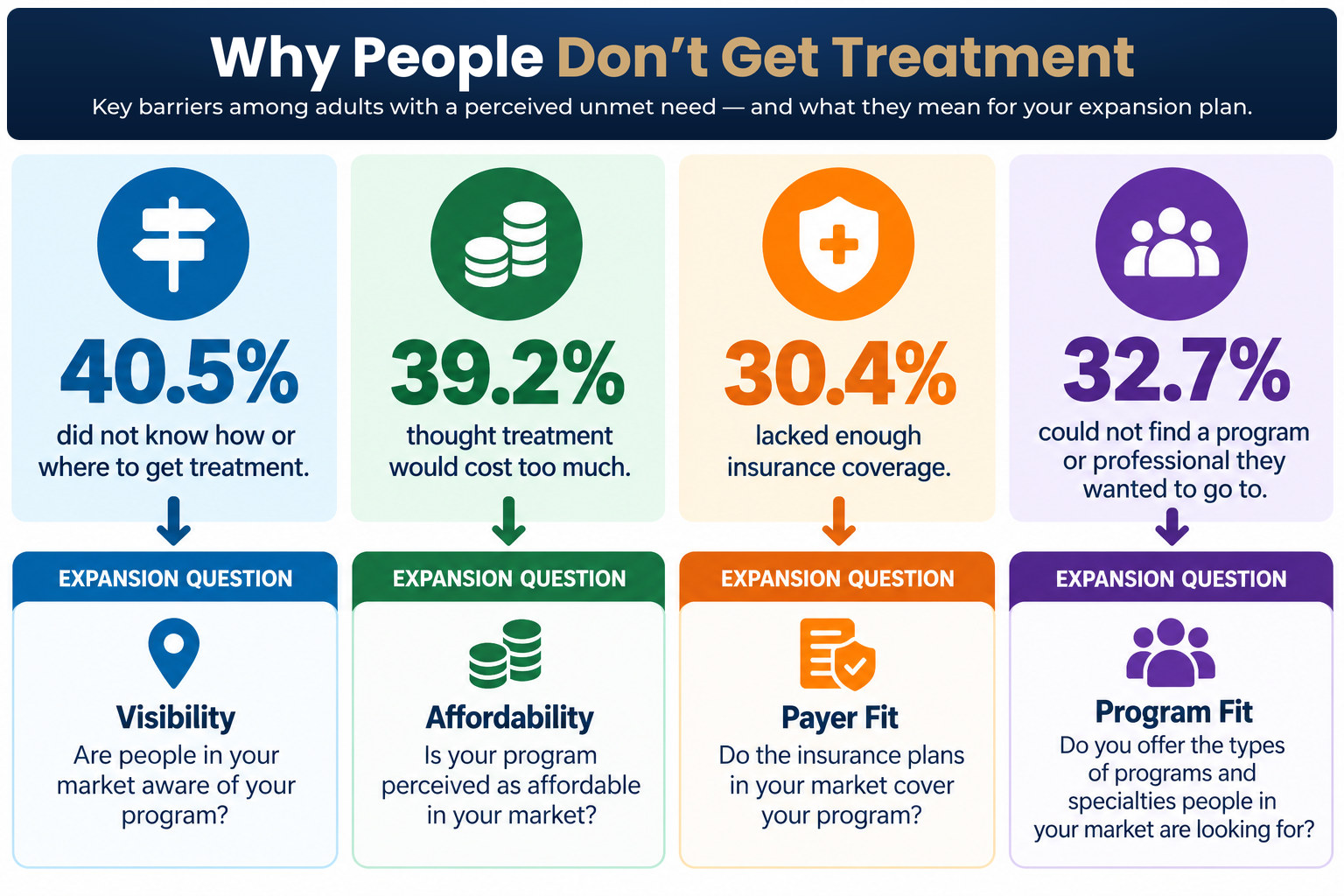
The reasons people who wanted treatment gave for not getting it matter more for an expansion plan. Among adults with a perceived unmet need, 40.5 percent did not know how or where to get treatment, 39.2 percent thought treatment would cost too much, and 30.4 percent lacked enough insurance coverage 1. Another 32.7 percent could not find a program or professional they wanted to go to 1. Each reason points to a local question: visibility, affordability, payer fit, or program fit.
Supply matters too. SAMHSA counted 15,953 substance use treatment facilities in 2024 2. Outpatient care was the most common service, offered at 83.8 percent of those facilities, while 22.5 percent offered residential care 2. A market can show high need and still be crowded at the level of care you plan to open.
The Four Demand Signals to Measure Before You Commit
Each signal answers a different question. Search shows interest. Calls show intent. VOBs show ability to pay. Referral partners show whether the market’s gatekeepers will send patients.
1. Search Demand by Geography and Level of Care
Pull keyword data for level-of-care terms such as detox, residential, PHP, IOP, and dual diagnosis, plus payer terms, for each target metropolitan area. Compare markets against each other, not against a national average.
Read Google Trends carefully. Google divides each data point by total searches in that geography and time range, then scales the result from 0 to 100 3. The index shows relative interest and seasonality, not raw volume. Use keyword planning tools for volume ranges.
Watch the share of searches that name existing facilities. If a handful of branded searches dominate a market, that market rewards brand and referral depth more than new supply. Budget for a longer ramp.
2. Call and Referral-Out Data
If you already operate, your call tracking data is the cheapest market study you own. Pull 12 months of calls from CTM or your current platform. Tag each call by caller location, requested level of care, and disposition.
Then count the calls you referred out because you did not offer the requested service or were out of network. Those referral-outs are demand you already paid to generate and could not capture. A steady monthly volume of IOP requests from one county is a stronger expansion signal than any national survey.
3. VOB Mix and Payer Fit
Verification of benefits (VOB) data shows whether demand can pay. Group 12 months of VOBs by payer, plan type, and outcome. Look for four numbers:
- The share of VOBs with in-network benefits for the planned level of care
- The share denied, or requiring authorization your team cannot support
- The out-of-network share and its historical collection rate
- Medicaid volume, if you plan to accept Medicaid
Strong search demand paired with a VOB mix dominated by payers you do not contract with is a weak market for your program. Fix the contracting plan before the facility plan.
4. Referral Partner Interest
Referral sources see placement gaps every week. Before you commit, run 15 to 20 structured conversations with hospital case managers, outpatient therapists, EAPs, and step-down providers in the target market. Ask each one the same five questions:
- Where do you send patients today?
- Which level of care is hardest to place?
- Which payers cause placement delays?
- How long does a typical placement take?
- How many patients per month would you expect to refer to a new program at our level of care?
Record every answer in Salesforce or your CRM. Count referral volume estimates, not goodwill.
Run a Pre-Launch Demand Test
Research signals tell you what may happen. A test shows what does happen.
Plan the test around certification rules. Google, Meta, Microsoft Ads, and Nextdoor require LegitScript certification to run addiction treatment ads, and applicants must offer licensed addiction treatment services 4. A program that does not exist yet cannot run paid addiction treatment ads under its own name.
- Existing certified operators: Run a geo-targeted campaign into the target market for 60 to 90 days, promoting services you offer today. Measure calls, Cost-Per-Lead (CPL), VOB pass rate, and admits from that geography.
- New entrants: Publish market-specific content and a pre-launch page, then track impressions and queries in Google Search Console. Pair that data with referral partner commitments.
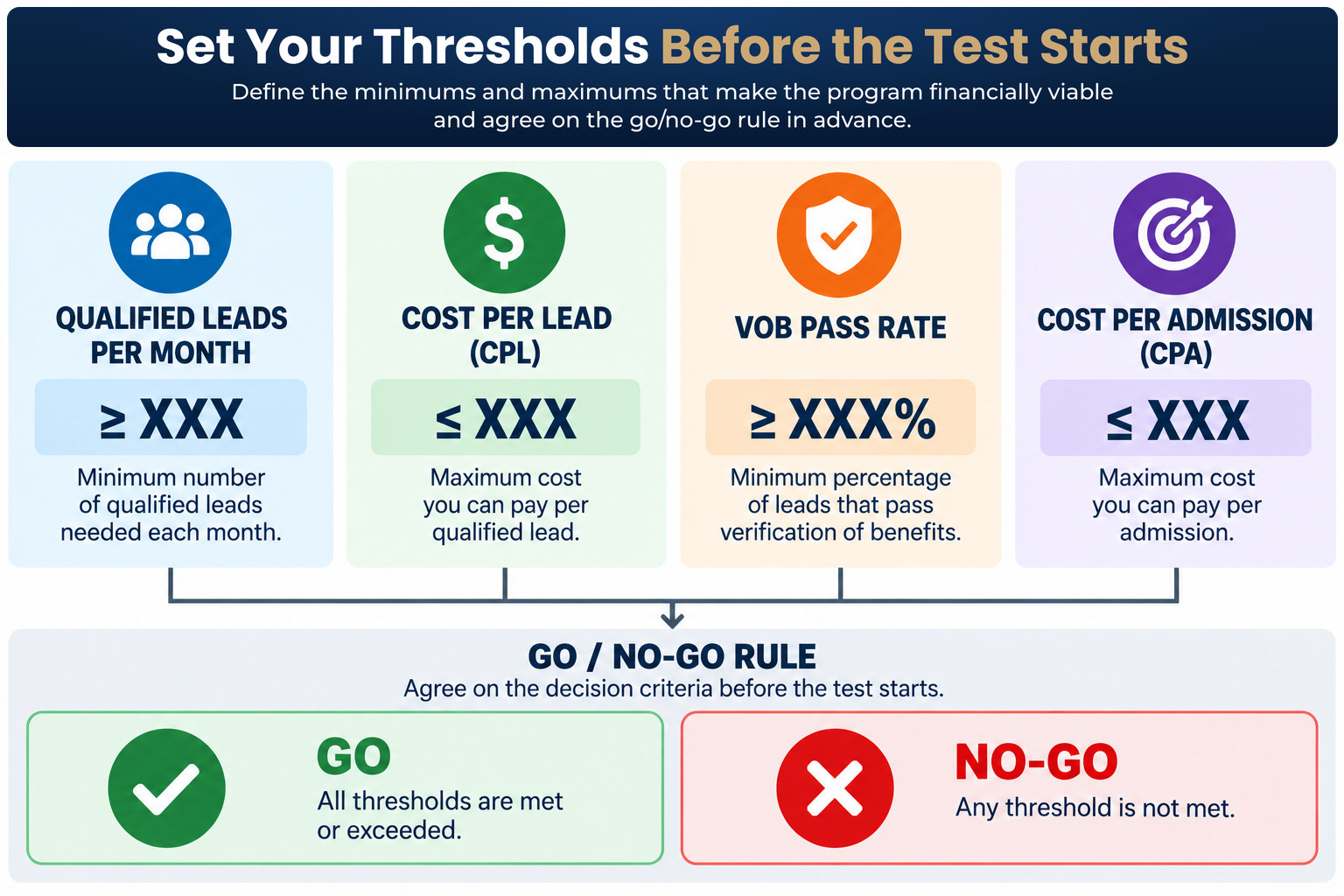
Set thresholds before the test starts. Write down the minimum qualified leads per month, the maximum CPL, the minimum VOB pass rate, and the maximum Cost-Per-Admit (CPA) that make the pro forma work. Agree on the go/no-go rule in advance so nobody rationalizes the result afterward.
Build the Go/No-Go Scorecard
Score each candidate market on the same six inputs:
- Search demand for the planned level of care, relative to comparable markets
- Referral-out volume from current call data
- In-network VOB share for the planned level of care
- Competitive density at that level of care within the drive radius, using SAMHSA’s FindTreatment.gov locator 5
- Referral partner volume estimates
- Test CPL and CPA against the pro forma
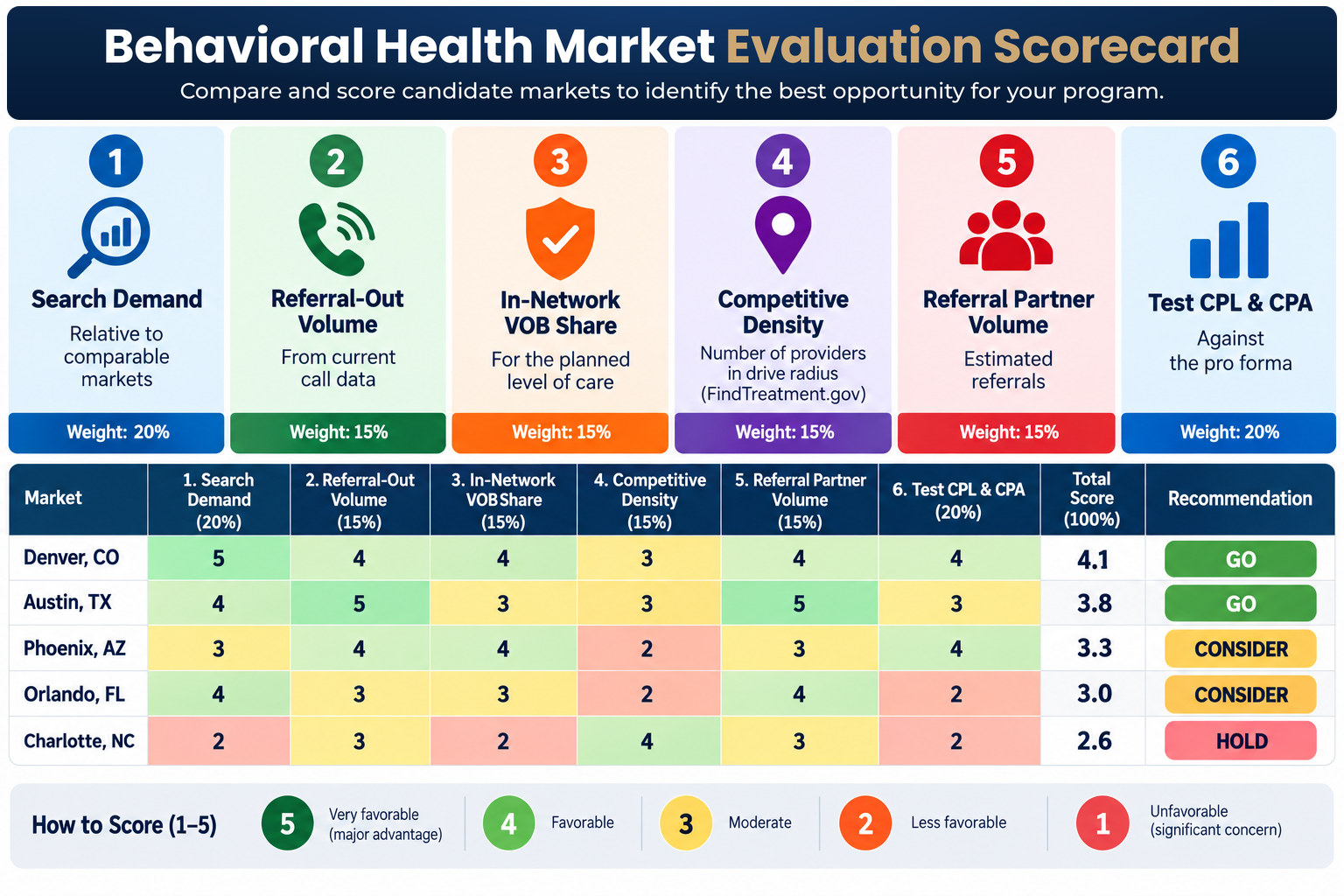
No single signal decides. A market that scores well on search and poorly on payer fit may still work after a contracting change. A market that scores poorly on referral interest and competitive density usually needs a larger marketing budget than the pro forma assumes. Put that number in the model before approval.
Keep Validating After Opening
Validation does not end at ribbon cutting. Track leads, VOBs, and admits by source every week from opening day, and compare each metric against the pre-launch baseline. A gap between test performance and live performance tells you where to act: visibility, intake, payer fit, or program fit.
elev8.io clients track this in the e8 Platform, alongside call tracking, VOBs, and census, so the expansion decision and the ramp use the same numbers.
The Census: The elev8 Newsletter
Join 2,000+ behavioral health leaders. Get notified when we publish new articles — the strategies, data, and insights shaping behavioral health marketing.
2,000+ executives already subscribed
Unsubscribe anytime. Just one newsletter a month — no spam.
Conclusion
Treatment center expansion works best when you measure demand before you commit capital. The national treatment gap signals need, but it does not prove a local market. Search demand, call and referral-out data, VOB mix, and referral partner interest each answer a different part of the question. A pre-launch test with thresholds set in advance turns those signals into a go/no-go decision.
Operators who follow this sequence can reduce the risk of opening into weak demand and can set a realistic census ramp from the start. The same data then becomes the baseline for managing growth after launch.
Try Our Free ROI & Census Growth Calculator
See how your marketing, admissions performance, and current census compare with relevant behavioral health benchmarks.
Sources
- Substance Abuse and Mental Health Services Administration. (2026). Key substance use and mental health indicators in the United States: Results from the 2025 National Survey on Drug Use and Health (HHS Publication No. PEP26-07-010, NSDUH Series H-61). Center for Behavioral Health Statistics and Quality.
- Substance Abuse and Mental Health Services Administration. (2025). National Substance Use and Mental Health Services Survey (N-SUMHSS) 2024: Data on substance use and mental health treatment facilities (Publication No. PEP25-07-013).
- Google. (n.d.). FAQ about Google Trends data. Trends Help.
- LegitScript. (n.d.). Addiction treatment certification. https://
www.legitscript.com/ certification/ addiction-treatment-certification/ - Substance Abuse and Mental Health Services Administration. (n.d.). FindTreatment.gov.

Founder & CEO · elev8.io
Gary Garth is the Founder & CEO of elev8.io, where he helps behavioral health organizations achieve full census through integrated marketing, admissions, and technology-driven growth systems.
With more than a decade of experience working alongside Google, Microsoft, and high-growth technology companies, Gary has built and implemented scalable growth frameworks now used by 45+ treatment centers across the United States to drive admissions and operational efficiency.
As a speaker, Gary focuses on the intersection of patient acquisition, AI-driven search, and admissions performance, helping founders, operators, and investors identify the hidden bottlenecks limiting growth—and how to fix them.
The author of The Zero to 100 Million Sales Blueprint and The Goals, Grit & Greatness Planner™, Gary is driven by a mission to close the gap between the millions of people struggling with addiction and mental health and the care they need.